
A Peplink certification is a baseline requirement; it is not a guarantee that a network will remain resilient during a hardware failure in the middle of the Atlantic or during a live national broadcast. Many organisations find that selecting a Peplink certified partner UK becomes a frustrating search for technical depth amongst a sea of high-volume providers who understand the hardware but struggle with the engineering. You likely recognise that configuring a multi-WAN environment for mission-critical use is a complex task where a single oversight in SpeedFusion settings can lead to avoidable downtime.
I have spent over fifteen years as a Peplink Certified Engineer Trainer and consultant. I am sharing the practical insights I have gained to help you identify a partner who prioritises network integrity over simple hardware sales. This guide outlines the specific engineering criteria you should look for to ensure your deployment is designed for resilience, correctly configured for your specific use case, and supported by genuine technical expertise.
Key Takeaways
- Learn why I view basic certification as a baseline rather than a guarantee of engineering depth for mission-critical environments.
- Identify a Peplink certified partner UK capable of designing custom multi-WAN architectures rather than one that simply provides off-the-shelf hardware.
- Recognise why we treat hardware selection as the final step of the deployment process, following a thorough network design phase.
- Understand the specific configuration requirements for SpeedFusion to ensure near-seamless failover for high-stakes broadcast and maritime operations.
- Establish a clear technical scope and training plan for your in-house team to maintain network stability long after the initial deployment.
The Role of a Peplink Certified Partner in the UK
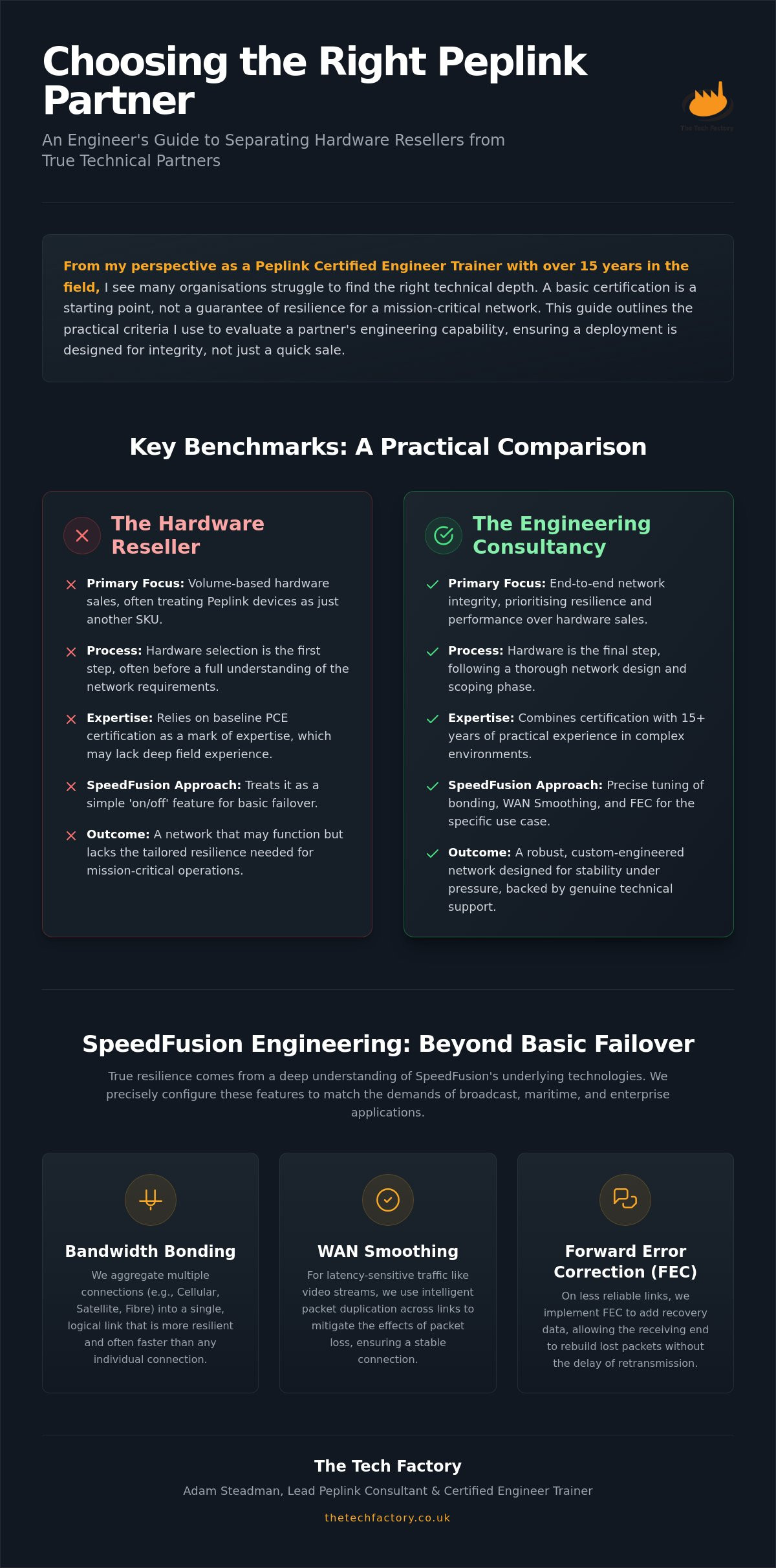
Identifying a Peplink certified partner UK is often the first step for an organisation requiring resilient connectivity. The Peplink ecosystem is structured to provide various levels of support, but it is important to understand what these tiers represent in practice. A partner is more than a source for hardware; they should be a technical resource that understands how to implement a Software-Defined Wide Area Network (SD-WAN) within your existing infrastructure. Many providers operate as simple resellers, focusing on high-volume transactions. In contrast, a consultancy-led partner prioritises the engineering required to make the hardware perform under pressure.
A specialist partner acts as the critical bridge between the manufacturer and your deployment. We translate complex firmware features into practical solutions for maritime, broadcast, or enterprise environments. While Peplink provides the tools, the partner provides the methodology. This distinction is vital when your operations cannot tolerate network instability. A reseller's involvement ends at the point of sale. For our team, the sale is merely the precursor to the design and configuration work that ensures your network is engineered for resilience.
Certification vs. Practical Experience
The Peplink Certified Engineer (PCE) status is a fundamental requirement. It confirms that a technician has mastered the core product range and understands the logic of the Balance and MAX series routers. However, I believe that 15+ years of hands-on experience in the field provides a level of insight that no exam can replicate. Certification proves knowledge; experience proves the ability to solve problems when variables change in the middle of a deployment. As advisors to Peplink’s largest global distributor, we see the broader picture of how these systems behave across thousands of diverse environments. This allows us to offer advice based on historical performance rather than theoretical specifications.
Local Knowledge and UK Connectivity Standards
Deploying multi-WAN solutions in the UK requires a deep understanding of the local cellular and satellite landscape. The performance of a bonded connection depends heavily on the quality of the individual links being aggregated. We understand how UK carrier frequencies interact with different antenna arrays in urban and rural settings. This local expertise is essential for navigating UK-specific regulations, such as the Wireless Telegraphy (Exemption) (Amendment) Regulations 2026. These rules govern mobile terminal exemptions and satellite system usage, and staying compliant is a core part of our consultancy. Whether you are operating a fleet in the English Channel or managing a remote broadcast from the Highlands, we know which local infrastructure challenges will impact your connectivity and how to mitigate them.
Technical Benchmarks: Evaluating SpeedFusion and Network Design Expertise
Many providers describe SpeedFusion as a simple fix for connectivity. In reality, it is a sophisticated suite of technologies that requires precise engineering to function correctly. A Peplink certified partner UK should be able to explain exactly how they will aggregate your specific links into a single logical connection. This process involves more than just enabling a feature; it requires a deep understanding of latency, jitter, and packet loss across disparate networks. I've seen many deployments fail because the provider lacked the technical depth to tune the tunnel parameters for the specific environment.
The Mechanics of SpeedFusion Configuration
Basic failover is straightforward. True bandwidth bonding and WAN Smoothing are not. When we design a network for a broadcast environment, we don't just rely on simple link switching. We utilise Forward Error Correction (FEC) to mitigate the impact of poor-quality cellular links, ensuring the video stream remains stable. This is particularly critical in maritime settings where signal stability fluctuates constantly. For vessels adhering to Global Maritime Distress and Safety System (GMDSS) requirements, the primary communication systems must be supported by a resilient data architecture. We ensure each SpeedFusion tunnel is tuned to the specific characteristics of the SIMs and satellite links in use, reducing the risk of packet loss during critical operations.
Centralised Visibility and InControl2
For enterprise multi-site deployments, visibility is a non-negotiable requirement. A competent partner uses InControl2 to provide a centralised view of the entire fleet. This isn't just about seeing if a router is online; it's about monitoring signal-to-noise ratios, tracking data usage, and pushing firmware updates without site visits. With over 800,000 devices managed through InControl2 worldwide, the scale of the platform is proven. We often go a step further by developing custom management portals for our clients. These portals provide stakeholders with simplified views of network health without exposing the underlying technical complexity. If you're struggling to maintain visibility across multiple locations, our network design services can help establish a more manageable architecture. I prioritise designs that allow for rapid scaling, ensuring that adding a new site doesn't require a complete overhaul of your existing SpeedFusion Hub configuration.
Hardware Sourcing: Selecting the Right Tools for Mission-Critical Connectivity
Hardware selection is the final stage of an engineered solution. I often encounter clients who have already purchased specific routers based on a datasheet before defining their actual connectivity requirements. This frequently leads to either under-powered networks that cannot handle peak traffic or over-specced hardware that adds unnecessary cost. A Peplink certified partner UK should ensure that the hardware is the tool that delivers the design, not the starting point of the project. We evaluate the environment, the number of concurrent users, and the specific WAN links available before recommending a model.
Choosing the right device involves more than just checking throughput figures. We consider physical constraints, such as rack space in a data centre or power limitations on a vessel. In our experience, hardware that is properly matched to the network's logical architecture reduces the risk of bottlenecks. This methodical approach is what separates a consultancy from a simple reseller. We prioritise functionality and long-term stability over simply moving stock.
Peplink Balance for Fixed Infrastructure
For permanent office locations or enterprise data centres, the Balance series provides the foundation for a resilient SD-WAN. These devices are designed to aggregate multiple fixed-line connections, such as fibre and DSL, alongside cellular failover. Selecting the correct model requires an assessment of your total bandwidth needs and the number of SpeedFusion tunnels you intend to run. If you are looking for a detailed breakdown of which model suits your enterprise, I have developed a guide on Peplink Balance for business that focuses on router selection from an engineering perspective. Balancing throughput requirements with budget constraints is essential for a sustainable deployment.
MAX Series for Mobile and Ruggedised Needs
When the deployment environment involves high vibration, extreme temperatures, or a reliance on multi-cellular connectivity, the MAX series is the appropriate choice. These routers are engineered for resilience in mobile scenarios, such as maritime vessels or broadcast vehicles. For example, the Peplink MAX HD4 is often the preferred choice for multi-cellular resilience because it allows for the bonding of four separate LTE or 5G links. In the UK, this allows us to aggregate signals from multiple carriers, mitigating the impact of local mast congestion or signal blackspots. We focus on specific engineering factors during these deployments:
- Vibration resistance for secure mounting in vehicular or maritime racks.
- Redundant SIM slots to facilitate cross-border roaming or carrier switching.
- Stable power inputs designed to handle the fluctuating DC supplies common in mobile environments.
In our experience as a Peplink certified partner UK, the success of a MAX series deployment depends heavily on the antenna array and the placement of the router. We ensure that the hardware can actually deliver the performance promised by the 5G or 4G bonding configuration by conducting thorough site surveys and signal analysis before the final installation.
Deployment Engineering: Tailoring Solutions for Maritime and Broadcast
Deployment engineering is where theoretical design meets environmental reality. For a Peplink certified partner UK, the challenge isn't just making the network work; it's making it work whilst a vessel is rolling in a six-metre swell or whilst a live broadcast is reaching millions of viewers. We approach every project with a mission-critical mindset, recognising that in sectors like public safety or emergency services, a network failure is more than a technical glitch. It's an operational risk that we must mitigate through meticulous planning and configuration. This mindset is equally applicable to enterprise multi-site deployments where the cost of downtime is measured in lost productivity and reputation.
Maritime and Offshore Connectivity
Maritime connectivity presents unique hurdles that go beyond simple signal strength. Vessels often move between high-speed cellular networks near the coast and high-latency satellite links further offshore. Simply having both connections is not enough. We configure SpeedFusion to manage these transitions, prioritising links based on their current performance metrics. In our experience, dealing with the inherent latency of satellite requires specific tunnel tuning to prevent the handover lag that often disrupts VoIP or video calls. Our work with Peplink for superyachts demonstrates how we aggregate these disparate links into a single, stable connection that remains resilient even as the primary carrier changes. We focus on the engineering of the hand-off, ensuring that the transition between terrestrial and satellite links is near-seamless.
Broadcast and Live Events
Broadcast environments demand a different set of engineering priorities, where jitter is the primary enemy of a successful feed. We utilise WAN Smoothing to replicate packets across multiple links, which reduces the risk of frame drops during a live transmission. This technique is essential when relying on bonded cellular connections in crowded event spaces where mast congestion is a constant variable. For temporary events across the UK, we often deploy portable SD-WAN kits that can be operational within minutes. This capability to scale at pace is a core part of our Peplink enterprise deployment strategy. We balance the need for rapid setup with the requirement for absolute reliability, ensuring that the network can handle the throughput demands of high-definition video streaming without compromise.
As a specialist Peplink certified partner UK, we understand that every sector has a different tolerance for risk. Whether it's ensuring a secure data link for an ambulance or maintaining a stable internet connection for a remote offshore platform, our focus remains on the engineering behind the connection. If you are managing a high-stakes deployment in one of these sectors, we can provide the technical consultancy required to ensure your network is fit for purpose and engineered for resilience.
Scoping Your Connectivity Project: The Next Logical Steps
Before you approach a Peplink certified partner UK, it is essential to move beyond the hardware mindset and define the specific problem you are trying to solve. I've found that the most successful deployments begin with a clear understanding of the environmental constraints and the required throughput. Don't start the conversation with a list of routers; start with a list of operational requirements. This preparation allows us to focus on engineering outcomes rather than hardware comparisons. If you can clearly articulate your connectivity challenges, we can design a solution that addresses them directly.
Identifying your core requirements involves assessing the number of users, the types of traffic you need to prioritise, and the available WAN links at your locations. We look for partners who ask about your network topology and your tolerance for latency before they mention a price. A well-scoped project reduces the risk of mid-deployment configuration changes and ensures that the final architecture is engineered for resilience from the outset. This methodical approach is the standard for any mission-critical network.
Building In-House Competence
We don't believe in creating artificial dependencies on external consultants. As a Peplink Certified Engineer Trainer, I prioritise technical training for your in-house engineering team as part of the deployment process. Empowering your staff to manage day-to-day operations whilst we handle the high-level network design and SpeedFusion optimisation is the most efficient way to maintain long-term stability. This knowledge transfer reduces your long-term reliance on external support and ensures your team can respond to minor issues without delay. Whilst managed services provide a safety net for complex troubleshooting, your team should have the competence to navigate the InControl2 dashboard and understand the logic of your specific configuration.
The Scoping Conversation
A productive scoping call should move quickly past sales talk and into technical specifics. When you engage with a Peplink certified partner UK, you should be prepared to discuss what resilience looks like for your organisation. Is it near-seamless failover for a single critical application, or is it aggregating multiple cellular links for a remote office? We recommend preparing a current network topology for a technical review before the first meeting. This allows us to identify potential points of failure and establish a realistic timeline for deployment and InControl2 onboarding. By defining these success metrics early, we ensure the final deployment is engineered to meet your specific mission-critical needs without unnecessary over-complication.
Establishing a clear timeline is also vital. This includes the initial design phase, hardware staging, and the final cut-over to the new architecture. We prioritise a phased approach that allows for thorough testing of the SpeedFusion tunnels before they are expected to handle live, mission-critical traffic. This disciplined scoping process is what ensures a network remains stable long after the initial installation is complete.
Establishing a Resilient Deployment
Selecting a Peplink certified partner UK is a decision that impacts the long-term reliability of your critical infrastructure. I have spent over fifteen years as a specialist engineer and a Peplink Certified Engineer Trainer; in my experience, the most stable networks are those designed with a clear understanding of environmental constraints. We prioritise engineering outcomes over hardware sales, ensuring that every SpeedFusion configuration is tuned for the specific challenges of your sector.
A successful deployment requires a partner who acts as a technical advisor rather than a reseller. My experience as an advisor to Peplink’s largest global distributor has reinforced the importance of meticulous design and proactive management. By focusing on network integrity and specialised training, you reduce the risk of downtime and establish a scalable foundation for your connectivity needs. I invite you to schedule a brief scoping conversation regarding your Peplink deployment needs. We can review your current topology and discuss how to engineer a more resilient solution for your organisation.
Frequently Asked Questions
What is a Peplink Certified Partner and why do I need one?
A Peplink Certified Partner is an organisation that has met specific technical and commercial benchmarks set by the manufacturer. You need one to ensure your network is designed for resilience and that you have access to official support and warranty services. In my experience, working with a certified partner reduces the risk of incorrect SpeedFusion configuration, which is the primary cause of instability in multi-WAN environments.
How do I verify the credentials of a UK Peplink partner?
You can verify a partner by checking the official Peplink directory or by requesting evidence of their technical certifications, such as the Peplink Certified Engineer (PCE) status. As a Peplink certified partner UK, we provide these credentials to demonstrate our competency. I also recommend checking if the partner has a history of successful deployments in your specific sector, whether that is maritime, broadcast, or enterprise multi-site.
Is SpeedFusion configuration included in hardware purchases?
SpeedFusion configuration is typically a separate consultancy service rather than a standard inclusion with hardware sales. Whilst the software features are built into the firmware, the engineering required to aggregate multiple links into a single logical connection depends on your specific environment. We treat configuration as a bespoke design task to ensure that the tunnel parameters are optimised for the latency and jitter of your available WAN links.
Can a UK partner support global maritime deployments?
Yes, a UK-based partner can provide remote network design, configuration, and management for vessels operating globally through InControl2. We frequently manage maritime deployments where the hardware is installed locally but the logical architecture is maintained from our UK centre. This allows for near-seamless transitions between cellular and satellite links regardless of the vessel's physical location, provided there is a reliable management connection.
What is the difference between Peplink InControl and InControl2?
InControl was the original version of the management platform, whilst InControl2 is the current, feature-rich cloud-based management system. InControl2 manages over 800,000 devices worldwide and provides the centralised visibility required for enterprise SD-WAN deployments. It allows for remote firmware updates, GPS tracking, and SpeedFusion tunnel monitoring. Some legacy on-premise versions still exist, but InControl2 is the standard for modern, mission-critical deployments.
Do you provide on-site installation for UK businesses?
We focus on the engineering, design, and remote configuration phases of a project. Whilst we provide comprehensive deployment guides and remote support, we typically work with your in-house team or local contractors for the physical installation of hardware and antennas. This approach allows us to focus our expertise on the SpeedFusion configuration and network architecture, which are the most critical factors for long-term stability.
What technical training options are available for my staff?
I provide specialised technical training as a Peplink Certified Engineer Trainer with 15+ years of experience. We offer sessions that cover everything from basic hardware management to advanced SpeedFusion optimisation and InControl2 onboarding. This training is designed to empower your team to manage the network whilst we provide high-level consultancy. We believe that knowledge transfer is essential for reducing your reliance on external support.
Can I buy Peplink hardware without a managed service contract?
You can purchase hardware as a standalone item, but I usually recommend a scoping conversation to ensure the model matches your requirements. We don't force managed service contracts on our clients; we prefer to act as an advisor. If you have the in-house expertise to manage the deployment, we can simply provide the hardware and the necessary design advice to ensure your configuration is engineered for resilience.