
Selecting the wrong hardware for a mission-critical network usually results in a phone call at 3:00 AM. In my fifteen years as a Peplink consultant, I have seen many organisations struggle with frequent network downtime because their edge devices cannot handle the throughput or the complexity of their multi-WAN environment. Deploying a Peplink Balance for business is about more than just purchasing a box; it is about engineering a resilient SD-WAN architecture that maintains connectivity when a primary link fails.
You likely already know that a standard failover mechanism is often too slow for modern VoIP or cloud applications, leading to dropped sessions and frustrated users. This guide provides a practitioner’s perspective on selecting and deploying the right Peplink Balance hardware to ensure your connectivity remains stable. We will look at the specific performance profiles of current models, from the versatile Balance 20X to the high-throughput 310X; whilst explaining how SpeedFusion technology aggregates multiple links into a single, logical connection to reduce the risk of service interruptions. By the end, you will have a clear understanding of which hardware suits your technical strategy and how to achieve a near-seamless failover environment.
Key Takeaways
- Learn how Peplink Balance routers serve as the resilient anchor for fixed-site SD-WAN deployments.
- Identify the specific hardware requirements for your organisation, ensuring the chosen Peplink Balance for business meets current and future throughput demands.
- Understand the modular advantages of the Balance 20X for small branch sites and how to utilise the FlexModule Mini for cellular resilience.
- Evaluate the technical differences between the Balance 310X and 380X when scaling for higher concurrent user counts and enterprise-grade performance.
- Recognise why a successful deployment relies on a meticulous design and installation process rather than simply purchasing hardware.
The Role of Peplink Balance in Business Continuity
I have spent fifteen years engineering networks where downtime is not an option. In high-stakes environments like broadcast, maritime, or public safety, a single point of failure is a design flaw. Peplink Balance routers serve as the anchor for fixed-site Software-Defined Wide Area Network (SD-WAN) deployments. They provide the necessary logic to manage multiple external connections simultaneously, ensuring that connectivity is a constant rather than a variable. The core requirement for a modern organisation has moved beyond simple failover. We now prioritise active-active resilience.
This means your network doesn't wait for a failure to occur before reacting. Instead, we use a Peplink Balance for business to aggregate multiple WAN links into a single logical connection. This approach provides a stable foundation for all downstream services, ensuring that your data remains in transit even if a physical link is compromised. We focus on building a system where the hardware is merely the tool used to execute a much broader resilience strategy.
Why Multi-WAN is Non-Negotiable
Single-provider dependence is a significant risk for any UK organisation. I often see businesses overlook the value of diverse carrier paths; they might have two lines, but if both enter the building through the same duct or terminate at the same local exchange, the redundancy is an illusion. It doesn't work. A true Peplink Balance for business deployment allows for the simultaneous use of disparate technologies such as fibre, Starlink, and cellular. By mixing these mediums, we ensure that a physical break in a fibre line or a provider-specific routing issue doesn't halt your operations. Diversity in the last mile is the only way to mitigate the risk of local infrastructure failure.
SD-WAN Resilience vs Traditional Failover
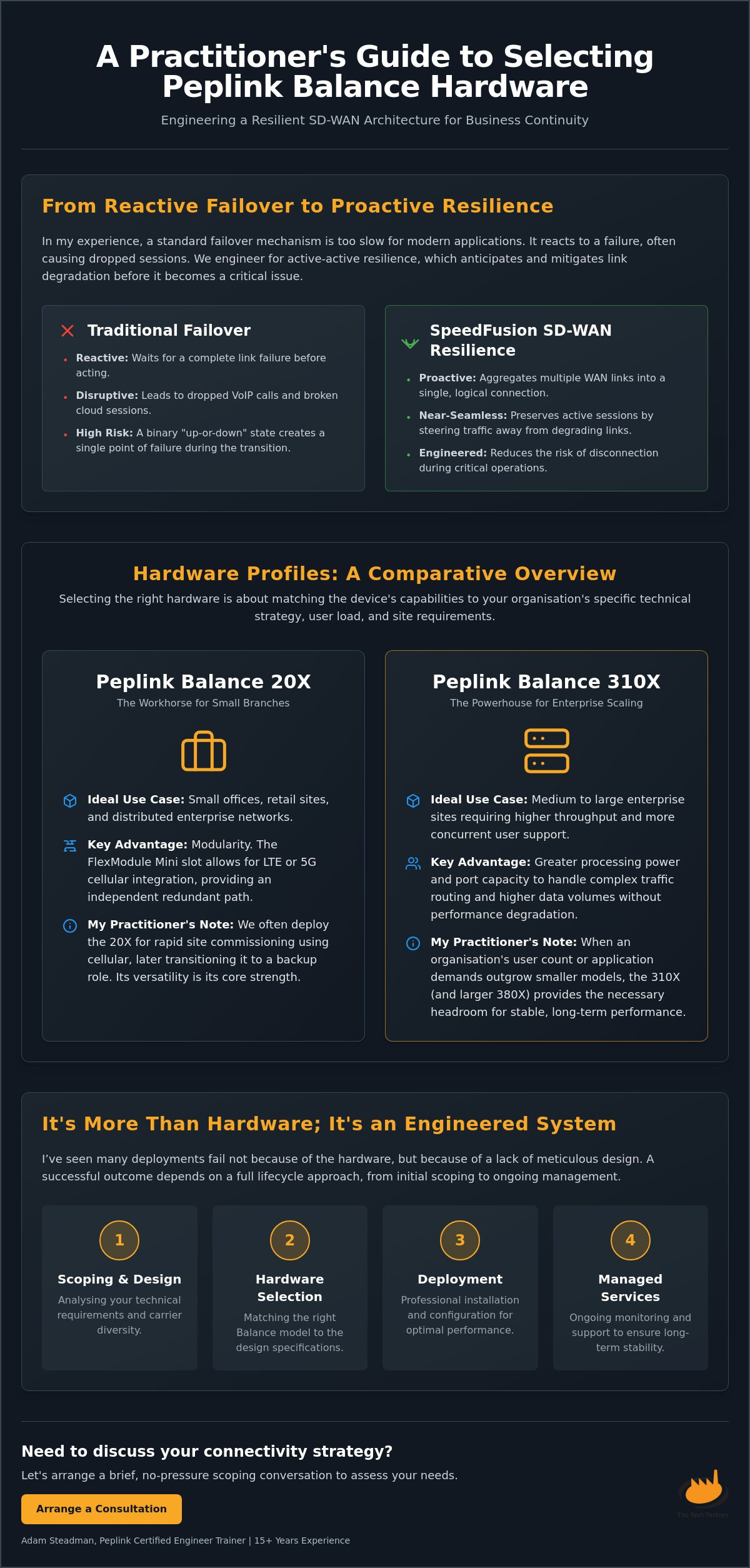
Traditional failover often results in dropped sessions and interrupted workflows. It's a reactive process that relies on timeouts and manual re-connections. In contrast, SpeedFusion technology aggregates multiple links to provide a near-seamless transition between paths. If one link's performance degrades, the traffic is already being handled by the remaining healthy connections. We focus on reducing the risk of disconnection during critical operations. This shifts the network from a binary "up-or-down" state toward a more sophisticated, engineered resilience that preserves active VoIP calls and database sessions without user intervention.
The Entry Point: Peplink Balance 20X for Small Branches
The Balance 20X is a versatile starting point for small offices and retail sites. In my experience, this model is the workhorse of distributed enterprise networks. We often deploy these units where a compact form factor is required without sacrificing core SD-WAN features. Whilst it is positioned as an entry-level device, its integration into a wider Peplink Balance for business ecosystem makes it a formidable edge component. It provides the essential routing logic required for smaller branches without the physical footprint or power requirements of larger rack-mount chassis.
The design is purposefully pragmatic. It handles the fundamentals of local networking whilst maintaining the sophisticated traffic steering capabilities found in higher-tier hardware. This allows for a consistent security and connectivity policy across an entire organisation, regardless of the individual site size. It is a reliable choice for maintaining a stable connection at the network edge.
FlexModule Mini and Cellular Integration
Modularity is the core strength of the 20X. The ability to add an LTE or 5G modem via the FlexModule Mini slot provides an essential redundant path that is independent of local fixed-line infrastructure. I recommend this specifically for sites where primary fibre installation is delayed. It ensures the organisation remains online whilst waiting for terrestrial services. This flexibility highlights many of the business benefits of SD-WAN, allowing for rapid site commissioning using cellular as a primary link before transitioning it to a backup role.
Virtual WAN and Performance Balancing
We often find that physical port counts can be a bottleneck for growing sites. Virtual WAN licenses solve this by expanding the input capabilities of the 20X hardware. We use this feature to manage multiple ISP handoffs through a single interface, effectively turning a simple branch router into a multi-WAN gateway. It is a cost-effective way to achieve resilience in smaller environments without upgrading to enterprise-grade hardware before it is strictly necessary. If you are currently evaluating your edge hardware, our team can assist with network design to ensure your selection aligns with your long-term resilience goals.
Enterprise Scaling with the Balance 310X and 380X
As site requirements grow, the limitations of entry-level hardware become apparent. Whilst the 20X serves the branch edge well, regional hubs and medium-sized offices require the increased processing capacity of the X-series rack-mount hardware. Selecting a Peplink Balance for business at this scale is a matter of matching throughput projections with the heavy CPU demands of encrypted traffic. I find that the Balance 310X and 380X represent a critical tier for organisations that have moved beyond basic connectivity and now require a centralised point for multi-site SD-WAN termination.
These models are engineered for higher concurrent user counts and more complex routing tables. In my experience, the jump in performance is not just about raw bandwidth; it is about the device's ability to maintain that bandwidth whilst performing deep packet inspection and managing multiple SpeedFusion tunnels simultaneously. We often specify these units for environments where the network is the primary delivery vehicle for real-time services like centralised VoIP or cloud-hosted ERP systems. They provide a stable foundation for hundreds of users without the latency spikes often seen in underpowered hardware.
Processing Power for SpeedFusion Tunnels
SpeedFusion technology is the cornerstone of Peplink resilience, but it places a significant load on the system's processor. Encryption and bonding are computationally expensive tasks. The Balance 310X provides a substantial step up in encrypted throughput over entry-level models, allowing for high-speed AES-256 tunnels that don't bottleneck the local area network. When I am designing a hub-and-spoke architecture, we ensure the hardware is sized to handle peak traffic loads, including future growth projections. It's a common mistake to size a router based on its stateful firewall throughput whilst ignoring the much lower limits of its encrypted tunnel capacity. Aligning your deployment with the NIST Cybersecurity Framework requires this level of rigour; ensuring that security measures like encryption don't compromise the availability of the service.
Rack-Mount Form Factors and Reliability
Enterprise environments require the physical stability of rack-mounted infrastructure. The 310X and 380X are designed for the server room, featuring robust thermal management systems that support 24/7 operation. I prefer these models for mission-critical sites where hardware longevity is a priority and where the environmental conditions of a data centre or comms cupboard demand active cooling. These units also offer more diverse physical interface options, allowing us to terminate multiple high-speed fibre handoffs directly into the router. This physical resilience, combined with Peplink's stable firmware architecture, reduces the risk of hardware-induced downtime in high-pressure scenarios.
Engineering Your Selection: A Practitioner Framework
Selecting the right Peplink Balance for business requires a methodical approach to network design. It is not a matter of simply picking the highest number on a datasheet. I start by auditing the total required throughput, including future growth projections. We then evaluate the number and type of WAN links available at the site. The final step is determining the level of SpeedFusion functionality required to meet the organisation's resilience goals. This framework ensures that the hardware is sized correctly for the specific application, avoiding both under-provisioning and unnecessary expenditure.
Calculating Required Throughput
Do not rely solely on headline data sheet figures for your planning. These are often measured under ideal laboratory conditions. Consider the overhead of VPN tunnels and internal VLAN routing; these tasks consume CPU cycles and can significantly reduce effective throughput. I suggest leaving a thirty per cent buffer for peak demand periods. This headroom ensures that the router maintains performance during unexpected traffic spikes or when additional security features are enabled. If the CPU is consistently pinned above eighty per cent, you will see increased latency and potential session instability.
WAN Port Density and Link Diversity
Ensure the router has enough physical ports for all planned ISP connections. We often combine fibre, leased lines, and cellular for maximum diversity. A common oversight is failing to account for the physical termination of secondary and tertiary links, which can lead to messy configurations that introduce new points of failure. Physical port considerations include:
- WAN Port Counts: Sufficient RJ45 ports for existing and future terrestrial links.
- SFP+ Requirements: Necessary for integrating with high-speed core switches or fibre handoffs.
- USB or Cellular Slots: For integrating 4G or 5G backup paths where internal modems aren't present.
SpeedFusion Logic and License Planning
Determine if you need simple failover or full bandwidth bonding. The choice between Hot Failover and Bandwidth Bonding dictates the required hardware tier and subscription level. I advise clients on the specific PrimeCare requirements for advanced features, as these are essential for maintaining SpeedFusion functionality. For those requiring a professional overview of their network architecture, we offer expert Peplink deployment services to ensure the design is sound from day one. If you need assistance with your hardware strategy, our team can provide a comprehensive managed services assessment tailored to your environment.
Deployment and Managed Services: The Full Lifecycle
Purchasing the hardware is merely the first step in a successful deployment. In my experience, the effectiveness of a Peplink Balance for business is entirely dependent on the quality of the initial network design and the precision of its implementation. A box sitting on a shelf or poorly configured in a rack provides no resilience. Our team focuses on the meticulous design and physical installation of the network, ensuring that every cable, antenna, and configuration parameter is optimised for the specific environment. We treat the deployment as an engineering project rather than a simple hardware sale.
This lifecycle approach includes a thorough audit of the site's RF environment for cellular links and a logical mapping of all terrestrial WAN connections. We don't just plug things in. We engineer the traffic steering rules and SpeedFusion parameters to align with your organisation's operational priorities. Technical training for your staff is also a core part of our process. By ensuring your internal team understands the logic behind the deployment, we secure the long-term operational success of the network.
InControl2 Onboarding and Visibility
Centralised management is essential for maintaining a distributed network. I use Peplink InControl2 to monitor link health, track data usage, and deploy configuration changes remotely across multiple sites. This provides the organisation with a clear, real-time picture of their network performance without needing an engineer on-site for every minor adjustment. We handle the InControl2 onboarding process to ensure all devices are correctly provisioned and that your reporting dashboards reflect the metrics that actually matter to your business. It reduces the risk of configuration drift and ensures that security patches are applied systematically across the fleet.
Custom Management Portals and Support
For complex deployments, particularly in sectors like broadcast or maritime, we develop bespoke portals for enhanced control. This custom software provides a tailored view of mission-critical connectivity data, often simplifying complex telemetry into actionable insights for non-technical stakeholders. Our managed services take the burden of daily network maintenance off your team. We monitor the tunnels, manage carrier relationships, and adjust load balancing algorithms as your traffic patterns evolve. This proactive management ensures that the resilience we engineered on day one persists throughout the hardware's operational life.
If you are looking for expert guidance on your connectivity strategy, I invite you to have a brief scoping conversation with our team. We can discuss your requirements and see how our consultancy and managed services can support your deployment.
Engineering Your Resilient Network Edge
Network resilience is not a product you buy. It is a state you engineer. Selecting the right Peplink Balance for business is the foundation of this process, but the final outcome depends on how you integrate varied WAN links and manage encrypted traffic loads. Throughout my fifteen years in the field, including my work as a Peplink Certified Engineer Trainer and advisor to Peplink's largest global distributor, I have seen that the most reliable deployments are those that account for the full lifecycle of the hardware.
From calculating the thirty per cent throughput buffer to managing remote sites via InControl2, every decision must be methodical. We focus on providing the technical strategy and practitioner-led advice needed to reduce the risk of downtime whilst ensuring a near-seamless failover experience. If you are planning a mission-critical network, contact us for a scoping conversation. Our team can help you navigate the complexities of network design and SpeedFusion configuration to ensure your organisation stays online. We look forward to supporting your next deployment.
Frequently Asked Questions
Which Peplink Balance model is best for a small office with 20 users?
The Balance 20X is typically the most appropriate choice for a 20-user office. It provides sufficient throughput for standard business applications whilst offering modular cellular backup through the FlexModule Mini slot. For sites requiring higher encrypted tunnel performance or more than one concurrent cellular link, I would suggest moving to the 310X to ensure the CPU has sufficient headroom for peak traffic periods.
Can I use Starlink as a WAN source with Peplink Balance routers?
Yes, Starlink is a frequent component in our multi-WAN designs. Peplink Balance routers terminate the Starlink ethernet handoff and treat it as a standard WAN source. We use SpeedFusion to mitigate the impact of Starlink's occasional packet loss or latency spikes by bonding it with a secondary cellular or fibre link. This approach provides a more stable connection for real-time applications like VoIP or video conferencing.
What is the difference between Peplink Balance and MAX routers?
Balance routers are engineered for fixed-site environments such as offices, retail branches, or data centres. MAX routers are designed for mobile, maritime, or harsh industrial settings. Whilst both ranges run the same firmware, Balance hardware prioritises port density and rack-mount form factors over the ruggedised, vibration-resistant chassis found in the MAX range. Balance models are the standard choice for server room installations.
Do I need a PrimeCare subscription for my Balance router to work?
Basic routing and firewall functions do not require a subscription. However, a PrimeCare subscription is necessary to access SpeedFusion bonding, InControl2 management, and ongoing hardware warranty. In our experience, most organisations deploying a Peplink Balance for business find these features essential for maintaining their resilience strategy. The first year is usually included with the hardware purchase, with annual renewals thereafter.
Can Peplink Balance routers handle 1Gbps fibre connections?
Several models in the Balance range are engineered for gigabit speeds and beyond. The Balance 310X, for example, offers a routing throughput of 2.5 Gbps, making it well-suited for high-speed fibre connections. Always ensure your hardware choice accounts for the overhead of any active security services or encrypted tunnels, as these tasks are more CPU-intensive and can reduce the effective throughput of the device.
How does SpeedFusion bonding differ from standard load balancing?
Standard load balancing distributes individual sessions across different links, which means a link failure will drop any active sessions on that path. SpeedFusion aggregates multiple links into a single logical connection. This allows for packet-level distribution, ensuring that a single file transfer or session can utilise the combined bandwidth of all available paths. It provides a more robust foundation for mission-critical data than simple session-based balancing.
Is it possible to manage multiple Peplink Balance routers from one place?
Yes, we utilise InControl2 for centralised management of entire router fleets. This cloud-based platform allows us to monitor link health, deploy configuration templates, and manage firmware updates from a single interface. It is a critical tool for maintaining visibility across multi-site enterprise deployments. Remote management reduces the need for on-site engineering visits and allows for rapid response to network performance issues.
What happens if one of my WAN links fails during a VoIP call?
If you have configured SpeedFusion Hot Failover, the VoIP call should continue without interruption. The technology detects the link failure and shifts the traffic to a healthy path near-seamlessly. This reduces the risk of dropped calls that typically occur with traditional failover mechanisms. Because the logical connection remains active, the application does not see a disconnection, even if the primary physical path is lost.