
A successful Peplink enterprise deployment is rarely about the hardware itself; it is a discipline of engineered organisation where every variable is accounted for before the first device leaves the warehouse. I have seen many teams struggle when they attempt to scale without a rigid framework, often finding that configuration drift and fragmented management of SpeedFusion tunnels create more problems than they solve. You likely recognise that at this scale, even a minor inconsistency in a configuration file can lead to systemic instability across hundreds of sites.
In my 15 years as a Peplink consultant, I have learnt that resilience is built through meticulous planning rather than reactive fixes. I will share the engineering principles we use to maintain network integrity during large-scale rollouts and how we manage bulk hardware supply chains to keep projects on track. We will examine how to establish a standardised framework, maintain centralised visibility of your entire fleet, and configure SpeedFusion to aggregate multiple links into a single, resilient connection that performs reliably under pressure. My aim is to provide a pragmatic roadmap for those who view connectivity as a mission-critical component of their operations.
Key Takeaways
- Establishing a standardised framework is the primary defence against configuration drift when scaling connectivity beyond a single router.
- A successful Peplink enterprise deployment requires strategic hardware selection and a sourcing partner that understands the technical nuances of both the Balance and MAX series.
- SpeedFusion technology aggregates multiple links into one logical connection, providing the resilience and throughput necessary for mission-critical traffic like VOIP and high-resolution video.
- InControl2 facilitates zero-touch provisioning for bulk hardware shipments, ensuring that devices are configured correctly and visible on the network before they are even deployed to site.
- Long-term operational stability is achieved through a structured lifecycle of expert design, technical training, and managed services that build in-house competence.
Beyond the Single Router: The Realities of Peplink Enterprise Deployment
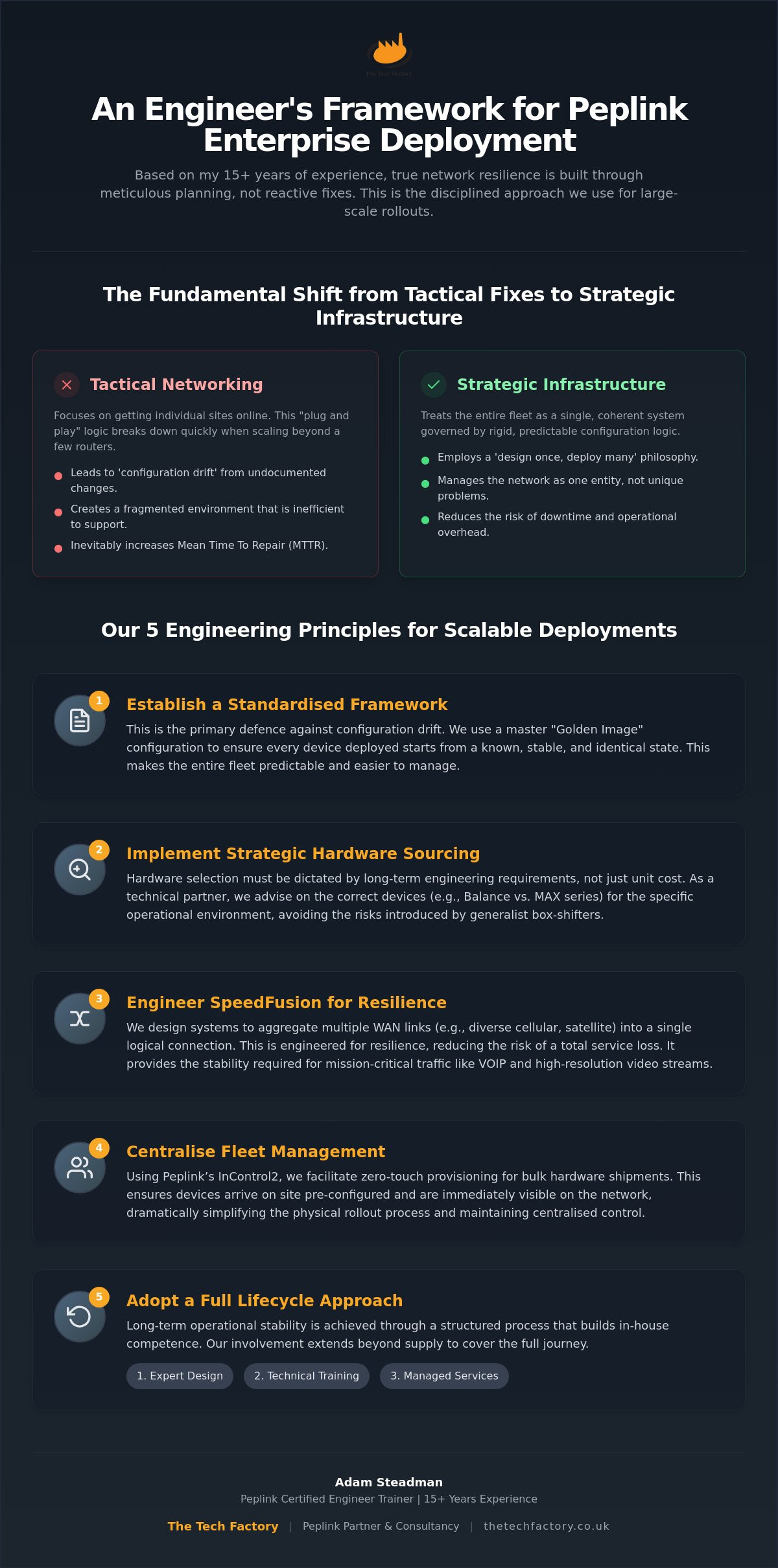
Enterprise connectivity is often misunderstood as merely a collection of individual sites. In reality, a successful Peplink enterprise deployment represents a fundamental shift from tactical fixes to strategic infrastructure. When you move beyond managing three or four routers, the logic of "plug and play" breaks down. Tactical networking focuses on getting a single location online; strategic infrastructure focuses on how that connection behaves as part of a global fleet. I have found that the most resilient networks are those where hardware is treated as a standardised commodity, governed by a rigid configuration logic that leaves no room for interpretation by local installers.
Standardisation is your primary defence against configuration drift. In large fleets, it is common for small, undocumented changes to creep into individual devices over time. A modified firewall rule here or a custom MTU setting there might seem harmless, but across a hundred sites, these inconsistencies create a fragmented environment that is impossible to support efficiently. We prioritise a "design once, deploy many" philosophy. This ensures that every device remains a predictable node within the wider architecture, allowing your team to manage the network as a single entity rather than a collection of unique problems.
We should also address the industry's tendency towards hyperbole. You will often see marketing materials promising "unbreakable" connectivity. In my experience as a Peplink engineer, I prefer the term "engineered for resilience." No system is immune to failure, but a well-designed Peplink enterprise deployment reduces the risk of downtime by accounting for the failure of individual links or hardware components. Our role is to bridge the gap between the box-shifting approach of generalist providers and the meticulous network design required for mission-critical operations.
The Challenge of Scaling SD-WAN
Scaling a network introduces the risk of heterogeneous hardware environments, where different generations of routers must coexist. If these devices aren't managed through a centralised framework, your mean time to repair (MTTR) will inevitably rise as engineers struggle to diagnose site-specific quirks. We mitigate this by using a "Golden Image" configuration for bulk rollouts. This master template ensures that every device starts from a known, stable state. This methodology draws heavily from the core principles of Software-defined networking (SDN), where the separation of the control plane from the data plane allows for more granular, centralised management of the entire fabric.
Mission-Critical Connectivity Requirements
For our clients in the broadcast and maritime sectors, connectivity isn't a luxury; it is the core of their business. A vessel in the mid-Atlantic or a remote broadcast team requires persistent uptime that standard office networking simply cannot provide. These environments demand a robust approach to multi-carrier WAN solutions. By utilizing diverse cellular providers and satellite links, we ensure that geographic signal gaps do not result in a total loss of service. We design these systems to aggregate multiple links into one logical connection, providing a level of stability that is essential when failure is not an option.
Strategic Sourcing and Peplink Bulk Hardware Supply
Procuring hardware for a Peplink enterprise deployment requires a different mindset to standard IT purchasing. A generalist supplier will often focus on the transaction; they ship boxes and consider the job done. In my experience, this approach introduces significant risk into large-scale projects. When you are rolling out infrastructure across fifty sites or more, the choice of hardware must be dictated by the long-term engineering requirements rather than immediate availability or price alone. I have seen many organisations struggle because they prioritised a low unit cost over the technical suitability of the device for their specific environment.
We differentiate between the various product lines based on their intended environment. For example, selecting a Peplink Balance for business usually indicates a requirement for fixed-site branch connectivity with high-capacity WAN failover. Conversely, the MAX series is engineered for the rigours of mobile or remote environments where cellular connectivity is the primary link. Managing these selections across a fleet requires a partner who understands how hardware revisions and firmware lifecycles impact project stability. We advise on these nuances to ensure that the hardware you buy today remains supported and functional for the duration of your project lifecycle.
Hardware Selection for Enterprise Fleet Standardisation
Standardisation is the foundation of a manageable network. For mobile enterprise needs, we often assess the Peplink MAX HD4 for its ability to aggregate four cellular links simultaneously. This provides the multi-carrier redundancy required for mission-critical transit or public safety applications. In contrast, fixed-site enterprise branch offices are better served by the Balance series, which offers the routing throughput needed for local LAN traffic. For the data centre, we look toward the Balance SDX or other modular routers that provide the flexibilities for modern enterprises to scale their backhaul capacity as demand grows without requiring a full hardware refresh.
The Consultant-Led Sourcing Model
A consultant-led model ensures that technical vetting happens before a single purchase order is signed. I have seen projects stalled because the hardware lacked the specific cellular bands required for a global rollout or because the chosen model didn't support the necessary SpeedFusion throughput. Bulk supply should always include pre-provisioning and InControl2 onboarding as part of the service. This removes the burden from your on-site teams and ensures that every router arrives ready to join the network. It is about reducing the variables that can lead to deployment failure.
Working with a partner who advises the global distribution chain gives you visibility into lead times and hardware lifecycles that a box-shifter simply cannot provide. If you are currently planning a rollout, we can help you with network design and hardware selection to ensure your infrastructure is fit for purpose from day one.
Engineering SpeedFusion for Multi-Site Resilience
SpeedFusion is the technology that fundamentally enables a resilient Peplink enterprise deployment. It works by aggregating multiple physical links, such as fibre, cellular, and satellite, into a single logical connection. This process does more than just increase available throughput; it provides a layer of abstraction that protects the application layer from the instability of individual circuits. In my experience, the difference between a functional network and a truly resilient one lies in how these tunnels are engineered to handle session persistence during a link failure. We configure the failover logic to be near-seamless, ensuring that a VOIP call or a critical data transfer continues without interruption even if one of the underlying carriers drops out.
Managing tunnel overhead is a critical consideration when deploying SpeedFusion at scale. Every bonded tunnel requires a portion of the bandwidth for management and encapsulation, which can impact efficiency if not properly optimised. We carefully tune the encryption levels and packet fragmentation settings based on the specific traffic types being carried. For general data, we prioritise bandwidth efficiency; for mission-critical video or voice, we prioritise stability. This granular control allows us to maintain high performance across a large fleet without over-provisioning the underlying links.
SpeedFusion Tunnel Architecture at Scale
In a large-scale environment, we typically contrast hub-and-spoke topologies with mesh configurations. Most enterprise SD-WAN designs favour a hub-and-spoke model for its simplicity and centralised control. We often use FusionHub, the virtualised version of Peplink’s bonding technology, hosted in cloud environments like AWS or Azure. This acts as a central termination point for all remote sites. By managing outbound policies within these tunnels, we can direct traffic based on its importance, ensuring that business-critical applications always have the path of least resistance.
Mitigating Latency and Jitter in Bonded Links
Latency and jitter are the primary enemies of real-time communication. To mitigate these risks, we utilise features like WAN Smoothing, particularly in broadcast and public safety sectors. WAN Smoothing is a technique that replicates packets across multiple links to ensure delivery. Whilst this increases the total bandwidth consumed, it significantly reduces the risk of packet loss. In broadcast environments, there is always a trade-off between latency and redundancy; we work with your team to find the balance that ensures a stable feed without introducing unnecessary delay into the signal path.
Centralised Management: InControl2 and Bespoke Portals
A Peplink enterprise deployment lives or dies by its management layer. If your team is required to log into individual routers to push security patches or modify firewall rules, the network is a liability rather than an asset. Centralised management through InControl2 provides the essential "single pane of glass" visibility required to oversee a global fleet. It allows us to monitor the health of every SpeedFusion tunnel and WAN link in real-time; this ensures that performance issues are identified before they impact the end user. However, for many of our clients, the standard cloud dashboard is only the starting point.
We often find that large organisations require more than what a generic interface can offer. Whilst InControl2 is a powerful tool for engineers, it can be overwhelming for non-technical stakeholders who only need to monitor high-level KPIs. This is where bespoke management portals and custom software integration become necessary. By utilising the Peplink API, we can extract telemetry data and present it within your existing enterprise management systems. This ensures that connectivity data is not siloed but integrated into the wider operational picture.
Zero-Touch Provisioning (ZTP) Workflows
Zero-touch provisioning is the mechanism that allows us to scale at pace without compromising configuration integrity. It removes the need for highly skilled engineers to be present at every site during the initial rollout. The workflow we implement is methodical:
- Step 1: We define a global configuration profile within InControl2 that encompasses all standard network and security settings.
- Step 2: Hardware serial numbers are assigned to specific groups or sites before the devices even reach their destination.
- Step 3: Upon the initial internet connection, the device automatically downloads its specific configuration and joins the managed fleet.
Bespoke Software and Management Portals
Custom portals provide a simplified view of the network for those who do not need to see every technical detail. We have developed solutions that track cellular data usage across multi-carrier fleets, helping organisations manage costs and avoid unexpected overages. This level of visibility is particularly important in maritime and broadcast sectors where data costs can be significant. If your current reporting is fragmented, we can design custom software and portals to consolidate your network data into a single, actionable interface.
Automating firmware updates and security patches is another critical function of centralised management. We schedule these updates in waves to ensure that the entire enterprise remains protected against emerging threats without causing widespread disruption. This systematic approach to maintenance is what separates a professionally managed deployment from a collection of disparate hardware. It ensures that the integrity of the initial design is maintained throughout the entire lifecycle of the equipment.
Executing the Deployment: From Design to Managed Service
Executing a Peplink enterprise deployment successfully requires a shift in focus from the day of installation to the entire lifecycle of the network. I have often seen projects lose momentum because the initial enthusiasm for new hardware wasn't matched by a long-term operational strategy. In our experience, the most stable networks are those that follow a structured lifecycle of design, configuration, and ongoing training. It's a process that begins long before a single box is opened and continues well after the final site goes live. We view this as a partnership where we build your team's competence alongside the physical infrastructure.
Meticulous network design is the foundation of this lifecycle. Without a clear understanding of the environmental challenges and traffic requirements of each site, even the most advanced hardware will underperform. We use our Peplink deployment services to map out these variables, ensuring that the resulting architecture is engineered for the specific demands of your organisation.
Network Design and Scoping
Scoping begins with identifying potential points of failure within your existing infrastructure. We look beyond the router to consider redundant power sources, diverse carrier paths, and physical security. It's not enough to have multiple WAN links if they all enter the building through the same conduit or rely on the same local exchange. I always recommend a pilot phase for any Peplink enterprise deployment. This allows us to validate the design in a controlled environment, making necessary adjustments to the SpeedFusion configuration before a full-scale rollout begins.
Managed Services and Technical Training
Once the network is operational, the focus shifts to proactive maintenance. A managed service model provides the continuous oversight needed to identify trends in link performance or data usage before they become critical. However, we also provide structured technical training for your staff to ensure they can manage day-to-day operations with confidence. This builds in-house competence and ensures that your team isn't reliant on external support for routine tasks. We then use the resulting data to inform future hardware refreshes, closing the loop on the deployment lifecycle.
Engineered Resilience for the Long Term
A successful Peplink enterprise deployment is defined by the rigour of its initial design and the consistency of its long-term management. We've examined how a standardised framework protects against configuration drift whilst SpeedFusion technology ensures that critical traffic remains persistent across multiple aggregated links. By moving away from tactical, site-by-site fixes and embracing a centralised, engineered approach, you can build a network that remains stable under the most demanding conditions.
My work as a Peplink Certified Engineer Trainer and advisor to the brand's largest global distributor has shown me that the most reliable rollouts are those where engineering expertise precedes hardware procurement. With over 15 years of experience in mission-critical networking, I help organisations bridge the gap between complex requirements and operational reality. If you're ready to discuss the specific needs of your next project, I invite you to book a scoping conversation with Adam Steadman to discuss your enterprise Peplink deployment. Building a resilient network is a methodical process, and we're here to ensure every stage is executed with precision.
Frequently Asked Questions
How does Peplink handle bulk configuration for hundreds of sites?
Peplink handles bulk configuration through InControl2 and Zero-Touch Provisioning (ZTP). We establish a master configuration profile that defines every standard parameter, from firewall rules to SpeedFusion settings. When new hardware is added to the organisational group, it automatically downloads this profile upon its first internet connection; this ensures consistency across hundreds of sites without the need for manual intervention by local installers.
Can Peplink routers bond 4G and 5G connections from different carriers?
Yes, Peplink routers can aggregate 4G and 5G connections from diverse carriers into a single logical connection. SpeedFusion technology is carrier-agnostic; it evaluates the performance of each individual WAN link and bonds them to increase throughput and resilience. This approach reduces the risk of downtime caused by a single carrier's local network congestion or a specific tower failure.
What is the difference between SpeedFusion bonding and standard failover?
Standard failover switches traffic to a backup link only after the primary link fails, which usually results in a session drop and a brief period of connectivity loss. In contrast, SpeedFusion bonding aggregates multiple active links simultaneously. If one link fails, the traffic continues on the remaining links without dropping the session, providing a near-seamless experience for real-time applications like VOIP or video streaming.
Is InControl2 required for a large-scale enterprise deployment?
Whilst it's technically possible to manage devices individually, InControl2 is essential for any Peplink enterprise deployment that aims for operational stability. It provides the centralised visibility required to manage firmware updates, monitor tunnel health, and enforce configuration standards across a global fleet. Without it, managing a large-scale network becomes a reactive and fragmented process that significantly increases the risk of human error.
How do you ensure security across a distributed Peplink SD-WAN?
We ensure security by utilising AES-256 encryption for all SpeedFusion tunnels, creating a secure fabric across the entire distributed network. By managing firewall policies centrally through InControl2, we prevent the configuration drift that often leads to security vulnerabilities. This ensures that every site, no matter its geographic location, adheres to the same rigid security standards defined by your central IT policy.
What industries benefit most from Peplink bulk hardware supply?
Sectors such as broadcast, maritime, and public safety benefit most from a reliable bulk hardware supply and meticulous network design. These industries operate in environments where failure is not an option and standard office networking is insufficient. We provide the technical vetting and pre-provisioning required to ensure that large volumes of hardware are ready for mission-critical use immediately upon arrival.
Does The Tech Factory provide on-site installation for enterprise projects?
We focus on high-level engineering, network design, and remote commissioning rather than physical on-site cabling. By utilising Zero-Touch Provisioning, we enable your local teams or third-party contractors to install the hardware whilst we manage the technical configuration and validation remotely. This approach is more efficient for large-scale projects and allows our specialists to focus on the integrity of the architecture.
How can I monitor data usage across a large fleet of mobile routers?
You can monitor data usage through the reporting tools in InControl2, which track consumption by WAN link and individual device. For organisations with complex multi-carrier requirements, we design bespoke portals that use the Peplink API to aggregate this data into a simplified, actionable view. This provides stakeholders with the visibility needed to manage costs and identify unusual consumption patterns across the entire fleet.