
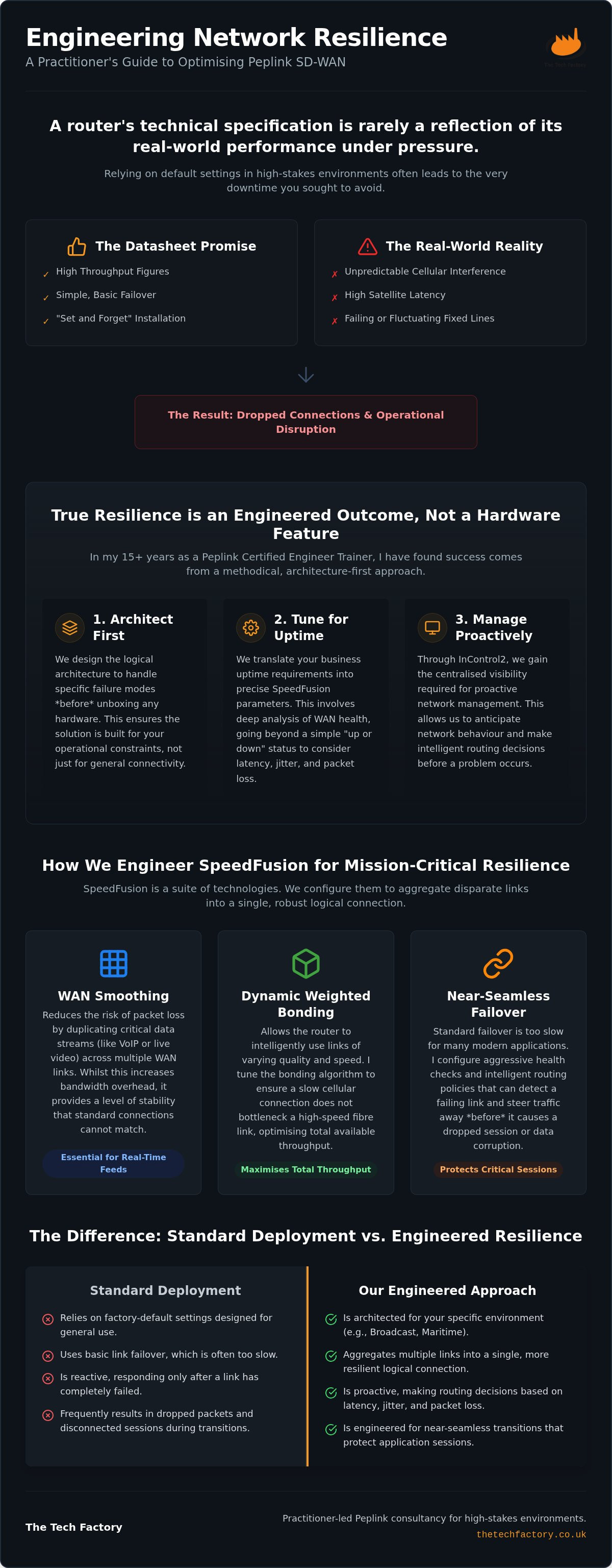
A router's technical specification is rarely a reflection of its real-world performance under pressure. Whilst a datasheet might promise high throughput, it cannot account for the unpredictable nature of cellular interference, satellite latency, or a failing fixed line. You likely invested in this hardware because you require mission-critical stability, yet you may still be facing dropped connections or complex SpeedFusion tuning issues that disrupt your operations. Relying on default settings in high-stakes environments often leads to the very downtime you sought to avoid.
In my 15 years as a Peplink Certified Engineer Trainer, I have found that true resilience is an engineered outcome rather than a hardware feature. Through our Peplink professional services UK, I share my experience to help you architect SD-WAN environments that maintain performance when your primary links fail. This article details how we move beyond the datasheet to optimise SpeedFusion for near-seamless failover; it also explains how to use InControl2 to gain the centralised visibility required for proactive network management. We will examine the specific configuration strategies that protect your critical data streams and ensure your infrastructure remains robust under load.
Key Takeaways
- Understand why resilient network design starts with logical architecture rather than hardware selection to ensure performance under pressure.
- Learn how to tune SpeedFusion tunnels to aggregate multiple links into a single logical connection for near-seamless failover.
- Identify common configuration pitfalls, including misconfigured MTU settings and InControl2 organisation errors, that frequently impact remote network performance.
- Explore how Peplink professional services UK provide the engineering expertise needed to manage complex connectivity transitions in broadcast and maritime environments.
- Discover how a thorough scoping process ensures your deployment is engineered for your specific operational constraints rather than relying on factory-default settings.
The Role of a Peplink Professional Services Specialist
A factory-default router is a capable tool, but it is not a finished solution. In my experience, the gap between a standard deployment and a mission-critical environment is bridged by precise engineering. I focus on designing the logical architecture before any hardware is unboxed. This ensures that the network is built to handle specific failure modes rather than just providing a basic internet connection. Unboxing the hardware should be the final step in a methodical design process, not the first.
When providing Peplink professional services UK, I translate business uptime requirements into technical SpeedFusion parameters. This process involves more than just selecting a router model; it requires a deep understanding of how different WAN links behave under load. I prioritise long-term stability over the temporary quick fixes often found in online forums. This approach ensures that the network remains robust as traffic patterns evolve and environmental conditions change.
Resilience vs. Default Connectivity
Factory settings are designed for general use, but they are rarely sufficient for broadcast or maritime environments where signal conditions fluctuate rapidly. A simple failover setup often results in dropped packets or disconnected sessions during the transition between links. By contrast, an engineered software-defined wide area network (SD-WAN) uses SpeedFusion to aggregate multiple connections into one logical pipe. I evaluate WAN health beyond a simple "up or down" status. I look at latency, jitter, and packet loss to trigger intelligent routing decisions that maintain data integrity.
The Value of Practitioner-Led Consultancy
Drawing on 15 years of experience allows me to anticipate network behaviour before it becomes a problem. As a Peplink Certified Engineer Trainer, I have seen how misconfigured tunnels can cause bottlenecks in otherwise high-performance hardware. This specialised knowledge reduces the risk of deployment delays and ensures that your team understands the logic behind the configuration. We act as high-level practitioners who are personally invested in the success of the deployment, providing a level of depth that generalist providers cannot match. Our team focuses on the specific constraints of high-stakes sectors, ensuring that every configuration choice is backed by technical necessity and practical field experience.
SpeedFusion Engineering: Tuning for Mission-Critical Resilience
SpeedFusion is not a singular feature. It is a sophisticated suite of technologies designed to address the inherent instabilities of Wide Area Networks. In my role providing Peplink professional services UK, I configure these tunnels to aggregate multiple disparate links into a single, resilient logical connection. This goes beyond simple load balancing; it involves deep-packet inspection and intelligent traffic steering to ensure that mission-critical data remains protected even when individual connections fluctuate.
WAN Smoothing is a critical component of our engineering process. It reduces the risk of packet loss by duplicating traffic across multiple paths, which is essential for protecting VoIP and live broadcast video feeds. Whilst this increases bandwidth overhead, it provides a level of stability that standard connections cannot match. I also utilise Dynamic Weighted Bonding to allow the router to use links of varying quality effectively, ensuring that a slow cellular connection does not bottleneck a high-speed fibre link.
Optimising Bandwidth Bonding
Successful bonding requires precise calculation of the overhead needed for stability. When aggregating carriers with different performance profiles, I manage latency differences to prevent out-of-order packets. This involves tuning the Bonding Algorithm to suit specific data types; for example, a file transfer requires different parameters than a real-time remote desktop session. If you require assistance with these technical configurations, our team provides specialist SpeedFusion configuration services to ensure your infrastructure performs under pressure.
Implementing Near-Seamless Failover
Standard failover is often too slow for modern applications, leading to dropped sessions and data corruption. I move beyond these defaults by configuring health check intervals that are aggressive enough to detect failure quickly but stable enough to avoid "flapping." The design choice between using SpeedFusion Cloud or private FusionHub appliances is also vital. In our experience, private FusionHub instances often provide better control over routing and security for enterprise multi-site environments. This careful engineering ensures that failover remains near-seamless, protecting your critical data streams from the impact of local ISP outages.
Beyond the Default Settings: Avoiding Common Deployment Pitfalls
Assuming that a high-end router will perform optimally straight out of the box is a common error. Many organisations encounter performance bottlenecks because they rely on factory defaults that were never intended for complex multi-WAN environments. When providing Peplink professional services UK, I frequently identify misconfigured Maximum Transmission Unit (MTU) settings as a primary cause of packet fragmentation. This often results in sluggish throughput and increased latency; it is particularly problematic when traffic is encapsulated within a SpeedFusion tunnel, where overhead calculations become critical.
Over-reliance on "Auto" settings for link health checks or WAN prioritisation can also lead to unstable network behaviour. In a high-stakes scenario, a router might attempt to failover to a degraded link because the health check parameters were too broad. This is why a structured Peplink deployment service is essential. I begin every project with a thorough site survey to inform the configuration. We must consider physical factors like antenna placement and cable runs. Even the most precise logical configuration cannot overcome poor signal quality caused by RF interference or physical obstructions.
The Problem with Plug and Play Expectations
In my experience, the "plug and play" mindset often leads to downtime during mission-critical tasks. Broadcast and maritime environments require specific tuning that factory settings simply do not provide. I focus on hardening the configuration to handle specific failure modes, such as the sudden loss of a primary cellular carrier or the high latency of a satellite link. We avoid the "set and forget" approach, opting instead for a methodology that accounts for the unpredictable nature of remote connectivity.
Security and Management Oversights
Effective Peplink professional services UK must also address security and management oversights. I frequently see InControl2 environments that lack proper organisation, making it difficult to identify specific remote nodes during a failure event. Without security tags and logical grouping, managing a distributed fleet becomes inefficient and prone to error. Centralised visibility via a custom network management portal allows us to monitor link health in real time and ensure firmware consistency across all devices. We also address common firewall errors where restrictive rules inadvertently block the UDP ports required for SpeedFusion handshakes. These technical details are the difference between a network that merely connects and one that performs under pressure.
Structured Network Design for High-Stakes Environments
Resilient network design requires a deep understanding of the specific environment in which the hardware operates. A configuration that works for a fixed office location will likely fail when subjected to the movement of a maritime vessel or the bandwidth demands of a live broadcast. My approach to Peplink professional services UK involves creating a logical framework that allows for future scaling without requiring a complete architecture overhaul. We prioritise configuration uniformity, particularly in enterprise multi-site deployments where a templated approach reduces the risk of human error during mass rollouts.
I design networks to handle the specific constraints of the sector. Broadcast environments, for instance, require prioritised bandwidth for video return feeds to ensure production teams can monitor remote talent without lag. In contrast, maritime environments must manage the transition between cellular and satellite links with extreme precision to avoid session drops in international waters. By building these requirements into the initial design phase, I ensure the network remains stable under the unique pressures of the industry.
Connectivity at Sea: Maritime Specialisations
Managing high-latency satellite links alongside coastal 5G requires a nuanced approach to traffic steering. I focus on configuring the router to recognise the cost and performance profiles of different WAN sources, ensuring that expensive satellite data is only used when cellular coverage is unavailable. This is a core component of how I configure Peplink for superyachts to maintain owner privacy and uptime. We also implement sophisticated SIM management strategies to handle the transition between different regional carriers as a vessel moves across borders, reducing the risk of unexpected data roaming charges.
Broadcast and Events: The Pressure of Live Feeds
In the broadcast sector, failure is not an option. I configure cellular bonding for outside broadcasts to aggregate multiple 5G and 4G links, providing a stable pipe for high-bitrate video. This technical rigour also applies when providing temporary SD-WAN for events in the UK, where infrastructure must be deployed rapidly and perform immediately. We ensure low-latency return paths for remote production teams, allowing for real-time collaboration between the field and the gallery. If you are planning a deployment in a high-stakes environment, our team provides specialist network design services to ensure your infrastructure is fit for purpose.
Collaborating with The Tech Factory on Your Deployment
Engaging with our team provides more than just a hardware supply chain. I act as a lead consultant on every project, ensuring you have a direct line to engineering expertise from the initial design phase through to final handover. Our Peplink professional services UK are built on a foundation of technical mastery and a pragmatic approach to problem-solving. We don't just ship boxes; we engineer environments that are designed to perform under the specific pressures of your industry.
Our process begins with a thorough scoping conversation. This allows us to understand your specific constraints, such as power limitations in remote locations or the complexities of international roaming. By identifying these factors early, we reduce the risk of deployment delays and ensure the configuration is fit for purpose. We also offer technical training as part of our engagement. This ensures your own team can manage the infrastructure confidently, providing them with the skills needed to troubleshoot and optimise the network as your requirements evolve.
Adam Steadman: A Practitioner’s Perspective
My role as a Peplink Certified Engineer Trainer is to bridge the gap between complex engineering concepts and practical, real-world deployment. Working with a Peplink certified partner in the UK gives you the assurance that your network is designed according to official best practices and informed by 15 years of field experience. I prioritise engineering integrity over hardware volume. My focus is on creating a robust architecture that meets your uptime requirements, even if that means recommending a more simplified, stable setup over a more complex, untested one. Our team also acts as an advisor to Peplink’s largest global distributor, ensuring we stay at the forefront of firmware developments and new hardware capabilities before they reach the wider market.
Next Steps for Your Connectivity Project
Moving from a scoping call to a detailed network design is a methodical process. We examine your current network challenges and translate them into a technical roadmap that includes SpeedFusion configuration, InControl2 onboarding, and custom management portals where required. We also provide options for managed services and ongoing software support to maintain the health of your distributed fleet. If you are facing frequent connection drops or struggling with the complexity of your current SD-WAN environment, I invite you to have a brief scoping conversation regarding your connectivity needs. We can discuss your technical requirements and determine how to engineer a more resilient solution for your organisation.
Architecting Your Mission-Critical Network
Resilience is not a byproduct of hardware selection; it is the result of methodical planning and technical precision. We have explored how moving beyond factory defaults allows us to mitigate the risks of packet loss and session drops in high-stakes environments. Whether you are managing coastal 5G transitions on a superyacht or prioritising video feeds for a live broadcast, the logical architecture of your SD-WAN determines its success under pressure.
In my 15 years as a specialist, I have found that the most stable environments are those built on practitioner-led experience rather than datasheet promises. Our Peplink professional services UK provide the direct engineering oversight required to ensure your infrastructure remains robust. As a Peplink Certified Engineer Trainer, I focus on delivering configuration integrity that supports your team long after the initial deployment. If you are ready to refine your network architecture, I invite you to book a scoping call with Adam Steadman to discuss your specific connectivity challenges. We look forward to helping you engineer a more resilient network.
Frequently Asked Questions
What is the difference between a Peplink reseller and a configuration specialist?
A reseller primarily focuses on the logistics of hardware supply, whereas a configuration specialist provides the engineering expertise required to build a resilient network. In my experience, Peplink professional services UK bridge the gap between a factory-default device and a mission-critical deployment. I prioritise the design of the logical architecture, ensuring that SpeedFusion tunnels are tuned to handle your specific environmental constraints and performance requirements.
How does SpeedFusion actually reduce the risk of downtime?
SpeedFusion reduces the risk of downtime by aggregating multiple disparate connections into a single, resilient logical pipe. By using technologies like Hot Failover and Bandwidth Bonding, the system can shift traffic away from a failing link before a session drops. This approach provides near-seamless continuity for live data streams, such as broadcast video or VoIP, ensuring that a single point of failure does not result in total network collapse.
Can I manage my Peplink configuration remotely without on-site support?
Yes, remote management is a core component of our service via Peplink's InControl2 cloud platform. I can monitor link health, adjust SpeedFusion parameters, and troubleshoot performance issues from our UK operations centre without requiring a physical presence on-site. This centralised visibility allows for proactive maintenance and rapid response to connectivity fluctuations, which is essential for maritime or distributed enterprise environments.
Is it possible to bond Starlink with 5G cellular connections?
It is entirely possible to bond Starlink with 5G cellular connections to improve overall network stability. In our experience, Starlink provides high throughput but can suffer from intermittent packet loss or latency spikes. By bonding it with a stable 5G link using SpeedFusion, we can mitigate these interruptions. This ensures a more consistent data stream for high-stakes applications in remote locations where fixed-line infrastructure is unavailable.
Why is InControl2 configuration so important for enterprise fleets?
InControl2 is vital for enterprise fleets because it ensures configuration uniformity and provides essential centralised visibility. Without it, managing a distributed network of dozens or hundreds of devices becomes inefficient and prone to human error. I use InControl2 to push templated settings, manage firmware consistency, and track real-world performance metrics across the entire organisation, reducing the operational burden on your internal IT team.
What kind of technical training does The Tech Factory provide for staff?
We provide practitioner-led technical training designed to empower your internal engineering teams. As a Peplink Certified Engineer Trainer, I deliver sessions that move beyond basic operation to cover advanced SpeedFusion tuning and InControl2 management. This ensures that your staff can confidently manage the infrastructure day-to-day, allowing them to troubleshoot local issues and maintain the resilience we have engineered into the deployment.
How do you handle firmware updates for mission-critical deployments?
We handle firmware updates through a methodical, tiered approach using InControl2 to minimise operational risk. For mission-critical deployments, we never push updates to an entire fleet simultaneously. Instead, we test the latest stable release on a subset of devices first. This allows us to verify performance in your specific environment before a wider rollout, ensuring that your connectivity remains stable throughout the maintenance cycle.
What information do I need to provide for a network design scoping call?
To make a scoping call productive, it is helpful to provide details on your current connectivity pain points and your required throughput. We need to understand the types of WAN links you intend to use, such as cellular, satellite, or fibre, and any sector-specific constraints you face. This information allows me to begin architecting a logical solution that addresses your resilience from the very first conversation.