
Owning a fleet of Peplink routers is not the same as maintaining a resilient wide area network. Whilst InControl2 provides a powerful interface for remote monitoring, the gap between a standard configuration and an engineered, high-availability deployment is often where mission-critical systems falter. In my 15 years as a Peplink Certified Engineer Trainer, I have found that the most complex challenges are rarely found in the hardware itself; they reside in the ongoing optimisation required to prevent configuration drift across large fleets. Many organisations begin with a DIY approach, but as they scale into broadcast or maritime environments, they discover that Peplink managed services provide a level of stability that internal teams often lack the specific expertise to sustain.
I recognise that whilst SpeedFusion technology is highly effective, it is not a "set and forget" solution. Maintaining clear visibility into WAN health across a global organisation is a relentless task that can easily distract your internal engineers from their primary objectives. This article provides a pragmatic comparison of in-house management against specialist engineering to help you decide which model fits your mission-critical connectivity requirements. We will examine the technical realities of deep SpeedFusion troubleshooting and how a managed approach reduces the risk of unexpected downtime during high-stakes transits or live broadcasts.
Key Takeaways
- Understand why hardware alone cannot maintain resilience in changing RF environments and how active oversight prevents configuration drift.
- Learn how Peplink managed services bridge the gap between generalist IT knowledge and the specific engineering required for SpeedFusion optimisation.
- Explore the architecture of a managed environment, including the use of custom portals to provide network health visibility to non-technical stakeholders.
- Evaluate the pragmatic trade-offs between in-house management and specialist engineering by calculating the true cost of downtime in mission-critical scenarios.
- Discover how to verify the technical competence of service providers by focusing on the credentials of the engineers who design and maintain the infrastructure.
Beyond Hardware: Why Peplink Managed Services are Mission-Critical
Connectivity is often treated as a line item on a budget; in our experience, it is a critical utility that requires active oversight. Hardware alone cannot account for changing RF environments or ISP routing shifts. I have frequently observed organisations invest in high-specification routers but fail to implement the underlying logic required for true resilience. A router is a tool, not a solution in its own right. Peplink managed services provide the proactive layer of engineering needed to anticipate failure before it impacts the end user. We focus on the continuity of the data stream, ensuring that the logic governing your links is as robust as the hardware itself.
The Complexity of High-Stakes Connectivity
In maritime environments, a vessel moving between satellite coverage and coastal 5G providers faces constant shifts in signal quality and latency. Simple failover logic is rarely sufficient for these scenarios. Broadcast feeds require similar precision; a packet lost during a live transmission cannot be recovered. Proper Peplink deployment services establish the foundation, but ongoing management ensures the configuration evolves with the environment. We look for several variables to maintain stability:
- Dynamic signal thresholds for handover between cellular providers.
- Optimised SpeedFusion Bonding to mitigate packet loss on high-latency links.
- Link prioritisation based on real-time cost and performance metrics.
The Role of the Specialist Engineer
The role of a specialist Managed Service Provider (MSP) goes beyond monitoring a dashboard for green lights. A green light on InControl2 indicates connectivity, but it does not confirm that the link is performing at its peak. An engineer must optimise tunnel parameters based on real-world data, adjusting for jitter and packet loss in real-time. My 15 years as a Peplink Certified Engineer Trainer have taught me that resilience is found in the details of the SpeedFusion configuration, not just the hardware model. We look for patterns in WAN health that suggest a modem is failing or a carrier is throttling traffic, allowing us to intervene before a total outage occurs. This proactive stance reduces the risk of downtime during critical operations where manual intervention by on-site staff is not an option.
In our experience, the difference between a standard setup and an engineered environment is the depth of the diagnostic process. We don't just react to outages; we refine the network behaviour to prevent them. This level of Peplink managed services ensures that your connectivity remains a reliable utility rather than a constant source of technical debt.
The Architecture of a Managed Peplink Environment
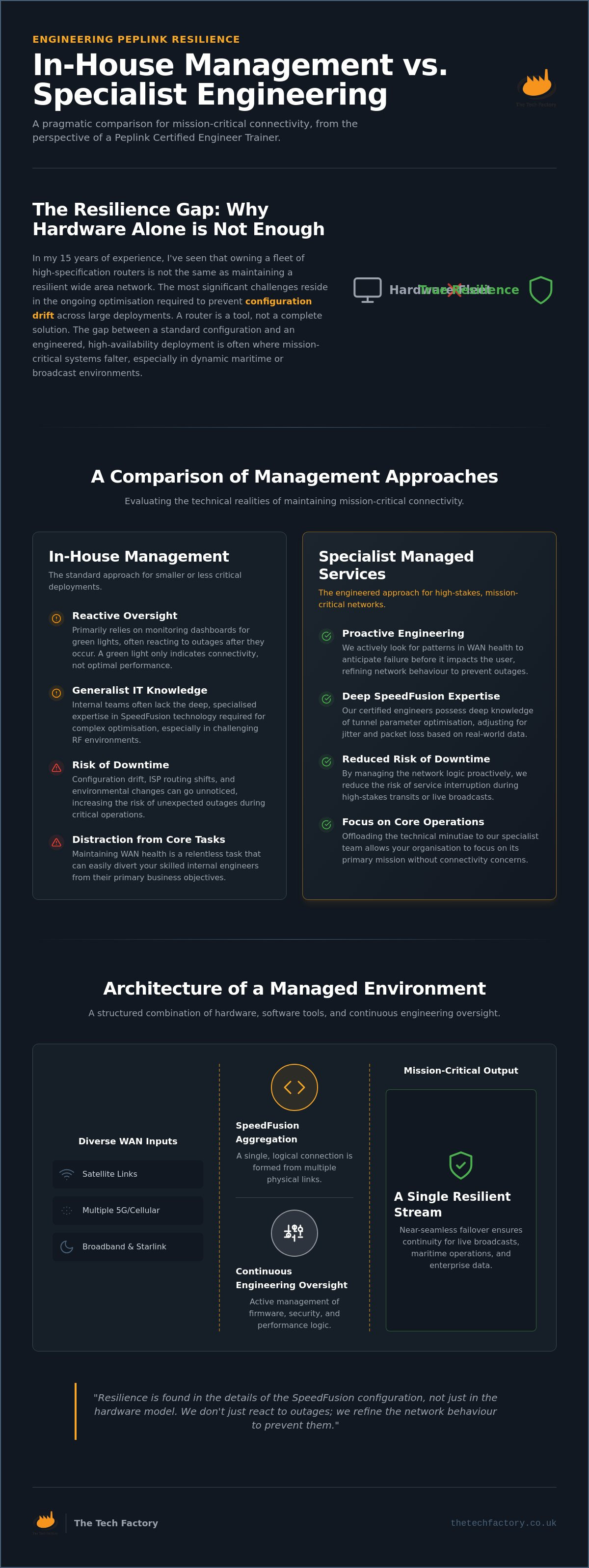
A resilient network architecture is built on more than just hardware placement. It is a structured combination of software tools, engineering protocols, and bespoke visibility. Whilst the hardware provides the physical path, Peplink managed services provide the intelligence that governs how data moves across those paths. At the centre of this architecture is SpeedFusion technology, which we use to aggregate multiple physical links into a single, logical connection. This ensures that even if a specific cellular or satellite link fails, the session remains active, providing the near-seamless failover required for mission-critical applications.
Our team focuses on the continuous health of these SpeedFusion tunnels. This involves more than just verifying uptime. We manage the entire lifecycle of the deployment, from initial configuration to the ongoing application of firmware updates and security patches. Forbes explains the business case for MSPs as a way to access specialised expertise that would be prohibitively expensive to maintain in-house, and this is particularly true for complex SD-WAN environments. By offloading the technical minutiae to our engineers, organisations can focus on their primary operations without worrying about the underlying infrastructure.
InControl2: The Foundation of Visibility
We use InControl2 as the primary engine for fleet-wide configuration management. It allows us to push standardised settings across hundreds of devices simultaneously, which reduces the risk of configuration drift. One of the most vital aspects of our management protocol is the scheduling of automated firmware updates. We coordinate these windows to ensure they do not clash with operational peaks, such as a maritime transit or a live broadcast. Whilst InControl2 is an excellent tool, it can sometimes present too much raw data for non-technical stakeholders, which is why we often supplement it with more focused reporting methods.
Custom Portals and Bespoke Software
To provide clear visibility, we often develop custom software and portals that simplify network reporting. These tools translate complex engineering metrics into actionable insights for fleet managers or operations directors. For instance, in our work with SD-WAN for fleet management, we provide unified views that combine real-time GPS location with WAN health and data consumption. This level of bespoke visibility ensures that decision-makers have the information they need without needing to navigate a technical CLI or a dense engineering dashboard. If you require a more streamlined way to monitor your network health, our bespoke management portals offer a clear alternative to standard dashboards.
Comparison: In-house Management vs. Specialist Managed Services
Choosing between a DIY approach and professional management involves weighing internal capacity against the potential cost of failure. I often advise my clients to look closely at what an hour of downtime actually costs their operation. In-house IT teams are usually capable generalists. They manage the office LAN, the server infrastructure, and the firewall. However, they often lack the deep, Peplink-specific troubleshooting experience required to diagnose a degraded SpeedFusion tunnel under pressure. Peplink managed services provide a predictable cost model whilst significantly reducing the risk of configuration errors that lead to unexpected outages.
Technical Depth vs. Generalist Knowledge
The primary difference lies in the time-to-resolution. When a mission-critical link stutters, a generalist team might spend hours navigating logs to find a root cause. A specialist engineer, who manages thousands of devices across diverse sectors, can often identify the issue in minutes. This is the value of practitioner advice. We understand the specific nuances of how different cellular modules interact with specific firmware versions. Implementing a truly high availability SD-WAN configuration requires more than just following a setup wizard; it requires an understanding of how to tune the network for resilience in unstable environments. We focus on the fine details of the tunnel parameters that generalists often overlook.
Operational Overhead and Scalability
The administrative burden of a growing fleet is often underestimated. Managing SIM card inventories, monitoring data quotas, and ensuring that all devices adhere to cybersecurity best practices is a relentless task. As you scale from five devices to fifty, the operational overhead grows exponentially. A managed service allows an organisation to scale its fleet without the need to hire and train additional niche engineers. We provide the mission-critical oversight that ensures your security patches are current and your configurations remain standardised across the entire organisation. This peace of mind allows your internal team to focus on their primary objectives whilst we ensure the foundation of your connectivity remains stable.
In my experience, the DIY model works well for static enterprise sites with standard requirements. However, for maritime, broadcast, or public safety operations, the "cost of failure" is simply too high to leave to chance. Professional management is not just a service; it's a strategy for maintaining network resilience in scenarios where failure is not an option.
Evaluating Technical Competence in Peplink Service Providers
Selecting a partner for Peplink managed services requires a critical eye for engineering substance. I have found that many providers lead with marketing claims whilst lacking the technical depth to support complex deployments. You should always verify the credentials of the lead consultants who will design your network architecture. In my experience, a provider who cannot explain the nuances of their SpeedFusion optimisation process is unlikely to maintain your resilience when environmental conditions degrade. A competent partner acts as an advisor, ensuring your hardware choices align with your long-term operational goals rather than just acting as a hardware supplier.
When evaluating a firm, ask for specific examples of how they have engineered SD-WAN for remote workforce or maritime scenarios. These environments are unforgiving; they require a deep understanding of how to manage high-latency links and fluctuating signal quality. We don't just provide a dashboard; we provide the engineering oversight required to keep those links stable. If you are currently vetting providers to support your mission-critical infrastructure, you can enquire about our specialist managed services to see how our engineering-first approach differs from standard support models.
Key Questions for Potential Providers
I recommend asking the following technical questions to gauge a provider's technical maturity and practitioner experience. Their answers will reveal whether they are truly managing the network or simply monitoring it:
- What is your specific process for SpeedFusion tunnel optimisation based on real-world packet loss?
- How do you handle firmware regression if a new release causes stability issues in our specific environment?
- Do you provide custom portals that translate raw engineering data into actionable insights for our non-technical stakeholders?
The Importance of Training and Knowledge Transfer
A managed service should never be a "black box" that excludes your own team from the technical reality of the network. Whilst we take on the burden of day-to-day management and troubleshooting, I believe it is vital that your internal staff understand the fundamentals of the infrastructure. We prioritise building in-house competence alongside our managed offering. As a Peplink Certified Engineer Trainer with 15 years of experience, I ensure that our clients receive the knowledge transfer necessary to make informed decisions. This approach reduces the risk of operational silos and ensures that your organisation remains agile, even as your connectivity requirements become more complex.
The Tech Factory Approach: Engineering Resilience as a Service
At The Tech Factory, we do not view connectivity as a secondary concern. We design and manage infrastructures where failure is not an option. My 15 years of experience as a Peplink Certified Engineer Trainer informs every deployment we manage; I have seen how easily a poorly configured network can fail during a critical transit or a live broadcast. Our Peplink managed services are built on this practitioner knowledge, providing the technical depth that generalist MSPs cannot match. We act as an extension of your team, ensuring the engineering layer of your network remains stable whilst you focus on your core business objectives.
From Scoping to Long-Term Success
Our process begins with a methodical approach to network design. We don't just ship hardware; we scope the specific requirements of your environment, whether that involves complex RF challenges at sea or high-bandwidth demands in a broadcast studio. Once the architecture is defined, we handle the intricate SpeedFusion configuration required to aggregate multiple links into a resilient connection. We onboard our clients into InControl2 and, where necessary, provide custom management portals for enhanced visibility. Our role as advisors to Peplink’s largest global distributor gives us a unique perspective on the technology, allowing us to implement solutions that are engineered for long-term reliability.
A Scoping Conversation for Your Connectivity
If you are managing a fleet in the maritime, broadcast, or enterprise sectors, you understand that standard support is often insufficient. Our advice is based on hard-won practitioner experience, not sales targets. We prioritise the engineering reality of your deployment over marketing fluff. I invite you to have a brief technical scoping conversation regarding your connectivity requirements. This is an opportunity to discuss your specific challenges and explore how a specialist approach to Peplink managed services can reduce the risk of downtime in your organisation.
Please contact us to arrange a brief scoping call to discuss your network design and management needs.
Securing Your Mission-Critical Infrastructure
Engineering resilience in a wide area network is a continuous process. Whilst hardware is the foundation, the stability of your deployment depends on the technical logic that governs your links. We have explored how Peplink managed services bridge the gap between generalist IT support and the high-level engineering required for sectors like maritime and broadcast. My 15 years of specialist experience as a Peplink Certified Engineer Trainer informs our methodical approach to network design and SpeedFusion optimisation. We focus on reducing the risk of downtime whilst providing clear visibility through our bespoke custom software portals.
Managing a complex fleet is a relentless task that shouldn't distract you from your core operations. If you are weighing the trade-offs between in-house management and specialist engineering, I am available to discuss your specific requirements. I invite you to contact Adam Steadman for a Peplink managed services scoping call to explore how we can support your connectivity goals. Our goal is to ensure your network remains a reliable utility that supports your mission without constant manual intervention.
Frequently Asked Questions
What exactly is included in a Peplink managed service?
A managed service provides proactive oversight of your network infrastructure. This typically includes fleet-wide configuration management, scheduled firmware updates, and continuous SpeedFusion tunnel optimisation. We also provide bespoke visibility through custom portals that translate technical data into actionable operational insights. It is an engineering-led approach that ensures your network remains resilient against changing environmental conditions and ISP routing shifts.
Do I still need InControl2 licenses if I use a managed service?
Yes, InControl2 licenses remain a requirement for remote management and monitoring. InControl2 is the foundational tool that allows our team to push configurations and monitor device health across the organisation. Whilst we use this platform as part of our Peplink managed services, the service itself provides the human expertise required to interpret the data and make engineering decisions that automated systems might miss.
Can a managed service provider help with SpeedFusion configuration?
Specialist configuration is a core component of our managed offering. We don't just enable SpeedFusion; we tune the tunnel parameters to suit your specific data requirements. This involves adjusting for packet loss, jitter, and latency across multiple aggregated links. In my experience, these fine adjustments are what separate a standard connection from an engineered, mission-critical link suitable for broadcast or maritime use.
Is it more cost-effective to manage Peplink in-house or outsource it?
Cost-effectiveness is usually determined by the cost of failure in your specific operation. For mission-critical environments, the cost of a single hour of downtime often exceeds the annual fee for a managed service. Outsourcing provides access to high-level engineering and practitioner expertise without the significant overhead of hiring a full-time, niche specialist. It allows your internal IT team to focus on general operations whilst we secure the connectivity layer.
How does a managed service improve network resilience for live events?
Resilience is improved through active, real-time oversight during high-stakes periods. During a live broadcast or an emergency response, our engineers monitor the health of the logical connection rather than just the physical links. We can proactively adjust traffic steering and bonding protocols if one carrier begins to throttle data or if signal quality degrades. This reduces the risk of packet loss impacting your live stream or critical data feed.
What happens if my Peplink hardware fails whilst under a managed service?
If a hardware failure occurs, our team handles the technical diagnostics to confirm the fault. We then coordinate with the distributor to facilitate the replacement process. Once the new hardware arrives, we restore the specific configuration from our backups and re-onboard the device into InControl2. This ensures that the replacement unit is integrated back into the network with the correct settings and security protocols without delay.
Can you manage a fleet that was originally deployed by another provider?
We frequently take over the management of fleets that were deployed by other providers. The process begins with a comprehensive technical audit to identify any configuration drift or security vulnerabilities. Once we have stabilised the environment, we onboard the devices into our management protocols. This ensures that even legacy deployments can benefit from the same level of engineering oversight and bespoke visibility as a new network design.
Do managed services include data plan and SIM card management?
Data management is a vital part of maintaining network uptime. We monitor data consumption and SIM card health to prevent unexpected throttling or overages that could disrupt your connectivity. Whilst we don't act as an ISP, our Peplink managed services include the oversight required to ensure your data plans align with your actual usage patterns. This proactive management helps maintain predictable performance across your entire fleet.