
The term "unbreakable" is frequently used by marketing departments to sell a dream that rarely survives its first encounter with a real-world fibre cut. I have spent 15 years as a Peplink consultant, and I have seen many organisations invest heavily in a high availability SD-WAN configuration only to be let down by packet loss during a simple link transition. It is frustrating to be told a network is resilient, only to watch a critical video stream or VoIP call drop the moment a primary connection fails.
I understand that frustration, as the gap between marketing claims and engineering reality can be vast. I will explain why chasing the myth of zero downtime is a distraction; instead, we focus on how to engineer genuine resilience using Peplink SpeedFusion technology. This approach aggregates multiple links into a single logical connection, allowing for a near-seamless transition if a provider goes offline. This article explores the technical differences between basic failover and true sub-second resilience. I will also detail the configuration strategies we use to reduce the risk of operational downtime, ensuring your network remains stable when the stakes are at their highest.
Key Takeaways
- Understand the engineering required to achieve high resilience rather than chasing the statistical impossibility of zero downtime.
- Learn how SpeedFusion technology aggregates diverse links into a single logical tunnel to facilitate near-seamless per-packet distribution.
- Discover practical methods to implement a high availability SD-WAN configuration that maintains session persistence during a WAN handover.
- Evaluate the technical differences between VRRP and Hot Standby to eliminate hardware as a single point of failure.
- Recognise why professional network design and methodical logic are the true foundations of a stable, mission-critical deployment.
Why "Zero Downtime" is a marketing myth in SD-WAN
I have spent 15 years designing networks for sectors where failure is not just an inconvenience but a significant operational risk. During this time, I have learned that 100% uptime is a statistical impossibility. No matter how many redundant paths or high-specification appliances you deploy, external factors like physical fibre cuts, power outages at a carrier's data centre, or massive BGP routing errors remain beyond your control. These are the realities of the field that marketing brochures often choose to ignore.
The industry frequently uses the term "zero downtime" to sell a sense of security. It sounds definitive and reassuring. However, in my experience, this phrase often hides the reality of packet loss and session resets during a WAN handover. When a link fails, the transport mechanism must detect the failure and reroute traffic. If this process is not engineered correctly, your applications will still experience a drop, even if the secondary link is technically ready. A genuine Software-Defined Wide Area Network (SD-WAN) strategy does not promise perfection; it focuses on reducing the risk of failure to the lowest possible margin through meticulous planning.
We approach a high availability SD-WAN configuration as a exercise in risk management rather than a search for an absolute guarantee. Our team focuses on sub-second failover and resilience. This means engineering the network so it can withstand the loss of a primary circuit without the user ever noticing a change in application behaviour. It is about maintaining stability under pressure, not claiming that pressure doesn't exist.
The difference between failover and resilience
Standard failover is a reactive process. The system waits for a link to be confirmed as "dead" before switching traffic to a secondary path. This confirmation period, which often lasts several seconds, results in a noticeable drop for real-time applications like VoIP or video conferencing. Resilience is a different standard entirely. It implies a network that continues to function even when a primary path experiences high latency, jitter, or partial packet loss. I prefer to discuss session persistence rather than "unbreakable" connections. By using technology that aggregates multiple links into one logical connection, we ensure that a single link failure does not terminate the underlying application session.
The role of the human element in network stability
Hardware is remarkably reliable in the modern era. In most deployments I oversee, configuration errors are far more common than hardware failures. A robust network design must be simple enough for an engineering team to manage whilst remaining complex enough to handle multi-faceted failure scenarios. I often see over-engineered solutions that fail because they are too difficult to troubleshoot during a live incident. We prioritise clean, logical designs that favour technical competence over unnecessary complexity, ensuring the high availability SD-WAN configuration remains manageable throughout its lifecycle.
SpeedFusion and the mechanics of sub-second failover
SpeedFusion is the technology that differentiates a standard failover setup from a truly resilient network. It operates by creating a logical VPN tunnel that spans across every available WAN link. Unlike traditional routing protocols that treat links as separate paths, SpeedFusion aggregates them. This allows the system to distribute traffic at the packet level rather than the session level. In a high availability SD-WAN configuration, this per-packet distribution is what prevents a total connection drop when a single carrier fails.
Academic research into sub-second failover confirms that the speed of detection and rerouting is the primary factor in maintaining application stability. In maritime and broadcast environments, link quality is never static. Signal strength fluctuates and latency spikes. If you rely on basic failover, the system typically waits for a complete link timeout before reacting. By then, your video stream has buffered or your VoIP call has disconnected. SpeedFusion ensures that packets are already being sent across alternative paths. If one link degrades, the remaining links carry the load with near-seamless transition.
WAN Smoothing vs Bandwidth Bonding
WAN Smoothing is a specific sub-feature designed to mitigate the effects of packet loss by duplicating packets across multiple links. It consumes more bandwidth, but the result is a significantly more stable connection for jitter-sensitive traffic. Bandwidth Bonding, conversely, combines the throughput of multiple links into a single high-capacity pipe. I typically recommend WAN Smoothing for VoIP and live video feeds. Stability is usually more critical than raw speed in mission-critical scenarios. If you require a bespoke SpeedFusion configuration for a complex environment, our team can help design a logic that matches your specific link profiles.
Hot Failover: The key to session persistence
Hot Failover is a foundational component of SpeedFusion that is often overlooked. It keeps secondary links in a "hot" state, meaning they are already authenticated and ready to pass traffic instantly. This reduces the risk of a VPN drop during a primary link failure. In my experience, this is the most reliable way to handle transient cellular signal drops. It ensures that the underlying VPN tunnel remains established even whilst the hardware switches its primary path. This level of session persistence is essential for maintaining a stable high availability SD-WAN configuration in the field.
Hardware redundancy: VRRP vs Hot Standby in Peplink environments
A single router, no matter how robust the build quality, remains a single point of failure. In my 15 years of field experience, I have seen premium hardware succumb to everything from lightning strikes to simple power supply failures. A resilient high availability SD-WAN configuration often requires two identical routers working in tandem to ensure that hardware failure does not lead to a total site blackout. I advise clients on whether to use standard VRRP or Peplink's dedicated High Availability (HA) mode based on their specific network topology and the urgency of their failover requirements. We must also consider environmental factors; redundant routers are entirely useless if they share a single UPS or a single power circuit. True resilience requires separate power paths to ensure that a tripped breaker does not take down both units simultaneously.
When to deploy a High Availability (HA) pair
I recommend HA pairs for central hubs, data centres, and mobile command centres where connectivity is essential. A Peplink HA pair consists of a Master and a Slave unit that share a virtual IP address on the LAN side. Under normal conditions, the Master handles all traffic and maintains the SpeedFusion tunnels. If the Master unit fails or loses power, the Slave takes over the LAN and WAN responsibilities almost immediately. This transition is engineered to be near-seamless. Whilst the Slave unit is in standby mode, it monitors the Master via a dedicated heartbeat connection. This ensures that the handover occurs the moment the Master stops responding, protecting the integrity of the local network.
Cabling for hardware resilience
I have seen many engineers install two routers but forget to split their WAN feeds correctly. If your fibre or satellite feed only plugs into the Master unit, the Slave has no path to the internet when it takes over. Using a managed switch to deliver WAN links to both units is a common, yet critical, design choice. We typically use VLANs on a separate switch to present the WAN handovers to both Peplink appliances. This ensures that regardless of which router is active, the physical internet paths remain available. We also ensure the configuration is synchronised across both units via InControl2. This ensures that any change made to the Master is automatically reflected on the Slave. Without this synchronisation, the high availability SD-WAN configuration is compromised, as the Slave unit may lack the necessary routing logic to maintain the network during a failure event.
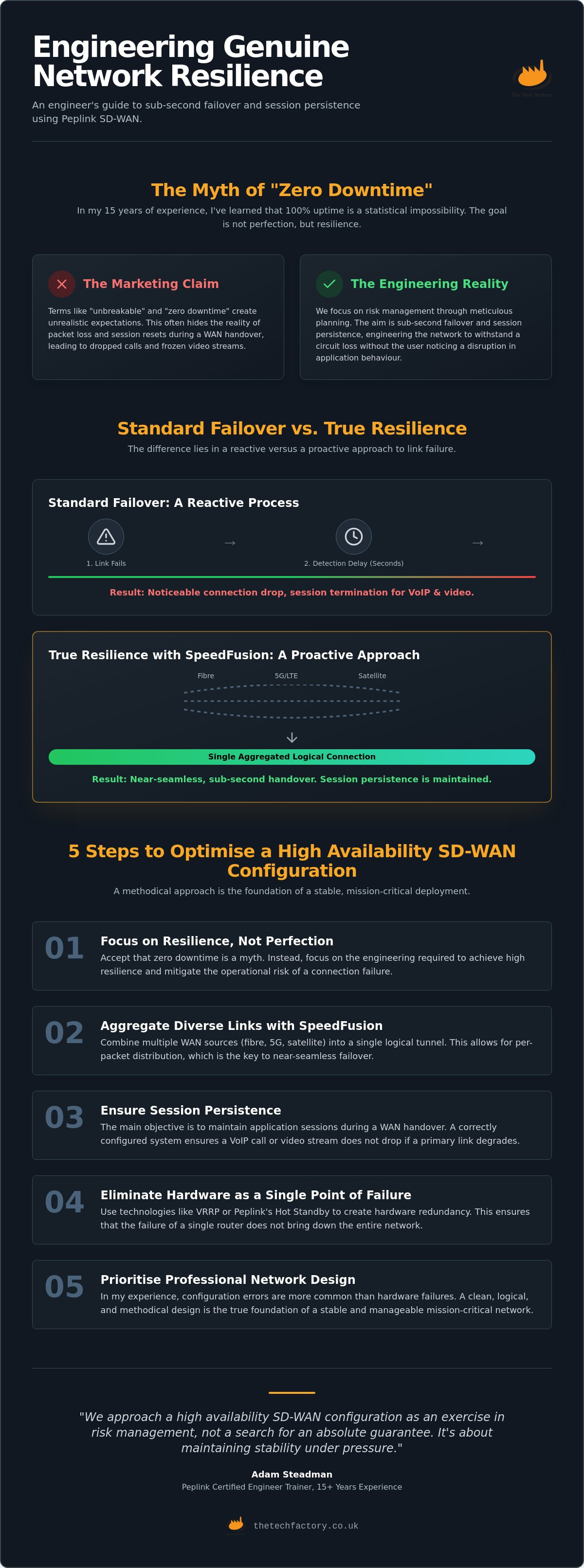
5 Steps to optimise high availability SD-WAN configuration
Optimising for resilience requires a methodical approach to both hardware and software. In my experience, a high availability SD-WAN configuration is only as strong as its weakest link, whether that is a physical cable or a logical routing rule. I follow these steps to ensure a network is engineered for the highest possible uptime, moving beyond basic connectivity to a state of genuine operational stability. The goal is to eliminate single points of failure at every layer of the stack, starting with link diversity and ending with rigorous, real-world testing.
Step 1: Diversify your WAN transport
True resilience begins with physical path diversity. I advise against relying on two SIM cards from the same carrier; a single tower failure or a regional core network outage will take down both links simultaneously. Instead, combine different technologies such as LEO satellite (Starlink), 5G, and fixed-line fibre. This diversity is vital for SD-WAN for fleet management where coverage is constantly changing and signal shadows are a frequent occurrence.
Step 2: Configure SpeedFusion for resilience
Once the links are established, you must configure the SpeedFusion tunnels to prioritise stability. I set up tunnels with WAN Smoothing for mission-critical traffic, which duplicates packets to mitigate the impact of sudden jitter. I also adjust the "Link Failure Detection" time to be as aggressive as the link quality allows. By using sub-second health checks, the system can trigger a failover before the user or the application notices a performance dip.
Step 3: Implement hardware redundancy
Hardware redundancy is the next layer of protection. For core sites, I deploy a Peplink HA pair using two Balance routers. It is essential to ensure that the InControl2 configuration is set to automatically push updates to both units. This prevents configuration drift where the Slave unit lacks the latest routing rules. I also verify that the heartbeat connection between units is stable, as this is the primary mechanism for detecting a hardware failure.
Step 4: Centralise visibility with InControl2
Proactive monitoring is the only way to catch failing hardware or degrading links before they cause a total outage. I use InControl2 to monitor link health and tunnel status in real-time. By setting up automated alerts for link drops, even if the SpeedFusion tunnel remains up, our team can investigate carrier issues whilst the redundant links maintain the site. If you require assistance with a custom network design and deployment, we provide the technical oversight needed to manage these complex environments.
Step 5: Test the failure scenarios
A configuration is only theoretical until it has been tested under load. I always perform "pull-the-plug" tests during the deployment phase to verify that the session persists when the primary WAN is disconnected. This is especially important for SD-WAN for remote workforce deployments where users rely on stable VPN connections to access centralised resources. Testing confirms that the logic we have engineered actually holds up when the primary path goes dark.
Why professional network design is the foundation of resilience
Hardware is only half the battle. In my 15 years of field experience, I have seen many organisations invest in high-specification kit only to suffer outages because the underlying network logic was flawed. A high availability SD-WAN configuration is an engineered outcome, not a product that can be bought off a shelf. It requires a deep understanding of how different transport mediums interact under load. Our team specialises in Peplink deployment services that are tailored for the most demanding environments, from maritime vessels to command centres. We provide the technical training and managed services necessary to ensure your internal staff can maintain this resilience long after the initial deployment.
The value of an expert consultant
I bring over 15 years of experience to every design project. This longevity in the industry allows me to help clients avoid the common pitfalls that lead to session drops and configuration drift. We act as an advisor to some of Peplink’s largest global distributors, which gives us a unique perspective on how these systems behave at scale. A brief scoping conversation at the start of a project can often identify technical risks that might have been overlooked during the initial planning phase. My goal is to ensure that the network architecture is robust enough to handle simultaneous link failures without compromising the user experience. We prioritise stability over complexity, ensuring the design remains manageable for your engineering team.
Beyond the deployment: Managed services
Resilience is a continuous process. It is not a one-time setup that can be forgotten. Our managed services provide ongoing monitoring and custom software portals to give you full visibility into your network health. We ensure that your firmware and security patches are always up to date without interrupting mission-critical operations. This proactive approach allows us to detect subtle link degradation or hardware anomalies before they escalate into a total outage. By combining professional design with consistent management, we create a high availability SD-WAN configuration where stability is the default state rather than a sporadic achievement. We focus on the technical details so you can focus on your core operations.
Engineering Stability for Mission-Critical Operations
Achieving a robust network requires moving past the myth of zero downtime. It involves acknowledging that failure is a constant risk and designing an architecture that survives it. A successful high availability SD-WAN configuration depends on physical link diversity, hardware redundancy, and the sub-second failover logic provided by SpeedFusion technology. These elements work together to ensure that application sessions persist even when individual links or hardware components fail.
With over 15 years of experience as a Peplink Certified Engineer Trainer, I have deployed these resilient systems in the most demanding maritime and broadcast environments. Our team at The Tech Factory operates as a specialist consultancy and advisor to Peplink's largest global distributor, ensuring every design we produce is grounded in field-proven logic rather than marketing theory. We prioritise technical mastery to protect your operations from the high stakes of connectivity failure.
Resilience is a continuous engineering commitment that requires professional oversight and methodical testing. If you are ready to move beyond marketing claims and engineer a truly resilient network, I invite you to book a brief scoping conversation with our team. We look forward to helping you build a network that remains stable when it matters most.
Frequently Asked Questions
What is the difference between Hot Failover and WAN Smoothing?
Hot Failover maintains a secondary link in an active, standby state to prevent a VPN drop if the primary connection fails. WAN Smoothing differs by duplicating every packet across multiple links simultaneously. If one link loses a packet, the duplicate is delivered by another path. I recommend Hot Failover for general resilience and WAN Smoothing for jitter-sensitive applications like live video or VoIP feeds.
Can I achieve high availability with just one Peplink router?
You can achieve link-level resilience by using diverse connections such as Starlink and 5G, but the router itself remains a single point of failure. For a true high availability SD-WAN configuration, I always advise deploying a dual-router HA pair. This protects your site against hardware failure or power supply issues that a single appliance cannot survive.
Does a high availability SD-WAN configuration increase latency?
SpeedFusion introduces a small amount of encapsulation overhead, but in my experience, the impact on latency is negligible compared to the stability it provides. When using WAN Smoothing, the latency is determined by the slowest link in the group. However, the significant reduction in packet loss often makes the connection feel much more stable for real-time applications.
Do I need a Peplink Certified Engineer for the setup?
While Peplink hardware is user-friendly, a mission-critical configuration requires a deep understanding of routing protocols and SpeedFusion tuning. As a Peplink Certified Engineer Trainer, I often see deployments that fail because they were not tuned for the specific link conditions of the site. Professional design ensures the high availability SD-WAN configuration holds up under real-world pressure.
What happens if both routers in an HA pair fail?
If both routers fail, the network will go down. This is why I stress the importance of environmental factors like redundant power sources and diverse physical cable routing. High availability is about reducing the probability of failure to the lowest possible margin. It is a strategy of risk mitigation rather than a claim of absolute invulnerability.
Is SpeedFusion Bonding the same as load balancing?
No. Load balancing distributes different sessions across different links, whilst SpeedFusion Bonding breaks a single session into packets and sends them across all links simultaneously. This provides much higher resilience and combined throughput for a single user. Bonding ensures that a single application can use the total capacity of all available connections at once.