
Relying on a single 5G carrier for mission-critical operations is not a connectivity strategy; it is a calculated risk that eventually fails. In my experience as a Peplink Certified Engineer Trainer, I have found that the most robust networks are not defined by the peak speed of a single modem, but by the meticulous engineering of the entire data path. This Peplink 5G deployment guide focuses on moving beyond basic setups to create resilient, multi-carrier architectures that withstand the unpredictable nature of cellular environments.
You likely recognise that high latency spikes and signal drops in remote areas are the primary enemies of a stable connection. I will show you how to mitigate these risks by correctly configuring SpeedFusion to aggregate diverse links into a single logical pipe. We will examine the practical implementation of 5G Standalone (SA) support introduced in Firmware 8.6.0 and how to use InControl2 for granular performance visibility. This approach ensures your deployment is engineered for resilience, providing a stable foundation for your live operations whilst reducing the risk of total connectivity failure.
Key Takeaways
- Learn why 5G SD-WAN requires the logical bonding of multiple carriers through SpeedFusion to reduce the risk of packet loss during carrier handovers.
- Follow this Peplink 5G deployment guide to select hardware with appropriate thermal management and ruggedised modems for mission-critical environments.
- Understand the necessity of conducting site surveys and frequency audits to manage the unique propagation characteristics of higher 5G frequency bands.
- Discover how a phased rollout strategy allows for the validation of tunnel performance under real-world load before live operations commence.
- Identify the benefits of bespoke monitoring portals that provide clear visibility into network health whilst avoiding the noise of standard dashboards.
Understanding the Shift to 5G in SD-WAN Infrastructure
Many organisations I work with assume 5G is merely a faster version of 4G. This assumption is a fundamental error that often leads to poor deployment outcomes. The technical reality of 5G involves higher frequency bands that require far more precise engineering for penetration and range than legacy LTE. In my experience, the most significant advantage of 5G within a Software-defined networking architecture isn't just raw bandwidth; it's the drastic reduction in latency. This guide serves as a practical Peplink 5G deployment guide for those who recognise that 5G is a critical component of a broader multi-WAN strategy, rather than a standalone silver bullet.
We approach 5G as one element of a diversified connectivity stack. Whilst the throughput is impressive, the signal characteristics are less forgiving than 4G. Lower-frequency 4G signals can penetrate buildings and travel long distances with ease. Conversely, the mid-band and high-band frequencies used by 5G providers in the United Kingdom require a clear line of sight or advanced antenna arrays to maintain performance. If you don't account for these physical limitations during the design phase, your SD-WAN will suffer from inconsistent throughput and frequent carrier handovers.
The Role of 5G in Mission-Critical Scenarios
Broadcast and maritime sectors are increasingly prioritising 5G for high-bandwidth uplinks. We're seeing a shift where 5G is no longer just a failover option; it's becoming a primary transport medium. This transition is supported by 5G Standalone (SA) standards, which allow for more efficient use of spectrum and lower overheads. When providing Peplink deployment services, we focus on how these standards facilitate the bonding of diverse links. By using SpeedFusion to aggregate 5G with other sources, such as LEO satellite or fixed-line fibre, we create a logical pipe that's far more resilient than any single connection.
Managing Expectations: Throughput vs Resilience
It's vital to distinguish between lab-tested throughput and real-world performance in congested urban areas. I've seen 5G speeds vary wildly based on carrier load and local interference. For live event connectivity, our team always prioritises link stability over peak throughput. A stable 100Mbps connection is always preferable to a jittery 1Gbps link that drops packets during carrier negotiation. This Peplink 5G deployment guide emphasises that achieving resilience requires carrier diversity. Relying on a single network provider creates a single point of failure that no amount of bandwidth can fix. We design for the worst-case scenario, ensuring that even if one carrier's 5G node becomes congested, the SD-WAN remains operational.
The Architecture of a Resilient 5G SD-WAN
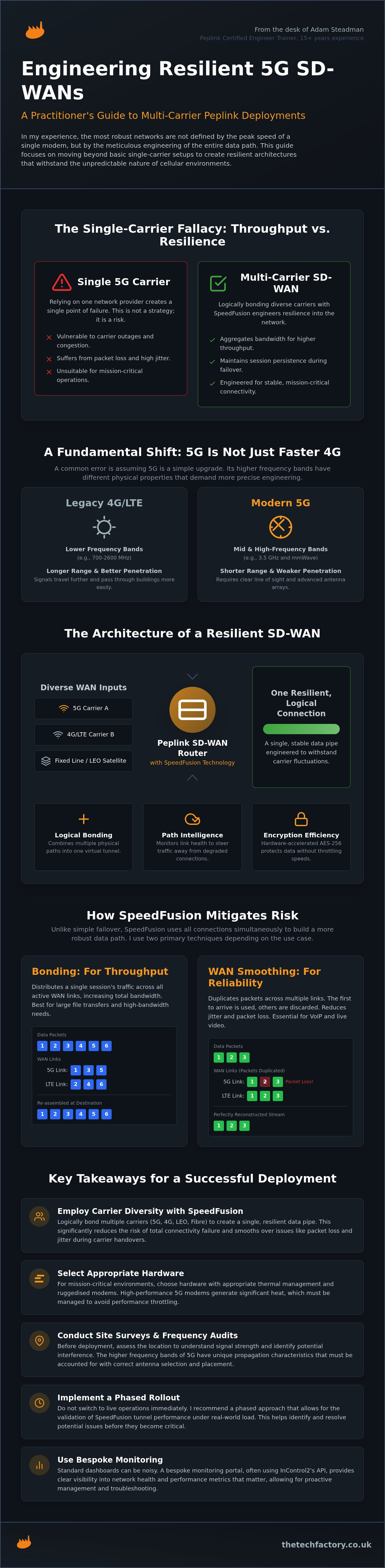
Designing a 5G SD-WAN requires a shift in how we perceive the wide area network. It is a software-defined architecture that aggregates 5G cellular links with other WAN sources into a single logical connection. In my experience, the architecture must be engineered to handle the bursty nature of 5G traffic. Whilst 5G offers high peak speeds, the throughput can fluctuate rapidly based on cell tower load. We prioritise a layered security approach, ensuring the data plane is encrypted whilst maintaining high throughput. This ensures that the performance gains of 5G are not lost to the processing overhead of security protocols.
A resilient architecture relies on three primary pillars:
- Logical Bonding: Combining multiple physical paths into one virtual tunnel.
- Path Intelligence: Real-time monitoring of link health to steer traffic away from degraded connections.
- Encryption Efficiency: Using hardware-accelerated AES-256 encryption to protect data without throttling 5G speeds.
SpeedFusion Bonding and 5G
I often recommend SpeedFusion technology to bond these links, as it significantly reduces the risk of packet loss during carrier fluctuations. Unlike simple failover, which waits for a link to fail before switching, active-active bonding uses all available paths simultaneously. This is a core concept in any professional Peplink 5G deployment guide. For real-time traffic like VoIP or video feeds, I configure WAN smoothing. This process replicates packets across multiple 5G and LTE links, which helps maintain a steady stream even if one connection suffers from jitter or temporary interference. It is a pragmatic way to ensure consistency in unpredictable environments.
Carrier Diversity and SIM Management
Using multiple network providers is essential for engineering resilient maritime connectivity and high-stakes land deployments. Relying on a single carrier in the UK, such as EE or Vodafone, leaves you vulnerable to localised mast congestion or outages. Peplink hardware with multi-SIM slots allows us to manage regional carrier handovers near-seamlessly. We also implement strategies to avoid throttling and manage data caps across a 5G fleet. By setting per-WAN bandwidth limits and monitoring usage via InControl2, we ensure that no single link exceeds its quota and triggers a performance penalty. If you are currently designing a multi-carrier network, our team can provide a technical scoping session to review your proposed architecture.
Critical Hardware and Antenna Considerations for 5G
Selecting the right Peplink hardware is the foundation of any 5G deployment I oversee. I prefer the MAX series for mobile or harsh environments due to their ruggedised modems and thermal management. In my experience, 5G modems generate significantly more heat than their LTE predecessors during sustained high-throughput operations. If the hardware cannot dissipate this heat effectively, the modem will throttle performance to protect its internal components. This Peplink 5G deployment guide emphasises that hardware selection must be based on environmental constraints and thermal reality rather than just datasheet peak speeds.
Antenna strategy is where most 5G deployments fail. Internal antennas are rarely sufficient for professional use, as the building or vehicle structure acts as a Faraday cage. We often specify high-gain MIMO (Multiple Input, Multiple Output) antennas to ensure we are capturing the best possible signal in marginal areas. For 5G, this typically requires a 4x4 MIMO configuration to utilise the full capability of the modem. Using a 2x2 antenna with a 5G modem is a common engineering oversight that effectively halves your potential throughput before the first packet is even sent.
Choosing Between Balance and MAX Routers
I typically recommend Balance routers for fixed-site 5G SD-WAN centres where the device is housed in a climate-controlled rack. These units are ideal for aggregating 5G with fibre and Starlink connections in a head-office environment. Conversely, the MAX HD series is our standard choice for SD-WAN for events UK. These units are built to withstand the physical rigours of temporary deployments and mobile broadcast. When reviewing specifications, remember that "5G Ready" is often a marketing term. I always verify that the specific modem category supports the local 5G NR frequency bands, such as n78 (3.5 GHz), which is widely used in the UK.
Antenna Placement and Cable Losses
The impact of cable length on 5G signal quality is severe, especially at higher frequencies. At 3.5 GHz, signal attenuation over standard RG58 cable is significant. I always aim to keep cable runs as short as possible or switch to low-loss LMR400 cabling for longer distances. When mounting antennas on vessels or temporary structures, height is important, but isolation is critical. We test for interference from other onboard radio equipment to prevent desensitisation of the 5G receiver. A poorly placed antenna near a powerful Wi-Fi access point or radar system will result in high packet retransmission rates and degraded tunnel stability.
Best Practices for a Successful 5G SD-WAN Deployment
In my experience, a successful deployment starts with a thorough site survey and frequency audit. I've seen many projects falter because they skipped this foundational step. This Peplink 5G deployment guide highlights that you must understand exactly which bands are available at your specific location before committing to a hardware configuration. I always advise a phased rollout, starting with a pilot to validate the SpeedFusion tunnel performance under real-world load. This allows us to identify any carrier-specific anomalies before the system becomes mission-critical.
Standardising configurations across an entire organisation via InControl2 is another essential practice. It prevents the configuration drift that often leads to intermittent connectivity issues. We focus on achieving near-seamless failover by fine-tuning the health check parameters of each WAN link. If the health checks are too aggressive, you risk link flapping; if they're too slow, you experience unnecessary downtime. Finding the correct balance is a matter of technical precision rather than guesswork. If you require assistance with your initial network design, our team can help you engineer a resilient architecture that meets your specific operational requirements.
The Deployment Workflow
A professional workflow begins with initial network design and carrier selection based on local UK 5G coverage maps. We then move to physical installation, where I cannot overstate the importance of professional cable termination. At the higher frequencies used by 5G, a poorly crimped connector can introduce enough signal loss to render a high-gain antenna useless. Once installed, we onboard all devices to InControl2. This provides centralised visibility through a custom network management portal, allowing your engineering team to monitor link health and throughput in real time across the entire fleet.
Testing and Validation Protocols
Validation is where the engineering is proven. We perform rigorous stress tests to see how the SD-WAN behaves when a 5G link is suddenly degraded or disconnected. This process validates that SpeedFusion is correctly prioritising mission-critical traffic, such as broadcast feeds or command-and-control data, over less important background tasks. I also use the Peplink WAN Analysis tool to identify hidden bottlenecks within the carrier network. This tool allows us to test the end-to-end performance of the SpeedFusion tunnel independently of the public internet, ensuring the bonded connection meets our required stability benchmarks.
Beyond the Initial Setup: Monitoring and Management
Deployment is only the beginning; the real work lies in proactive management and optimisation. I've found that the first few weeks of live operation often reveal carrier-specific behaviours that require subtle adjustments to the SpeedFusion configuration. This Peplink 5G deployment guide emphasises that proactive management is what separates a resilient network from one that merely functions. I find that standard dashboards often provide too much noise for high-level decision-making. That is why we develop bespoke monitoring portals that filter out irrelevant data, allowing your team to focus on the metrics that truly impact performance.
Regular firmware updates are another non-negotiable aspect of management. As UK carriers continue to refine their 5G Standalone (SA) infrastructure, your hardware must stay aligned with these evolving standards. For instance, the transition to Firmware 8.6.0 introduces expanded per-WAN bandwidth controls and improved TCP performance. Failing to maintain these updates can lead to degraded modem efficiency or compatibility issues with local masts. We provide technical training to our clients' staff to ensure they can manage these day-to-day operations with confidence, whilst we remain available for higher-level architectural support.
Utilising InControl2 for 5G Visibility
InControl2 is the backbone of our management strategy. We use it to monitor signal-to-noise ratios (SNR) across distributed 5G fleets, which is far more indicative of link quality than simple signal bars. I always set up automated alerts for link failures or when data usage thresholds are approached. This prevents bill shock and allows for near-seamless intervention before a performance bottleneck affects the end-user. Engaging a Peplink certified partner UK ensures you have access to this level of engineering expertise for long-term support and troubleshooting.
Managed Services vs In-House Management
Deciding whether to manage a complex 5G SD-WAN in-house or hand it over to specialists depends on your internal engineering capacity. For mission-critical sectors like broadcast or public safety, there is immense value in having an engineer-led support desk that understands the nuances of SpeedFusion bonding. We often use custom software to provide simplified, actionable views for non-technical stakeholders. This allows management to see the health of the global network at a glance, whilst your technical team retains the granular control needed to troubleshoot individual 5G nodes. Our team is available to assist with managed services and InControl2 onboarding to ensure your deployment remains stable as carrier environments shift.
Achieving Operational Stability in 5G Environments
Successful 5G integration into an SD-WAN architecture is a matter of technical precision rather than chance. We have seen that 5G is not simply a faster version of LTE; it is a complex transport medium that demands specific thermal management and advanced antenna strategies. By prioritising SpeedFusion bonding over simple failover, you create a logical connection that reduces the risk of packet loss during carrier fluctuations. This Peplink 5G deployment guide has outlined the necessity of professional site surveys and the value of bespoke monitoring to maintain visibility across a distributed fleet.
As a Peplink Certified Engineer Trainer with 15+ years of practitioner experience, I focus on the engineering nuances that ensure connectivity remains stable in the most challenging environments. If you are planning a mission-critical 5G SD-WAN deployment, I would be happy to discuss your network design requirements. Our team specialises in SpeedFusion configuration and managed services that move beyond basic hardware setups to deliver engineered resilience. With the right design and proactive management, your organisation can transition to 5G with the confidence that your connectivity is built to last.
Frequently Asked Questions
Is 5G SD-WAN reliable enough for primary internet connectivity?
Yes, provided the architecture is engineered with carrier diversity and logical bonding. In my experience, relying on a single 5G link is insufficient for mission-critical tasks because cellular environments are inherently variable. By bonding multiple 5G carriers using SpeedFusion, you create a resilient primary connection that reduces the risk of total failure during live operations.
How many 5G links should I bond for a live broadcast feed?
I typically recommend bonding at least two 5G links from different network providers, often supplemented by a third LTE or LEO satellite connection. This diversity ensures that if one carrier's local mast becomes congested or suffers an outage, the broadcast stream remains stable. The exact number of links depends on your required upload throughput and the local signal density at the site.
Can I use existing 4G antennas for a 5G SD-WAN deployment?
Generally, no, as most legacy 4G antennas are not tuned for the specific 5G NR frequency bands, such as the 3.5 GHz range used in the UK. Using 4G antennas often results in poor impedance matching and significant signal loss. To follow this Peplink 5G deployment guide correctly, you should specify high-gain antennas designed specifically for 4x4 MIMO 5G operations to ensure maximum modem efficiency.
What is the typical latency I should expect from a bonded 5G connection?
Latency on a bonded 5G connection in the UK typically ranges between 20ms and 50ms, though this fluctuates based on carrier load and signal quality. Whilst SpeedFusion adds a negligible overhead for encryption and bonding, the overall stability of the latency is improved through path intelligence. We focus on minimising jitter and packet loss rather than chasing absolute minimum latency figures that cannot be sustained.
Does SpeedFusion work with any 5G carrier in the UK?
Yes, SpeedFusion is carrier-agnostic and works with all major UK providers, including EE, Vodafone, Three, and O2. It treats each cellular connection as a raw data pipe, aggregating them into a single logical tunnel. This flexibility allows our team to select the best-performing carriers for a specific geographic location without being restricted by a single provider's network limitations.
How do I manage data costs when using multiple 5G SIM cards?
Data costs are managed through granular controls within InControl2 and the Peplink router firmware. You can set per-SIM data caps and bandwidth limits to prevent any single link from exceeding its monthly allowance. I often configure systems to prioritise lower-cost links for background traffic whilst reserving high-capacity 5G connections for mission-critical data or failover scenarios.
Do I need a Peplink specialist to configure my 5G SD-WAN?
Whilst basic setups are possible, mission-critical 5G deployments usually require specialist configuration to optimise SpeedFusion parameters for specific applications. A specialist understands how to fine-tune health checks and WAN smoothing to prevent packet loss during carrier handovers. Our team provides the engineering expertise needed to ensure your architecture is resilient and performs predictably under load.
What happens to my SD-WAN if the 5G signal drops to 4G/LTE?
The SD-WAN will continue to operate, though the available throughput will decrease to match the LTE link's capability. SpeedFusion handles this transition near-seamlessly by dynamically adjusting the traffic distribution across all active links. This ensures that your critical applications stay online even as the underlying cellular environment shifts from 5G to legacy standards.