
If your management console shows a green light whilst your live broadcast is stuttering, your monitoring has already failed you. In high-stakes environments, a binary "up or down" status is a dangerous oversimplification that hides the packet loss and jitter threatening your mission. I have spent 15 years engineering networks where failure is not an option; I have found that a successful sd-wan implementation plan must look beyond standard dashboards to surface the specific data that determines operational success.
You likely recognise the frustration of information overload from generic tools that fail to provide deep visibility into SpeedFusion tunnel health. This guide serves as a practitioner’s blueprint for designing Peplink architectures that prioritise link stability and technical clarity. I will outline how to build a resilient network that handles link failure gracefully by aggregating multiple connections into one logical pipe, providing role-specific visibility for your team whilst keeping a firm grip on data costs. We will move past the marketing fluff to focus on the engineering required for near-seamless failover and sustained uptime in volatile conditions.
Key Takeaways
- Learn why binary "up/down" monitoring is insufficient for bonded links and how to surface the granular metrics required for mission-critical stability.
- Follow a practitioner’s five-stage sd-wan implementation plan that moves from rigorous requirement gathering to the deployment of resilient, multi-link architectures.
- Discover how to utilise the Peplink InControl API to create bespoke monitoring portals that offer role-specific visibility for both technical and non-technical staff.
- Understand the specific design considerations for sectors like outside broadcast and maritime, where managing the transition between cellular, satellite, and terrestrial links is vital.
- Gain insights from over 15 years of experience in deploying SpeedFusion technologies to reduce the risk of network failure during high-stakes operations.
Beyond Up/Down: Why Traditional SD-WAN Implementation Plans Fail
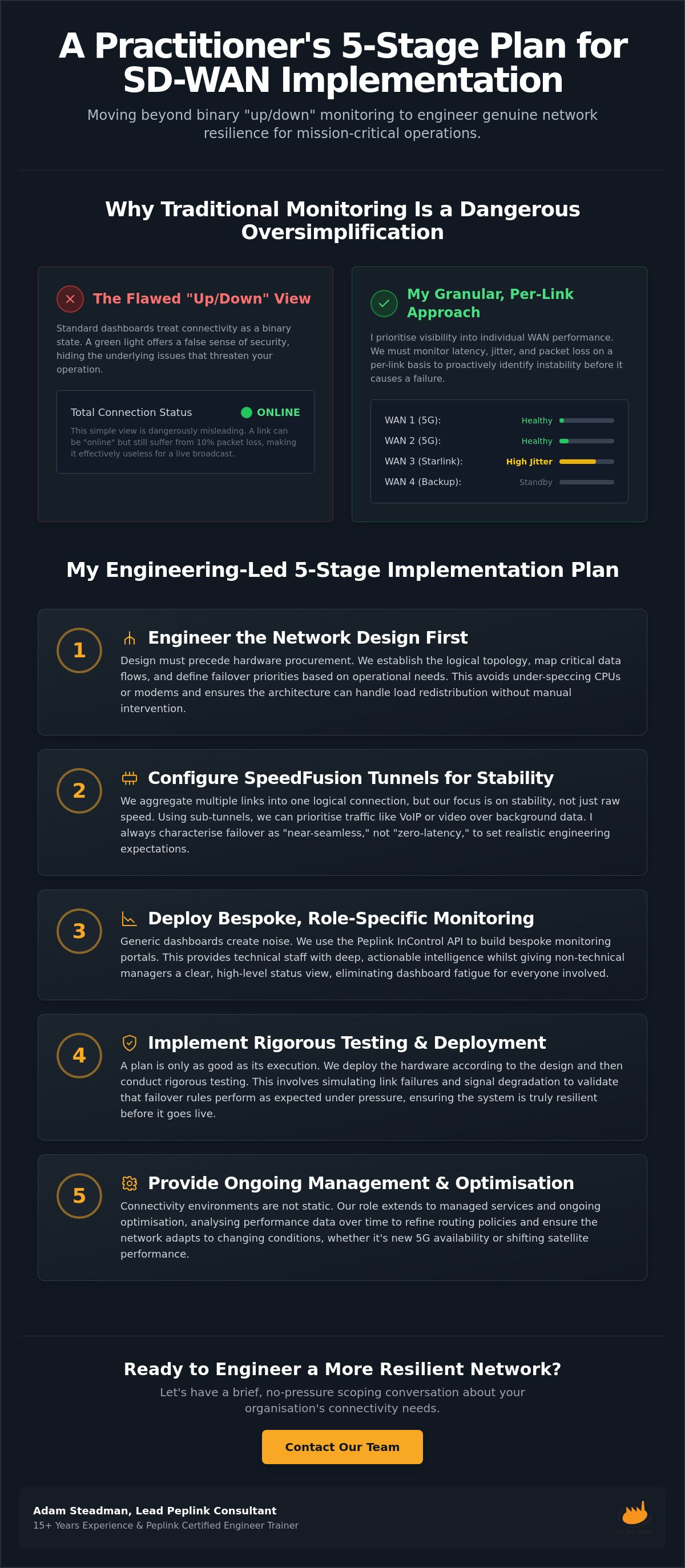
Most generic checklists for a Software-Defined Wide Area Network (SD-WAN) focus on enterprise migration from MPLS to fixed-line broadband. They assume static links with predictable performance. In my experience as a Peplink consultant, this approach is fundamentally flawed when applied to mission-critical mobile or remote environments. A standard sd-wan implementation plan often fails because it treats connectivity as a binary state. If the router responds to a ping, the dashboard shows green. However, for a broadcast engineer or a maritime operator, a "green" link that is dropping 10% of its packets due to fluctuating signal-to-noise ratios is effectively a failed link.
We've found that traditional plans overlook the inherent volatility of bonded cellular and satellite links. Standard connectivity checks don't account for the subtle degradation that occurs when a vehicle moves between cell towers or when atmospheric conditions affect a Starlink connection. Relying on basic "up or down" status reports creates a false sense of security that can be catastrophic during a live event. It leaves technical teams reactive rather than proactive, forced to troubleshoot failures after they've already impacted the operation. Our approach focuses on engineering resilience by anticipating these fluctuations and designing the network to handle link failure gracefully without manual intervention.
Understanding the Visibility Gap
Generic monitoring tools usually see one logical connection but miss the internal mechanics of SpeedFusion link aggregation. If you are bonding four 5G SIMs, you need to know if one is underperforming before it drags down the entire tunnel. I prioritise visibility into individual WAN performance, monitoring latency and jitter on a per-link basis. This granularity is essential; without it, you cannot identify which carrier is introducing instability whilst the service diminishes.
The Problem of Noisy Dashboards
High-pressure environments don't tolerate dashboard fatigue. Standard SNMP polling intervals are often too slow for mobile connectivity where signal conditions change in seconds. This lag means alerts often arrive after the connection has already glitched. We've seen engineers ignore critical warnings because their systems are flooded with background noise. A refined sd-wan implementation plan must filter this data, ensuring only actionable intelligence reaches the technical team.
A Practitioner’s 5-Stage SD-WAN Implementation Plan
Whilst many corporate roadmaps focus on high-level assessments and "current vs desired" states, I prefer a methodical, engineering-led approach. A robust sd-wan implementation plan isn't just a list of sites; it's a technical blueprint for resilience. It requires a deep understanding of how different transport layers interact under load, especially when you are mixing cellular, satellite, and terrestrial links. In my experience, the success of a deployment is determined long before the first router is racked. It's about building a foundation that can absorb the volatility of real-world connectivity.
Step 1: Engineering the Network Design
Establishing the logical topology for multi-site or mobile deployments is the first priority. In my experience, design must precede hardware procurement to avoid costly bottlenecks. If you buy the kit before you've mapped your data flows, you risk under-speccing the CPU or modem capacity required for your bonded throughput. We define failover priorities that reflect your specific mission-critical needs. If your primary satellite connection degrades, the system must know exactly how to redistribute that load across 5G or terrestrial links without manual intervention. This level of planning ensures that the architecture supports the operational workflow rather than hindering it.
Step 2: SpeedFusion Tunnel Configuration
This stage involves aggregating multiple links into one logical connection. We don't just configure for raw speed; we engineer for stability. By utilising sub-tunnels, we can prioritise specific traffic types like VoIP or live video feeds over less critical background data. It's important to be realistic about performance expectations. We characterise failover as near-seamless rather than zero-latency. Even the best-engineered tunnel requires a brief moment to re-route packets when a physical link drops, but our goal is to ensure the user experience remains uninterrupted and the application session stays alive.
The final stages of a comprehensive sd-wan implementation plan focus on hardware selection, visibility, and training. Sourcing Peplink routers must match operational demands, including modem density and antenna placement for mobile environments. We then integrate visibility, which I consider the fourth pillar of a successful deployment. We often find that off-the-shelf tools are insufficient for monitoring bonded health, which is why we offer network design and custom monitoring portals to surface the data that actually matters to your team. Finally, we build in-house competence through training. A resilient network is only as good as the team managing it; we ensure your engineers understand how to interpret SpeedFusion health metrics for long-term success.
Bespoke Network Monitoring Software: The Missing Link
Standard monitoring platforms often fail to interpret the complexities of bonded cellular environments. Whilst a universal tool might confirm a device is reachable, it rarely provides insight into the health of the underlying SpeedFusion tunnel. In my experience, a comprehensive sd-wan implementation plan must account for this visibility gap. We've seen organisations struggle with dashboard fatigue because their off-the-shelf software produces too much noise and not enough actionable intelligence. If you cannot see the signal quality of modem three in a four-modem array, you are essentially flying blind during a mission-critical operation.
Utilising the InControl API
We solve this by applying the Peplink InControl API to extract granular performance metrics directly from the source. This allows us to build custom reporting engines that go far beyond standard templates. We extract real-time data on cellular signal strength, link quality, and bandwidth usage across every physical WAN. This isn't just about collecting data; it's about ensuring secure, authenticated access to network management functions whilst providing a historical record of link behaviour. By bypassing the limitations of standard SNMP polling, which is often too slow for mobile connectivity, we can identify transient issues that would otherwise vanish between cycles. Our team uses this data to refine the sd-wan implementation plan, ensuring the architecture remains optimised for the specific carriers and signal conditions in your primary areas of operation.
Role-Specific Interface Design
Crucially, bespoke software enables role-specific interface design that standard tools simply cannot match. Different stakeholders require different levels of detail to perform their duties. A maritime captain or a broadcast producer doesn't need to see RSRP or RSRQ values; they need a clear, high-level confidence metric that confirms the connectivity is stable. Conversely, the technical team requires a deep-dive view for troubleshooting and network design. We design UIs that prioritise actionable intelligence, allowing non-technical staff to monitor status whilst giving engineers the tools they need for precise intervention. This tailored approach ensures that every member of the team, from the production gallery to the server room, has the exact information they need to maintain operational resilience without being overwhelmed by technical noise.
Operational Resilience in High-Stakes Sectors
Standard SD-WAN strategies usually cater to stationary branch offices with fixed fibre lines. My work frequently takes me into environments where the "branch" is a yacht in the Mediterranean or an outside broadcast truck in a remote field. In these scenarios, a standard sd-wan implementation plan is insufficient. You need an architecture that understands the movement of the vessel or the volatility of the local cell towers. We focus on engineering resilience into the very fabric of the network; ensuring that as transport layers shift, the mission remains unaffected.
Maritime: Connectivity at Sea
Managing the transition between VSAT, Starlink, and 5G through a single portal is a common requirement for our clients. In our work with Peplink for superyachts, we have found that owners and crew have vastly different needs. Crew members need to monitor data allowances and switch carriers with a single click to avoid excessive roaming charges whilst at sea. Owners, however, require a clear view of performance without being bogged down by technical jargon. Our bespoke portals surface these metrics clearly, allowing for informed decision-making without needing a network engineer on deck at all times. This level of control reduces the risk of bill shock whilst maintaining the high-bandwidth connection expected on a modern vessel.
Broadcast: Monitoring Bonded Cellular Health
In the broadcast sector, the feed is everything. We use SpeedFusion to aggregate multiple 4G and 5G links into a single, stable connection for high-definition video transport. However, simply bonding the links is not enough. Production teams need to visualise the impact of this bonding on stream stability in real-time. If a specific carrier begins to drop packets, the production gallery needs a plain answer on whether the feed will hold. We design monitoring tools that provide a confidence metric; a simplified "health score" that reduces the risk of downtime during a live event. This proactive approach allows technical staff to adjust settings before a glitch becomes a failure. Bespoke software is essential here; it provides the plain answers that production teams need when the pressure is on.
Public safety operations also benefit from this level of meticulous planning. Temporary command centres must move with the operation, requiring networks that can be established in minutes and remain stable in crowded RF environments. By including bespoke monitoring in the sd-wan implementation plan, we significantly improve response times during critical link failures. Our team can help you design a network that moves as fast as your operation does. If you are preparing for a high-stakes deployment, we can provide the network design and consultancy required to ensure your connectivity remains stable throughout the mission.
Engineering Certainty: My Approach to Peplink Deployment
I have spent over 15 years as a Peplink Certified Engineer Trainer, working across environments where a network failure isn't just an inconvenience; it's a project-stopper. My approach to a successful sd-wan implementation plan is rooted in this practical, field-tested experience. We don't simply ship hardware. We provide a comprehensive lifecycle of network design, deployment, and ongoing optimisation that ensures every component of the architecture is aligned with the specific demands of your operation. This methodology has been refined through years of advising Peplink’s largest global distributor and training the engineers who manage some of the world's most complex connectivity projects.
Consultancy-First Development
I start every project by understanding the specific operational challenges your team faces. We do not build software for the sake of it; we build it to solve a problem. Our process moves from initial network design through to the deployment of custom portals that provide the granular visibility discussed earlier. These bespoke interfaces are engineered to complement our Peplink deployment services, giving you a level of insight that standard dashboards cannot provide. In my experience, the most resilient networks are those where the design accounts for the physical realities of the site, from antenna placement on a vessel to the modem density required for a high-traffic command centre. We ensure that your hardware selection and SpeedFusion configuration are tuned for the specific latency and packet loss profiles of the carriers you actually use.
Building In-House Competence
A resilient network is only as effective as the people managing it. We focus on empowering your staff to manage their own infrastructure by providing better tools and direct knowledge transfer. Through our Peplink technical training, we help your engineers understand the nuances of SpeedFusion health and link aggregation. This ensures long-term stability and reduces the risk of operational downtime. We don't believe in creating a dependency on external support for routine adjustments; we believe in giving your team the technical mastery required to maintain a stable environment. This approach turns a standard deployment into a long-term strategic asset that handles link failure gracefully and maintains performance under pressure.
I invite you to discuss how we can optimise your sd-wan implementation plan through a brief scoping conversation regarding your monitoring and connectivity needs. We can explore how our network design and custom portal solutions can provide the technical clarity your organisation requires for its next mission-critical deployment.
Securing Operational Stability Through Technical Clarity
Building a network that handles link failure gracefully requires more than just high-end hardware; it demands a meticulous approach to visibility and design. I've spent over 15 years as a Peplink Certified Engineer Trainer and specialist advisor to Peplink’s largest global distributor, ensuring that mission-critical deployments remain stable in the most volatile environments. We've established that a successful sd-wan implementation plan must prioritise the extraction of granular performance data to move beyond the limitations of standard "up or down" dashboards. By focusing on role-specific visibility and engineering resilience into every SpeedFusion tunnel, your organisation can maintain operational continuity even when individual carriers fluctuate. It is this focus on engineering certainty that separates a resilient deployment from one that fails under pressure.
If you are finding that generic tools are failing to provide the visibility your mission-critical network requires, I invite you to start a scoping conversation with our team. We can help you design and deploy an architecture that provides the technical clarity and stability your project demands. I look forward to discussing how we can support your next deployment and help you achieve sustained uptime in the field.
Frequently Asked Questions
What is the difference between InControl2 and a bespoke network portal?
InControl2 is the central management platform provided by Peplink, whilst a bespoke portal is a custom interface built on top of it. We use the InControl API to extract specific data and present it in a way that suits your operational workflow. Whilst InControl2 is excellent for device management, a custom portal allows us to surface role-specific metrics for non-technical staff, such as a yacht captain or a broadcast production manager.
Can bespoke network monitoring software work with non-Peplink hardware?
No, our bespoke software is specifically engineered to work with Peplink hardware by utilising its proprietary API. We focus on the Peplink ecosystem because it allows for deep integration with SpeedFusion technologies and cellular modem metrics. If your network design includes other vendors, we can monitor the Peplink gateway that sits at the edge, but we cannot extract granular internal health data from third-party devices.
How long does it typically take to develop a custom network management portal?
The timeline for developing a custom network management portal typically ranges from a few weeks for a standard interface to several months for complex, multi-site integrations. Every project starts with a thorough network design phase to ensure the software solves your specific operational challenges. We work methodically to ensure the portal is stable and provides the technical clarity required before it is deployed to your live environment.
Is bespoke software more secure than off-the-shelf monitoring tools?
Bespoke software is engineered with security as a primary consideration, utilising authenticated API access and role-based permissions. It does not replace the inherent security of the Peplink hardware but adds a controlled management layer. By limiting what different users can see or change, we reduce the risk of accidental misconfiguration. This is a vital component of a secure sd-wan implementation plan for organisations handling high-stakes operations.
Do I need an internal software team to maintain a custom portal?
You don't need an internal software team to maintain the portal. We provide managed services and ongoing support for all the custom software we deploy. This includes maintaining the integration with the Peplink API and ensuring the portal remains optimised as your network grows. Our goal is to empower your staff with better tools without adding the burden of software maintenance to their daily tasks.
Can a custom portal help manage data costs on expensive satellite or cellular links?
Yes, a custom portal is an effective tool for managing data costs on expensive satellite or cellular links. We can design dashboards that provide real-time visibility into bandwidth consumption and alert you when thresholds are reached. This allows crew or technical staff to switch carriers or adjust traffic priorities with one click, reducing the risk of unexpected roaming charges or overages during a mission.
What happens if the Peplink API changes after the software is built?
If the Peplink API changes, our team handles the necessary updates to ensure continued functionality. As a Peplink partner and specialist advisor, we stay informed about firmware updates and API revisions before they are released. We treat the software as a living part of your infrastructure, providing the engineering support required to keep your portal synchronised with the latest Peplink features and security protocols.
How does bespoke monitoring improve the performance of SpeedFusion tunnels?
Bespoke monitoring improves SpeedFusion performance by surfacing the granular metrics required for precise tuning. Standard tools often miss packet loss or jitter on individual WAN links within a bonded set. By visualising this data in real-time, your engineers can identify underperforming carriers and adjust the sd-wan implementation plan accordingly. This visibility allows for a proactive approach to link stability, ensuring the tunnel remains resilient under load.