
A Peplink router sitting in a rack is not a guarantee of uptime. It is merely the hardware foundation for a resilience strategy that must be engineered from the ground up. If your organisation relies on connectivity for live broadcast, maritime operations, or public safety, you have likely discovered that default settings rarely survive the pressure of a real-world link failure. Engaging a specialist network design consultancy UK ensures that your infrastructure is built to handle the unpredictable nature of multi-WAN environments whilst adhering to the latest standards, such as BS 7671:2018+A4:2026.
I understand the frustration of seeing a supposedly seamless failover drop a critical session because the SpeedFusion tunnels were not tuned for the specific latency requirements of your traffic. In this article, I will share practical engineering advice on when to bring in specialised help and how to move beyond basic failover to true, engineered bonding. We will explore the technical nuances of resilient design, the importance of meticulous planning, and how a professional approach reduces the risk of downtime during mission-critical operations.
Key Takeaways
- Learn how to bridge the gap between hardware procurement and operational reliability by assessing throughput requirements against available WAN links.
- Understand the financial and technical indicators for when to engage a network design consultancy UK, particularly when the cost of a brief outage exceeds consultancy fees.
- Distinguish between reactive failover and engineered resilience, using SpeedFusion technology to aggregate multiple links into one logical, near-seamless connection.
- Gain insights into industry-specific challenges, such as managing the transition from terrestrial LTE to offshore satellite in maritime settings.
- Follow a structured scoping process that prioritises logical design, mapping out tunnels and firewall rules to reduce the risk of downtime.
What defines a network design consultancy in the UK?
I define a network design consultancy UK as the technical bridge between hardware procurement and operational reliability. Many organisations purchase high-end routers and expect resilience to occur by default. In my experience, hardware is only one part of the equation; the real value lies in the logical architecture that sits behind the physical ports. We assess your specific throughput requirements against available wide-area network (WAN) links to ensure the design survives real-world conditions. It is not enough to have a fast connection. You need a connection that behaves predictably when things go wrong.
A specialist consultant looks beyond the manufacturer's data sheet to understand how the network behaves under pressure. Whilst a vendor might claim a certain throughput, those figures often assume ideal conditions. We focus on the logical configuration of tunnels and traffic steering rather than just the physical installation. This involves engineering the path for every packet, ensuring that critical data takes the most stable route available. Modern connectivity often relies on a Software-Defined Wide Area Network (SD-WAN), but the logic governing that network must be meticulously planned to handle the specific stressors of your industry.
The difference between an IT generalist and a network specialist
Generalists often treat SD-WAN as a "set and forget" feature of a standard router. They might enable basic settings and assume the failover will work when a cable is pulled. I have found that specialists prioritise the resilience of the connection over simple internet access. We understand the nuances of Peplink SpeedFusion and how to optimise it for specific protocols. This includes:
- Latency-sensitive steering: Ensuring VoIP and real-time commands always use the lowest-latency path.
- Sub-second failover: Configuring tunnels to switch links so quickly that a user doesn't notice a primary link failure.
- Packet-level bonding: Aggregating multiple diverse links into a single logical pipe for high-bandwidth requirements.
Why UK businesses seek external design expertise
The UK connectivity landscape varies significantly between fibre-rich urban centres and remote offshore sites where satellite is the only option. Organisations seek our expertise because we provide a neutral perspective on carrier performance and hardware limitations. We help teams avoid common pitfalls in multi-WAN network design, such as "flapping" links that lead to intermittent outages. Our team acts as a "fixer" for deployments where internal teams lack deep Peplink-specific engineering experience. We don't just provide a configuration; we provide a design that has been tested against the high stakes of mission-critical operations.
When should you engage a network design consultancy?
Timing is a critical factor in the success of any technical deployment. In my experience, the best time to call a consultant is before you purchase a single piece of hardware. Too often, I see organisations invest in equipment based on a marketing data sheet, only to find the processing power is insufficient for the logical tunnels they require. A proactive approach allows us to size the hardware correctly for your specific throughput needs. If the cost of a thirty-second outage exceeds the cost of the consultancy fee, you have reached the point where professional intervention is necessary.
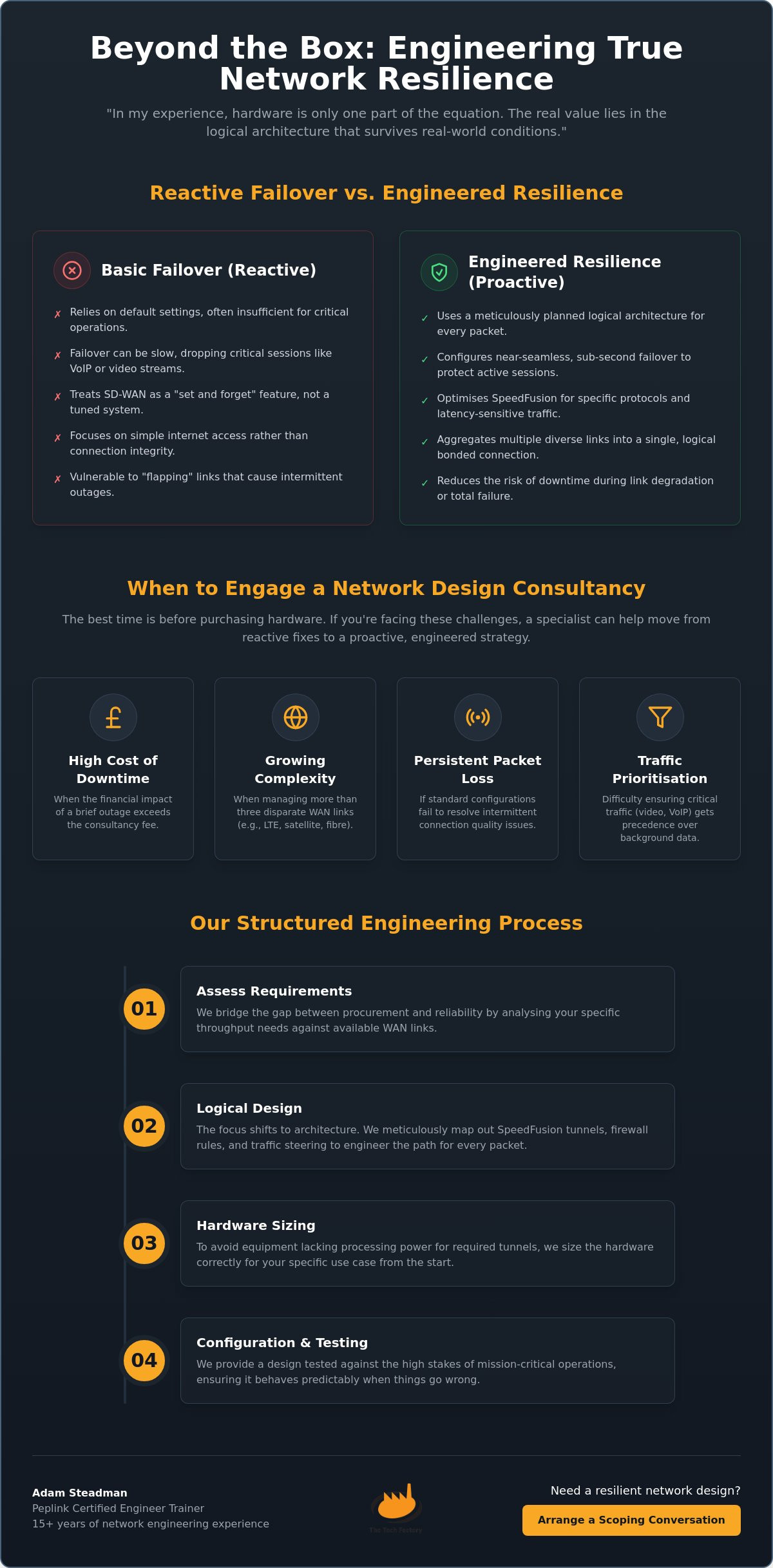
Managing a single fibre line is relatively simple. However, once your team is struggling to manage more than three disparate WAN links, the complexity of traffic steering increases exponentially. This is the stage where a network design consultancy UK becomes vital. We move beyond simple failover, which is reactive by nature, to complex bandwidth bonding. This ensures that your organisation uses every available bit of capacity whilst maintaining a near-seamless connection during link degradation.
Signs your internal team might need specialist support
There are clear technical indicators that a standard configuration is no longer fit for purpose. Persistent packet loss that "standard" setups cannot resolve is a common trigger for our involvement. If your engineers are finding it difficult to prioritise mission-critical traffic, such as live video feeds or emergency communications, over background data, the issue is likely in the logical design. For those reviewing a guide to SD-WAN solutions, it's evident that a lack of visibility into network performance across multiple remote sites is a significant risk factor that requires specialist engineering to solve.
Evaluating your options
When you begin comparing consultancies, I suggest focusing on practitioner experience rather than just partner status. A partner might be proficient at sales, but a specialist understands the behaviour of a Peplink router in a congested maritime or broadcast environment. Look for specialists who offer Peplink deployment services as a core competency. You should ask for specific examples of how they have engineered resilience in environments similar to yours. If you are currently assessing your infrastructure, we can help you audit your current network design to identify potential points of failure before they impact your operations.
Engineered Resilience vs. Basic Failover: A Comparison
Basic failover is a binary state. It waits for a link to die completely before moving traffic to a secondary connection. For mission-critical operations, this reactive approach is often insufficient. A specialist network design consultancy UK provides the technical logic required to move from basic redundancy to proactive resilience. Engineered resilience uses SpeedFusion to aggregate multiple links into one logical pipe. This allows the network to stay ahead of link degradation rather than merely responding to a total outage. In my experience, the difference is most visible during a "brownout" where a link is technically up but performing poorly; a basic setup will struggle, whilst an engineered one will have already steered the traffic elsewhere.
I often see "unbreakable" claims in marketing literature. As an engineer with over 15 years of experience, I find this terminology unhelpful. No network is truly unbreakable; instead, we design systems that significantly reduce the risk of disconnection. A professional design manages latency and jitter across all available links simultaneously. We look at the health of the connection in real-time, ensuring that traffic is steered away from "dirty" links before they fail entirely. This level of control is what separates a professional deployment from a standard router configuration.
The role of SpeedFusion in network design
SpeedFusion bonding allows us to combine disparate technologies, such as cellular, satellite, and fibre, into a single resilient tunnel. This is not just about bandwidth aggregation. It is about creating a stable environment for your data. We configure sub-algorithms to handle different types of link instability, such as the high latency inherent in satellite or the jitter common in congested cellular networks. Proper design ensures that even if one carrier drops, the session remains active. This persistence is vital for operations where a reconnect is not an option, such as remote command and control or live financial data feeds.
Traffic steering and WAN smoothing
WAN Smoothing is a technique that replicates packets across multiple links to mitigate the impact of packet loss. In my view, this is the most critical setting for broadcast and VoIP applications where even a single dropped packet can cause a visible or audible glitch. We design the network to prioritise these smoothed packets over bulk data transfers. This ensures that a background file upload does not compete for resources with a live video feed. By engineering these traffic steering rules, we create a predictable environment for your most sensitive data packets, ensuring they always have the cleanest path to their destination.
Practical considerations for mission-critical UK networks
UK infrastructure presents specific hurdles that a standard configuration cannot address. A network design consultancy UK must account for geographic and environmental variables that vary from the Scottish Highlands to the English Channel. Public safety networks, for instance, require hardware capable of withstanding physical vibration whilst maintaining logical tunnel stability. In these scenarios, the physical environment is as challenging as the electronic one. A vehicle moving at high speed through varying signal zones needs a design that can rapidly re-evaluate link quality. We often integrate multi-WAN network design to ensure diverse carrier paths. This prevents a single network provider's local outage from compromising the entire deployment.
We focus on engineering the tunnel persistence so that encrypted data remains secure and connected, regardless of the physical movement of the unit. This requires a deep understanding of how different UK carriers behave in both urban and rural settings. It is not enough to simply have multiple SIM cards; the design must logically separate traffic to ensure that a failure on one network does not cascade into another.
Designing for the Maritime sector
Offshore connectivity is a unique challenge that requires specialised antenna placement and link prioritisation. It is not just about having a satellite dish. The design must handle the transition between terrestrial LTE and offshore satellite without dropping the session. I have worked on projects where Peplink for superyachts saved thousands in satellite overage fees by intelligently switching to cellular links as soon as they became viable. The design must be capable of near-seamless handover between different satellite providers, managing the handoff between high-latency and low-latency links effectively whilst the vessel is in transit.
Broadcast and Live Events resilience
In broadcast and live media, a single dropped frame can be disastrous. We engineer networks to use "Hot Failover" to keep the stream alive even during a total link failure. For broadcast, the design must account for high-upload requirements in areas with congested cellular towers. During major events, the local masts are often saturated. We mitigate this by bonding multiple carriers and using traffic steering to prioritise the video stream above all else. The design includes remote management via InControl2 to allow for real-time troubleshooting from a central NOC. If you are preparing for a high-stakes deployment, you can contact our team for a network design consultation to ensure your infrastructure is resilient enough for the task.
The Scoping Process: How we engineer your network
Engineering a resilient network requires a methodical approach that avoids the 'best-guess' configuration often found in generalist deployments. Our scoping process is designed to eliminate ambiguity and ensure that every logical path is intentional. As a network design consultancy UK, we prioritise the discovery of your specific operational risks before we even consider the hardware configuration. This prevents the common mistake of building a network that looks good on paper but fails to handle the messy reality of link degradation. We focus on the logic that keeps your organisation connected.
Discovery and Requirement Analysis
We begin by asking a simple question. What is the cost of a thirty-second outage to your organisation? Understanding the financial or operational impact of downtime allows us to determine the exact level of redundancy required. During this phase, we evaluate your existing carrier contracts and current hardware to see what can be repurposed effectively. This is not about selling new equipment; it is about creating a clear roadmap for a deployment that reduces the risk of failure. This phase ensures that the final design is grounded in your actual throughput needs rather than arbitrary data sheet figures.
Once the requirements are clear, we move to the logical design phase. This involves mapping out tunnels, VLANs, and firewall rules to create a secure and efficient traffic flow. I personally oversee the configuration of SpeedFusion to ensure the sub-algorithms align perfectly with your design goals. Whether you are prioritising low-latency voice traffic or high-bandwidth video, the configuration must be precise. We don't rely on default settings. We engineer the tunnels to behave predictably under pressure.
Onboarding and Managed Services
Our involvement does not end with a design document. We assist with the InControl2 onboarding and initial testing to ensure the network performs as expected under real-world conditions. For organisations that require ongoing technical oversight, we offer managed services where our team monitors the health of the network indefinitely. This provides a reliable partner for long-term stability. Finally, we provide technical training to your internal team. We believe in empowering your engineers so they can manage the network day-to-day whilst knowing that a specialist network design consultancy UK is available for high-level architectural support.
Engineering Resilience for Future Operations
Moving beyond basic failover to engineered resilience is the only way to protect mission-critical operations from the unpredictable nature of modern connectivity. Successful deployments rely on the meticulous configuration of logical tunnels and traffic steering rather than just high-end hardware. By prioritising a structured scoping process, you ensure that your network remains stable whilst handling the specific stressors of your industry. A well-designed architecture does not just provide a connection; it provides the predictability required for high-stakes environments.
Choosing a network design consultancy UK allows you to draw on deep practitioner experience. As a Peplink Certified Engineer Trainer with over 15 years of experience in mission-critical connectivity and a role as an advisor to Peplink’s largest global distributor, I have seen how precise engineering reduces the risk of downtime in the most challenging sectors. If you are planning a mission-critical deployment and want to ensure it is engineered for resilience, I invite you to start a scoping conversation with our team. We look forward to helping you build a network where reliability is a deliberate outcome of design.
Frequently Asked Questions
What is the primary benefit of hiring a network design consultancy?
The primary benefit is the transition from a reactive failover setup to a proactive, engineered network. A network design consultancy UK focuses on the logical architecture of your tunnels rather than just the physical installation. This ensures that your traffic is steered across the most stable paths available at any given moment, reducing the risk of a session drop during critical operations.
Does a network design consultant also supply the Peplink hardware?
We supply Peplink hardware as part of our comprehensive service. Whilst our focus is on design and engineering, we ensure that you receive the correct models for your specific throughput and processing requirements. We avoid the common mistake of underspecifying hardware for complex SpeedFusion tunnels, which can lead to performance bottlenecks under heavy load.
Can you help with an existing Peplink setup that is underperforming?
I frequently assist organisations with existing deployments that are failing to meet operational expectations. We perform a thorough audit of your current configuration to identify bottlenecks or logical errors in the tunnel design. In our experience, performance issues are often caused by incorrect SpeedFusion settings or a lack of proper traffic prioritisation rather than hardware failure.
Do you provide on-site support for the networks you design?
We do not provide on-site support for the networks we design. Our team focuses on high-level consultancy, logical design, and remote managed services via InControl2. This approach allows us to monitor the health of your global deployment from our operations centre, providing technical expertise and troubleshooting without the need for physical site visits.
How long does a typical network design consultancy project take?
The duration of a project depends on the complexity of your requirements and the number of sites involved. A typical discovery and logical design phase can take several days to a few weeks. We prioritise a methodical approach to ensure that every aspect of the network is tested against your specific operational risks before the full deployment begins.
Is network design consultancy only for large enterprises?
Specialist consultancy is necessary for any organisation where the cost of a connection drop is high. This includes small broadcast teams, maritime vessels, and public safety units as well as enterprise organisations. If your operations rely on persistent connectivity, the size of your organisation is less important than the technical stakes of a link failure.
What information do I need to provide for a scoping conversation?
You should be prepared to discuss your current wide-area network links and your required throughput for critical applications. I also need to understand the specific environment where the hardware will operate, such as a remote offshore site or a congested urban centre. Providing a clear estimate of the cost of downtime helps us determine the appropriate level of resilience for the design.
Do you offer technical training for our internal IT staff?
We offer technical training for internal IT teams to ensure they can manage the network day-to-day. This training is a core part of our network design consultancy UK service and focuses on the specific logical architecture we have deployed. It covers SpeedFusion monitoring, InControl2 management, and basic troubleshooting procedures to ensure your team feels confident maintaining the system.