
If your failover strategy relies on a simple primary and backup logic, you are likely one outage away from a session drop that stalls your entire operation. Most engineers I speak with are tired of being told their network is redundant, only to watch a critical video feed lag or a remote session freeze the moment a primary fibre link fluctuates. Relying on basic failover is no longer sufficient for mission-critical connectivity. This guide provides a practitioner’s perspective on multi-WAN network design, focusing on how to build architectures that maintain connectivity even in high-stakes environments.
I understand the frustration of managing inconsistent performance across disparate links like 5G and satellite. It is a common pain point that we solve by moving beyond simple load balancing. In this article, I will share how our team engineers resilience by treating multiple physical paths as a single logical pipe. You will learn the technical distinctions between SpeedFusion bonding and standard balancing, the architectural requirements for high availability, and the specific logic needed to ensure your network survives a link failure whilst maintaining near-seamless connectivity for your most important applications.
Key Takeaways
- Understand why a resilient multi-WAN network design prioritises connection stability over raw bandwidth to protect mission-critical operations.
- Learn how to distinguish between load balancing and SpeedFusion bonding to prevent session drops during link fluctuations.
- Identify how to account for environmental factors, such as physical superstructure interference in maritime settings or specific uplink requirements in broadcast.
- Discover how centralised orchestration with InControl2 enables proactive management and real-time troubleshooting of link degradation.
- Recognise why a thorough scoping exercise is the essential first step in ensuring your engineered solution performs as intended in the field.
The Fundamentals of Multi-WAN Network Design
A successful multi-WAN network design integrates two or more independent internet connections into a single, resilient architecture. I have spent over 15 years as a Peplink engineer, and I have found that many organisations focus far too heavily on raw throughput. Whilst speed is a useful metric, the primary goal for mission-critical connectivity must always be resilience. A high-speed connection is of little value if it drops during a live broadcast, a maritime navigation update, or a public safety response. We aren't just looking for more bandwidth; we are looking for the assurance that the network will remain functional when a specific link fails.
A well-engineered design must account for the specific characteristics of disparate link types. In our experience, we often work with a mix of low-earth orbit (LEO) satellite services like Starlink, 5G cellular, and fixed-line fibre. Each of these technologies has its own latency profile, jitter behaviour, and susceptibility to environmental factors. The physical connection is only the foundation. The logical management of those paths determines your actual uptime. This approach is a central tenet of a Software-Defined Wide Area Network (SD-WAN), where the intelligence resides in how traffic is steered across available paths based on real-time health data.
Why Single-WAN Architectures Fail Under Pressure
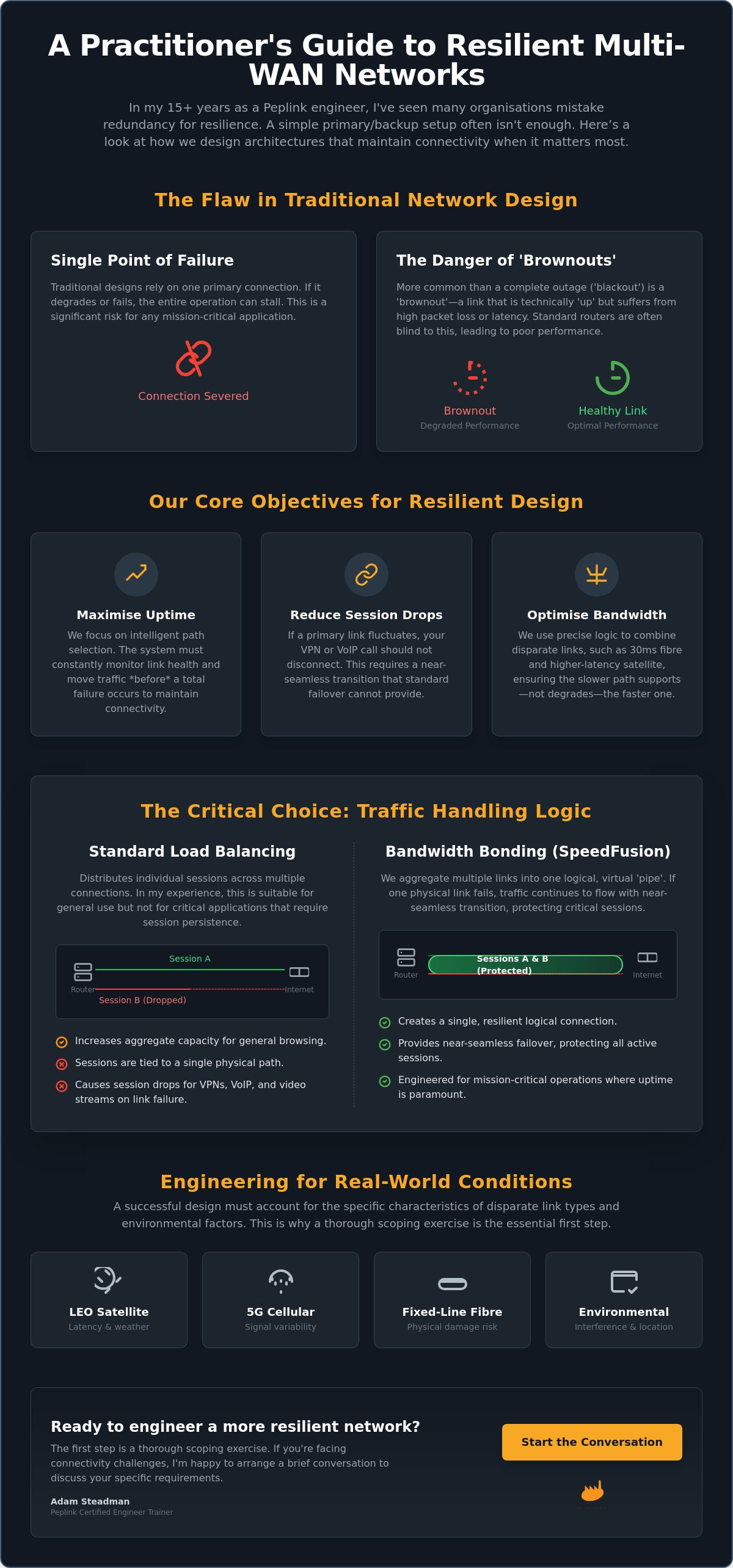
Traditional network designs often rely on a single point of failure. If that one ISP circuit goes dark, the operation stops. However, I often find that a total blackout is easier to manage than what I call a 'brownout'. This occurs when a link remains technically 'up' but suffers from extreme packet loss or fluctuating latency. Traditional routers are typically blind to these conditions. They continue to route traffic into a failing connection because the physical interface has not tripped. In high-stakes environments, this lack of granular visibility leads to inconsistent performance that disrupts critical sessions and stalls productivity.
The Core Objectives of Resilient Design
Our team prioritises three main objectives when architecting a multi-WAN solution. First, we focus on maximising uptime through intelligent path selection. The system must monitor link health constantly and move traffic before a total failure occurs. Second, we aim to reduce the risk of session drops during transitions. If a primary fibre link fluctuates, your VPN or VoIP call should not disconnect. This requires a near-seamless transition between links that standard failover cannot provide. Finally, we work to optimise available bandwidth across high-latency and low-latency connections. Combining a 30ms fibre link with a satellite connection requires precise logic to ensure the slower path does not degrade the performance of the faster one.
Load Balancing vs Bandwidth Bonding: Choosing the Logic
In any multi-WAN network design, the most critical decision involves how the hardware handles traffic flow across available links. I often find that clients assume all multi-WAN routers function identically, but there is a fundamental difference between load balancing and bandwidth bonding. Load balancing distributes individual traffic sessions across multiple connections. For example, one user's web session might go over a Starlink terminal whilst another's file download uses a 5G modem. This is effective for increasing aggregate capacity, but it keeps each session tied to a specific physical path.
In my experience, load balancing is unsuitable for applications that cannot tolerate a change in IP address. If a link fails, the router must reassign the session to a new path with a different public IP. This typically causes a disconnect in VPNs, VoIP calls, or secure banking sessions. If your operation relies on session persistence, you need a different approach. For those interested in broader architectural frameworks, Cisco's SD-WAN design guide provides a detailed look at how these routing decisions impact enterprise-scale deployments.
When to Use Weighted Load Balancing
Weighted load balancing is ideal for general web browsing and non-critical file transfers where cost efficiency is a priority. We configure weights based on the actual capacity and cost of your WAN links. If you have a 1Gbps fibre line and a 100Mbps backup, you would weight the fibre more heavily to ensure it handles the bulk of the traffic. However, this logic struggles with high-jitter cellular connections. When a 5G link becomes congested, a simple balancing algorithm might still send traffic into that bottleneck, leading to inconsistent performance for the end user.
The Case for SpeedFusion Bandwidth Bonding
For high-stakes sectors like broadcast or maritime, we move beyond balancing to Peplink SpeedFusion. SpeedFusion is a technology that aggregates multiple physical links into a single logical tunnel. By working at the packet level rather than the session level, it can split a single stream of data across 5G, LTE, and satellite links simultaneously. This hides link failure from the application layer entirely. If one link drops out, the remaining links carry the packets without the application ever seeing a disconnect. This ensures a near-seamless experience for the most sensitive data traffic. If you are unsure which logic fits your specific use case, our team can provide a tailored network design to suit your requirements.
Engineering for Environmental Constraints and Link Variability
A robust multi-WAN network design must account for the physical realities of the deployment site. It is a straightforward task to design a network for a static office building with clear lines of sight. It is a different matter entirely when the site is a vessel moving through heavy seas or a broadcast van parked in a congested urban centre. In my experience, the physical environment dictates the hardware choice and the logical configuration just as much as the data requirements do. Designing for these constraints requires a deep understanding of how signal attenuation and interference impact different frequencies.
Maritime environments present unique challenges that standard enterprise designs often overlook. Signal blockage from the vessel's own superstructure is a constant factor. If an antenna is shielded by a mast or a radar arch, that specific link will suffer from intermittent packet loss regardless of the reported signal strength. I always recommend a mix of technologies to mitigate this. Typically, we pair LEO satellite services with diverse cellular carriers. This ensures that even if one path is physically obstructed or enters a local dead zone, the logical connection remains stable.
Maritime Connectivity and Superyacht Requirements
Managing the transition from shore-based 5G to offshore satellite links requires precise timing and robust logic. When a vessel leaves port, the cellular signal degrades whilst the satellite link may still be acquiring a clear path. For more on this, see our guide on Peplink for superyachts. We often find that vessel movement itself impacts signal stability. Antenna placement must be engineered to maintain a connection even as the hull pitches and rolls. This necessitates a design that can aggregate multiple paths to compensate for momentary dropouts caused by the vessel's orientation.
Broadcast and Live Event Resilience
In broadcast scenarios, the priority is almost always uplink stability over download speed. A jittery 100Mbps connection is less useful than a rock-solid 10Mbps pipe for a live stream. We use SpeedFusion WAN Smoothing to reduce the risk of packet loss. This technology sends duplicate packets across multiple links, ensuring that if one path fluctuates, the duplicate packet arrives via another. Diverse carrier selection is more important than the total number of modems used. Having four modems on the same network provides little protection if that specific carrier's local mast is congested. We also rely on Hot Failover to maintain a constant feed. This ensures a near-seamless transition between links without human intervention, protecting the integrity of the live broadcast.
The Role of Orchestration in Complex WAN Environments
Centralised management is not a luxury; it is a requirement for maintaining complex networks. If you are managing a single site, a local web interface might suffice. However, for any sophisticated multi-WAN network design involving multiple vessels, broadcast vehicles, or enterprise branches, local management becomes a bottleneck. We use Peplink InControl2 to provide the visibility needed to troubleshoot link degradation in real time. I use this orchestration layer to push configuration changes across entire fleets without manual intervention. This ensures that every device in the organisation adheres to the same performance standards. It also allows us to react to network-wide issues in seconds rather than hours.
Visibility into signal quality and data usage is paramount when dealing with multiple cellular and satellite providers. Without a centralised view, it is nearly impossible to prevent bill shock from roaming cellular links or to identify which specific carrier is underperforming in a given region. In my experience, a well-orchestrated network is a visible network. We use these tools to move from a reactive "break-fix" model to a proactive stance where we can identify link degradation before it impacts the end user. If your team requires specialist assistance with InControl2 onboarding or managed services, we can provide the engineering support needed to secure your deployment.
Monitoring Link Health and Performance
We track latency, jitter, and packet loss across every WAN path simultaneously. This level of granularity allows us to see exactly how a 5G link is performing relative to a satellite connection in real time. We set up automated alerts for link failure or excessive data consumption to ensure the team is notified the moment a connection deviates from its baseline. By using historical data, we can identify patterns in ISP performance. If a specific provider consistently fails in a certain port or broadcast location, we adjust our routing logic to deprioritise that link automatically. This data-driven approach reduces the risk of unexpected downtime.
Remote Configuration and Firmware Management
Standardising SpeedFusion settings across multiple devices ensures consistent behaviour across the entire network. I find that manual configuration often leads to human error, which can compromise the resilience of the deployment. We prioritise scheduled firmware updates to maintain security and feature parity across the fleet, pushing these updates during maintenance windows to avoid operational disruption. For clients with specific visibility requirements, we build custom management portals that pull data from the orchestration API. This provides a simplified, high-level view of network health whilst maintaining the ability to drill down into specific technical metrics when required.
Moving from Theory to a Deployed Multi-WAN Solution
Hardware is a commodity. Engineering is the differentiator. I have seen many organisations purchase high-end routers only to suffer the same connectivity issues they had with consumer-grade gear. This happens because the physical hardware is only one component of a successful multi-WAN network design. The real work lies in the engineering and consultancy required to make that hardware perform as intended under pressure. A successful deployment begins with a thorough scoping exercise that moves beyond simple bandwidth requirements to address the specific environmental and logical constraints of your operation.
We focus on building architectures that are fit for purpose from day one. Our team provides specialised Peplink deployment services to ensure your architecture is sound and your logical tunnels are optimised for your specific traffic types. Training your internal staff is the final step in this process. It ensures long-term operational success by giving your team the tools to manage and troubleshoot the network without constant external reliance. A resilient network is not just about the technology; it is about the competence of the people managing it.
The Scoping and Design Process
In my experience, the scoping phase is where the most critical decisions are made. We begin by evaluating your current pain points, such as frequent session drops or inconsistent performance across disparate links. We then define the required level of resilience. This involves selecting the appropriate Peplink hardware based on actual throughput needs and the number of physical WAN ports required. We create a detailed network diagram that accounts for every failover path and logical tunnel. This blueprint serves as the foundation for the entire deployment, ensuring that there are no overlooked single points of failure in the physical or logical layers.
Validation and Technical Training
Testing the failover behaviour under simulated link failure is a non-negotiable part of our process. We don't wait for a real-world outage to see how the network reacts. By deliberately disconnecting links and monitoring the SpeedFusion tunnel's response, we verify that the transition is near-seamless for the end user. Once the technical validation is complete, we provide your team with the knowledge to manage the network via InControl2. This includes setting up custom dashboards and automated alerts. We ensure the deployment meets the specific demands of your industry standards, whether you are operating in the maritime, broadcast, or public safety sector.
Securing Your Mission-Critical Architecture
Building a resilient network is a deliberate engineering choice. It requires moving beyond simple primary and backup thinking to a more sophisticated multi-WAN network design. In my experience, the most successful deployments prioritise logical stability and packet-level bonding over raw bandwidth metrics. Whether you are operating in the maritime, broadcast, or public safety sector, your connectivity must be engineered to survive link degradation without interrupting critical sessions.
As a Peplink Certified Engineer Trainer with over 15 years of experience, I have advised some of the world's largest distributors on complex network architectures. Our team specialises in the consultancy and network design required to make these technologies perform in high-stakes environments. We don't just provide hardware; we provide the technical mastery needed to ensure your deployment remains functional when a single path fails. If you are ready to move from a reactive setup to an engineered solution, I invite you to book a scoping conversation with our engineering team. We look forward to helping you build a network that stands up to the pressure of your specific operational needs.
Frequently Asked Questions
What is the difference between multi-WAN and SD-WAN?
Multi-WAN refers to the hardware's ability to terminate multiple internet connections physically. SD-WAN is the management layer that uses software to control those links intelligently. In a professional multi-WAN network design, SD-WAN provides the orchestration and path selection needed to handle traffic across disparate connections efficiently.
Can I use different ISPs for my multi-WAN network design?
Using different ISPs is a fundamental requirement for true redundancy. We always advise clients to mix carriers and technologies, such as combining a terrestrial fibre link with 5G and LEO satellite. This diversity reduces the risk of a single provider's core network failure impacting your entire operation.
How does bandwidth bonding improve my internet speed?
Bandwidth bonding combines the capacity of multiple links into a single logical connection. Whilst this increases the total throughput available for a single stream, its real value lies in stability. By aggregating links, we create a larger pipe that is more resilient to the fluctuations of any individual connection.
Is multi-WAN failover truly seamless for video calls?
Standard failover is rarely seamless for video calls because the public IP address changes, forcing the session to restart. To achieve near-seamless transitions, we use SpeedFusion Hot Failover or bonding. This keeps the call active by maintaining the session on a single logical IP even if a physical link drops.
What happens if all my WAN links fail simultaneously?
If all WAN links fail, external connectivity will cease. However, we engineer our designs to make this scenario highly unlikely by using diverse paths like satellite and cellular. In such a case, local network traffic continues to function, but mission-critical cloud or remote services will be unreachable until a link is restored.
Do I need a static IP for a multi-WAN setup to work?
You don't need a static IP on every WAN link. However, a static IP is typically required at the aggregation point, such as a FusionHub in a data centre. This allows the remote multi-WAN network design to establish a persistent tunnel, providing a single stable IP for all your outbound and inbound traffic.
How much bandwidth is lost to overhead when using SpeedFusion?
SpeedFusion typically introduces an overhead of approximately 15% to 20%. This is due to the packet encapsulation and encryption required to bond multiple links into a single tunnel. In our experience, this is a necessary trade-off for the resilience and session persistence that mission-critical environments require.
Is it possible to prioritise specific traffic over a particular WAN link?
Prioritising specific traffic is a core feature of an engineered WAN. We use outbound policies to steer sensitive data, like VoIP or live video, over the most stable or lowest-latency links. Less critical traffic, such as background updates, can be restricted to higher-latency paths to preserve bandwidth for primary tasks.