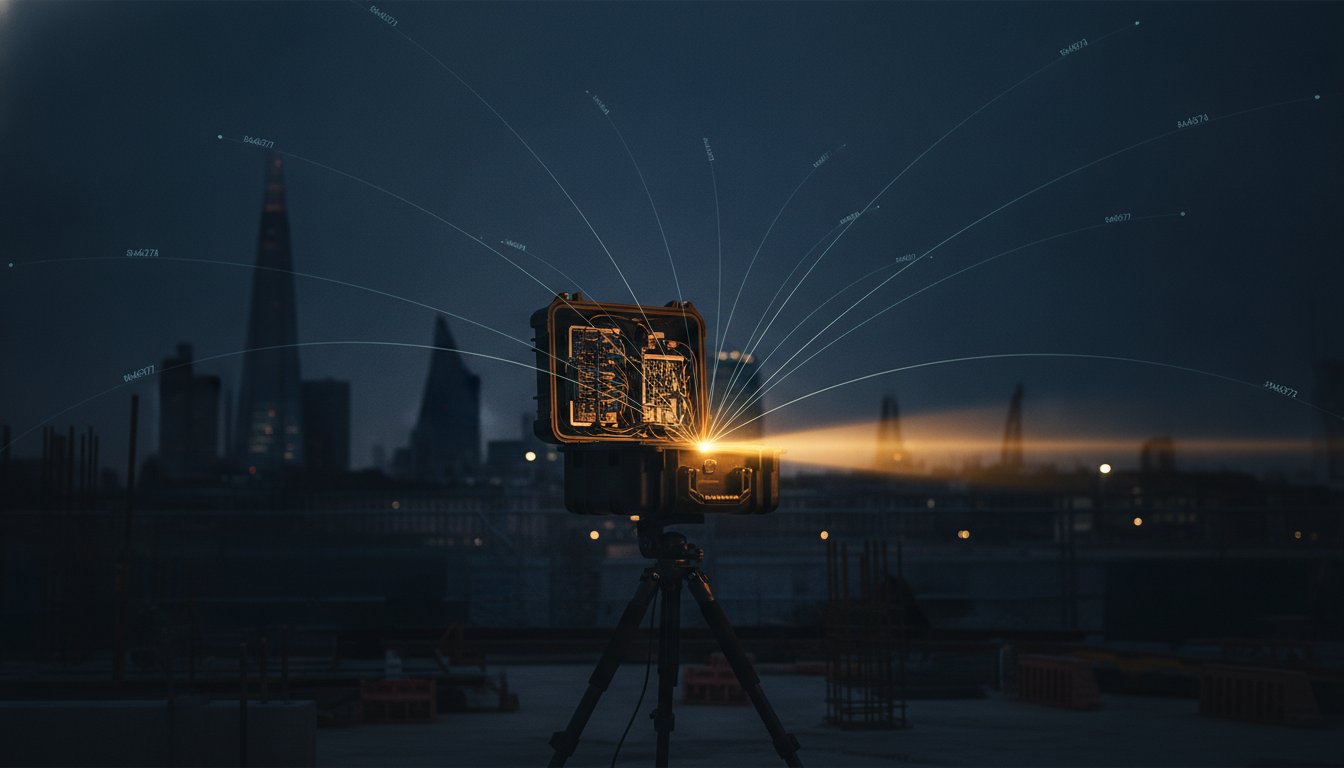
A single 5G connection is never enough for a mission-critical event. I've seen too many projects stumble because they relied on a consumer-grade router that couldn't handle local cellular congestion or signal drop-outs. When you're operating in a high-pressure environment, whether it's a live broadcast or a short-term construction site, the cost of network failure is simply too high. This is why our team prioritises the use of SD-WAN for temporary deployments to provide a level of stability that a single link cannot offer.
You likely recognise that standard cellular signals often become unreliable in crowded or remote areas just when you need them most. In this guide, I will explain how to engineer a network that remains resilient under pressure without waiting months for a fixed fibre installation. I'll share our approach to building networks that aggregate multiple cellular and satellite links into one logical connection. We will look at how SpeedFusion technology helps to reduce the risk of downtime and provides the centralised visibility required to manage remote sites effectively whilst maintaining fast deployment times.
Key Takeaways
- Understand why relying on a single cellular link is a risk and how SD-WAN for temporary deployments mitigates this through multi-carrier bonding.
- Learn how SpeedFusion aggregates disparate links into a single, logical connection to maintain throughput during peak network congestion.
- Discover the practical steps for site preparation, including why I consider high-gain external antennas and RF surveys to be non-negotiable.
- Explore how we design resilient networks for high-stakes scenarios such as outside broadcasts and mobile command centres.
- See how technical training for your on-site engineering staff helps ensure stability and faster troubleshooting during short-term projects.
The Engineering Challenges of Temporary SD-WAN Deployments
Temporary SD-WAN is often misunderstood as simply placing a router in a flight case. In my experience, it is a specific discipline within the broader Software-Defined Wide Area Network (SD-WAN) field that prioritises rapid deployment and high resilience over long-term fixed infrastructure. We define SD-WAN for temporary deployments as an engineered solution designed to provide stable connectivity in environments where traditional terrestrial links are either unavailable or impractical to install. It requires a practitioner's mindset to navigate the variables of a site that may only exist for a few days or weeks.
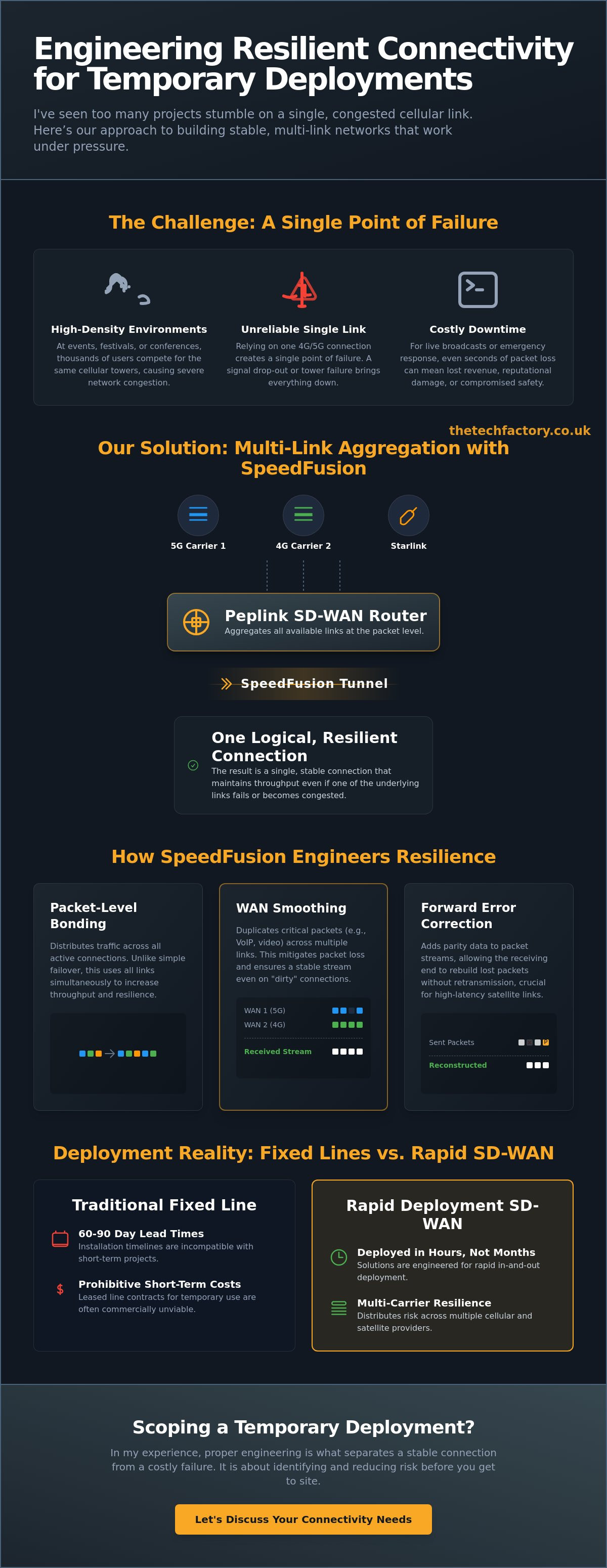
The primary hurdle we face is the inherent unpredictability of cellular and satellite backhaul. Unlike a controlled data centre environment, a temporary site relies on shared public infrastructure. This makes the network vulnerable to signal fluctuations and capacity issues. Many organisations attempt to use standard failover, but this is insufficient for mission-critical operations. If one link fails, the time taken for a secondary link to take over often causes a session drop. In high-stakes environments like live broadcasting or emergency response, even a few seconds of packet loss can be catastrophic. Our team focuses on engineering out these vulnerabilities from the start.
Why Fixed Lines Often Fail the Temporary Test
Traditional fibre installations are rarely compatible with the "rapid-in, rapid-out" nature of short-term projects. Lead times for fibre often stretch to 60 or 90 days; this is a timeline that most event organisers or construction firms simply do not have. The commercial reality is that short-term leased line contracts are often prohibitively expensive. In greenfield locations, the physical infrastructure might not exist at all. This leaves engineers with no choice but to rely on wireless technologies that must be bonded to achieve the necessary reliability.
The Risk Profile of Short-Term Connectivity
The consequences of downtime vary by sector, but they are always costly. In the broadcast world, a dropped feed means lost revenue and reputational damage. For emergency services, a loss of connectivity can hinder public safety efforts. We must also account for signal congestion. At a large festival or conference, thousands of users compete for the same cellular towers. This creates a high-density environment where a single 4G or 5G modem will likely struggle. Our approach focuses on reducing the risk of a single-point failure by distributing traffic across multiple carriers and technologies simultaneously; this ensures that the failure of one provider does not result in a total loss of service.
Core Technologies for Rapid SD-WAN Deployment
Building a network on the move requires more than just a collection of modems. It demands a sophisticated orchestration layer that can handle the volatility of wireless backhaul. In my work as a Peplink consultant, I rely on SpeedFusion to act as the primary engine for resilience. Unlike standard solutions that focus on office-based cost-savings, SpeedFusion is designed to aggregate multiple links into one logical, resilient connection. This is the cornerstone of effective SD-WAN for temporary deployments.
The strength of this approach lies in multi-carrier cellular bonding. By combining different network providers, we ensure that a local tower failure or carrier-specific congestion doesn't bring down the entire link. It's a level of redundancy that mirrors the requirements of a global battle management network; where connectivity must be maintained regardless of the environment. We aren't just switching between links; we're using them all at once to maintain throughput.
The Mechanics of SpeedFusion Bonding
True bonding happens at the packet level. This is a critical distinction from simple load balancing, which often fails when a session is interrupted. When I configure a system, I combine diverse inputs such as LTE, 5G, and Starlink into a single bonded tunnel. If one path experiences high latency or packet loss, SpeedFusion re-routes individual packets across the remaining healthy links. To protect sensitive traffic like VoIP or live video, we use WAN Smoothing and Forward Error Correction (FEC). These technologies duplicate packets or add parity data to mitigate the effects of jitter, ensuring a stable stream even on "dirty" connections. If you're unsure which configuration fits your specific use case, our team can assist with SpeedFusion configuration to optimise your setup.
Centralised Visibility and Management
Speed is just as important as stability when dealing with short-term sites. We use Peplink InControl2 to manage the entire lifecycle of a deployment. This cloud-based platform allows us to pre-configure devices before they even arrive on-site. Once the hardware is powered up, it downloads its profile and establishes the bonded tunnel automatically. I can then monitor real-time link health, signal quality, and data usage from a central dashboard. This visibility is vital for troubleshooting. Instead of flying engineers to remote sites, we can diagnose RF issues or carrier throttling remotely, ensuring the network stays performant throughout the event's duration.
A Roundup of High-Stakes Temporary Scenarios
In my 15 years as an engineer, I've found that the specific demands of a site dictate the network architecture. SD-WAN for temporary deployments isn't a static concept; it's a flexible framework tailored to the environment. Whether it's a festival field or a disaster zone, the stakes remain high and the room for error is non-existent. We don't just provide hardware; we design for the specific risk profile of the operation. This approach ensures that the network supports the mission rather than becoming a point of failure.
Outside Broadcast and Live Media
Live media teams operate in a world where a black screen is a professional catastrophe. Managing high-bitrate video uploads over aggregated cellular links requires a deep understanding of how to mitigate packet loss. By utilising cellular bonding for broadcasting, we can create a stable uplink even whilst moving or in remote fields. This reduces the risk of transmission failure by spreading the data load across multiple carriers. In our experience, this is the only way to ensure a consistent feed when local tower congestion would otherwise throttle a single connection.
Construction and Civil Engineering
Site offices often need to be operational before the first brick is laid. Providing immediate access to Building Information Modelling (BIM) and project data is essential for modern construction. Our Peplink deployment services are designed to scale rapidly from a single site office to a multi-site project. We focus on building a cellular-first infrastructure that allows for a near-seamless transition to permanent fibre once it becomes available. This removes the reliance on long-lead fixed lines and keeps the project timeline on track.
Emergency Response and Mobile Command
First responders and public safety agencies require an "office-in-a-box" solution that works anywhere, regardless of the local infrastructure's state. These mobile command centres must handle encrypted, reliable communications under extreme pressure. We engineer these systems to integrate satellite and cellular backhaul, ensuring coverage in the most remote areas. By combining these technologies, we create a resilient communication hub that reduces the risk of isolation during a crisis. It's a pragmatic application of SD-WAN that prioritises stability and rapid provisioning when every second counts.
Pop-up retail and large-scale events face similar challenges but with a focus on transactional data. Handling high volumes of secure payments requires a network that can manage traffic spikes whilst maintaining strict security protocols. We design these networks to isolate payment traffic from general-purpose guest Wi-Fi, ensuring that the core business operations remain unaffected by public usage patterns.
Designing for Resilience: Practical Implementation Tips
Software configuration is only one part of a successful deployment. In my experience, the physical environment of a temporary site often presents the greatest risk to connectivity. When engineering SD-WAN for temporary deployments, I focus as much on the RF environment and power stability as I do on the SpeedFusion tunnel settings. If the physical layer is weak, the most sophisticated bonding algorithms will struggle to maintain throughput. We treat every site as a unique engineering challenge that requires a hands-on approach to hardware placement and environmental protection.
The Importance of a Site Survey
A few "bars" on a mobile phone display do not constitute a professional site survey. For mission-critical work, I require a detailed analysis of all available UK mobile networks, including EE, Vodafone, Three, and O2. We look for the signal-to-noise ratio (SNR) and RSRQ values rather than simple signal strength. This allows us to identify potential sources of interference or physical obstructions that could degrade performance during the event. Identifying these variables early means we can adjust our antenna strategy or carrier mix before the first data packet is sent.
Physical Hardening of the Deployment
Temporary sites are rarely kind to networking hardware. Equipment is often housed in outdoor enclosures, flight cases, or unconditioned spaces where thermal management becomes a priority. I always recommend securing hardware in ruggedised cases to protect against transit damage and environmental exposure. Cable management is equally vital; in high-traffic areas, a single snagged Ethernet cable can take down a critical node. To mitigate this, we use locking connectors and clear labelling to ensure the physical integrity of the network.
Power stability is another frequently overlooked factor. Site generators are notorious for voltage fluctuations and surges that can cause hardware to reboot or fail. I mitigate this by using high-quality uninterruptible power supplies (UPS) and, where possible, redundant power inputs on the Peplink devices themselves. This layered approach to physical resilience ensures that the network remains stable even when the local infrastructure is under strain. If you require assistance in planning these hardware requirements, we provide expert network design services to ensure your deployment is engineered for the specific conditions of your site.
Scoping Your Temporary Deployment with The Tech Factory
Engineering a network that withstands the pressures of a live event or a remote site requires more than just high-end hardware. It requires a methodical approach to design. When we discuss SD-WAN for temporary deployments, we aren't just talking about routers. We're discussing a comprehensive strategy that encompasses everything from carrier selection to thermal management. My role is to act as a specialist advisor, ensuring that the architecture we build is fit for purpose and remains resilient under load. We don't believe in off-the-shelf solutions for mission-critical tasks; we believe in engineered results.
Our Engineering Credentials
I've spent over 15 years in this field. As a Peplink Certified Engineer Trainer, I've seen the difference that proper, practitioner-led configuration makes to a project's success. Our team at The Tech Factory acts as a consultancy and advisor to Peplink’s largest global distributor, focusing on the high-level design work that generalist providers often overlook. This includes bespoke software development, managed services, and technical training for your own on-site engineering staff. Training is particularly valuable for temporary sites. It empowers your team to handle minor environmental shifts or carrier issues without needing external assistance, which is vital when you're operating in a time-sensitive environment.
Next Steps for Your Project
A scoping conversation is the first step toward a stable network. We start by understanding your specific throughput requirements, the physical constraints of your site, and your tolerance for risk. We don't use high-pressure tactics or manufactured urgency. Instead, we offer a calm, technical assessment of your needs. From there, we move into a fully engineered design phase. This process involves precise SpeedFusion configuration and InControl2 onboarding to ensure that when your team arrives on-site, the network is ready to perform. Our goal is to provide measured advice that reduces the risk of downtime and keeps your operations connected.
If you are planning a project that requires robust, short-term connectivity, I invite you to have a brief scoping conversation with us. We can discuss your specific requirements and how our consultancy, network design, and managed services can support your deployment. Please get in touch to arrange a technical consultation regarding your connectivity needs.
Engineering Resilience for Your Next Deployment
Resilience in a temporary network is not a feature you simply toggle on; it is the result of meticulous planning and technical mastery. We have explored how multi-carrier bonding through SpeedFusion reduces the risk of downtime whilst maintaining throughput in high-density areas. Success depends on treating the physical layer with the same seriousness as the software configuration, from antenna placement to stable power management. When designing SD-WAN for temporary deployments, the focus must always remain on eliminating single points of failure before the first packet is sent.
I've spent 15 years as an engineer solving these specific connectivity challenges in the field. As a Peplink Certified Engineer Trainer and specialist advisor to global distributors, I lead a team that prioritises technical competence over marketing promises. We're here to ensure your short-term project has the robust foundation it requires. Contact me today to discuss scoping your temporary Peplink deployment. I look forward to helping you engineer a network that stays connected when the stakes are at their highest.
Frequently Asked Questions
How quickly can an SD-WAN for temporary deployment be set up?
In my experience, the initial configuration of SD-WAN for temporary deployments is often completed before the hardware leaves our lab. By using Peplink InControl2, we pre-provision the settings so that on-site setup involves little more than mounting antennas and connecting power. Physical deployment typically takes less than an hour, provided the site survey has already identified the optimal mounting locations for cellular reception.
Can I use multiple SIM cards from different networks in one router?
Yes, and I strongly recommend using a mix of carriers like EE, Vodafone, and Three to ensure network diversity. By using SIMs from different providers, we reduce the risk of a single network outage or local tower congestion impacting your entire connection. This carrier-agnostic approach is a fundamental part of how we engineer resilient links for short-term projects where failure is not an option.
What happens if one of the bonded cellular links fails during a live event?
If a link fails, SpeedFusion technology re-routes traffic at the packet level across the remaining active connections. This process is designed to be near-seamless, meaning active sessions like video streams or VoIP calls generally continue without dropping. In our experience, this provides a significantly higher level of stability than standard failover, which often requires a full session reset when a link drops.
Is SD-WAN secure enough for handling sensitive data at a pop-up site?
Security is built into the architecture through 256-bit AES encryption within the SpeedFusion tunnel. This ensures that all data moving between your temporary site and your head office or cloud environment is protected. We often configure these tunnels to isolate sensitive transactional traffic from guest Wi-Fi networks, maintaining a high level of security even in public or high-traffic event spaces where data integrity is paramount.
Do I need special antennas for a temporary SD-WAN deployment?
In my work, I consider high-gain external antennas to be non-negotiable for mission-critical environments. Internal antennas are often insufficient when hardware is placed inside flight cases or metal-clad site offices. We select antennas based on the specific RF environment identified during the site survey, focusing on MIMO configurations that maximise throughput and signal quality in challenging locations where signal penetration is poor.
How does SpeedFusion bonding differ from standard load balancing?
Standard load balancing distributes different sessions across different links, but a single large file transfer or video stream is still limited to the speed of one link. SpeedFusion bonding aggregates multiple links into one logical connection. This allows a single high-bandwidth application to use the combined capacity of all available links whilst protecting the session from the failure of any individual path during the deployment.
Can I integrate Starlink with my temporary Peplink SD-WAN setup?
We frequently integrate Starlink as a backhaul link alongside cellular connections within an SD-WAN framework. By bonding satellite and cellular links together, we mitigate the high latency or occasional obstructions associated with satellite whilst benefiting from its high download capacity. This hybrid approach is particularly effective for remote sites where cellular coverage might be inconsistent or limited to a single carrier.
What kind of technical support do we provide for temporary deployments?
Our team provides technical consultancy, network design, and SpeedFusion configuration to ensure your deployment is engineered correctly from the start. We also offer remote monitoring via InControl2 to help diagnose issues in real-time. For organisations with their own staff, I provide Peplink technical training to ensure your engineers have the skills to manage and troubleshoot the network effectively on-site without needing external assistance.