
Redundancy is not a strategy; it is merely a starting point. In my 15 years as a Peplink consultant, I have seen many deployments fail not because the hardware was inadequate, but because the underlying architecture lacked the necessary rigour to handle real-world conditions. Adopting professional Peplink network design best practices requires moving beyond basic connectivity to engineer for true mission-critical resilience. Whilst a simple failover might suffice for a small office, it is rarely enough for high-stakes environments like broadcast or maritime operations where even a brief interruption has significant consequences.
I understand the frustration of dealing with unpredictable cellular performance or the perceived complexity of SpeedFusion orchestration. We often see engineers struggle with a lack of visibility into remote deployments, leading to reactive fixes rather than proactive stability. This article serves as a practitioner's guide to architecting robust Peplink SD-WAN environments that prioritise performance over simple uptime. I will outline the blueprint for a resilient network, detail the hardware requirements for modern standards like Wi-Fi 7, and explain how to configure logical connections that reduce the risk of mid-operation disconnects.
Key Takeaways
- Learn why resilient architecture must be engineered before hardware is selected to ensure stability in broadcast and maritime sectors.
- Implement Peplink network design best practices by integrating diverse links, such as Starlink and 5G, to create a robust logical connection.
- Determine whether the Balance series or the MAX series is better suited for your specific deployment based on environmental rigours and throughput needs.
- Optimise SpeedFusion configurations to prioritise link stability and near-seamless failover, ensuring performance remains consistent during operation.
- Understand why centralised visibility through InControl2 and a rigorous scoping process are vital for managing complex remote deployments.
The Philosophy of Resilient Peplink Network Design
Design is not a secondary phase that follows hardware procurement. In high-stakes environments, the architecture of the network is the primary factor that determines whether a deployment succeeds or fails. I have found that the most common point of failure in remote connectivity is not the hardware itself, but a fundamental lack of link diversity. Adhering to Peplink network design best practices requires a shift in mindset; we must move away from viewing connectivity as a single pipe and instead treat it as a managed ecosystem of disparate paths.
For my clients in the broadcast and maritime sectors, mission-critical means that a disconnection is not merely an inconvenience; it is a catastrophic failure. A live television feed dropping or a vessel losing its primary navigation data has immediate financial and safety implications. To mitigate this, we move beyond simple failover, where one link sits idle until another fails. Instead, we utilise SpeedFusion to create an active-active environment. This approach is a core component of a modern Software-Defined Wide Area Network (SD-WAN), where multiple physical links are aggregated into a single logical connection to provide increased stability and throughput.
Understanding the Risk of Single-Vendor Reliance
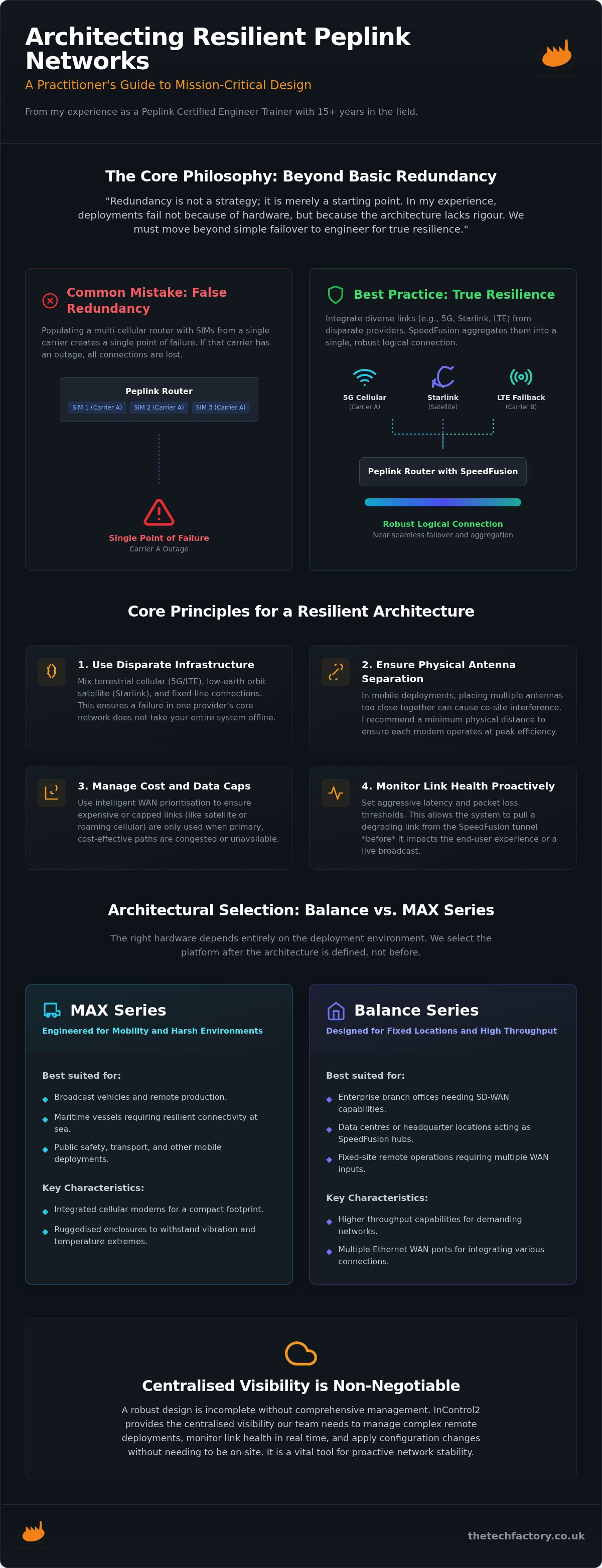
A frequent error I see in the field is the assumption that multiple modems equate to redundancy. If you populate a multi-cellular router with four SIM cards from the same carrier, you have not built a resilient system. You have simply created four ways to access a single point of failure. If that carrier suffers a regional outage or a local mast becomes congested, your entire operation goes dark. In my experience, true resilience requires disparate infrastructure providers. A robust design should mix terrestrial cellular networks with low-earth orbit satellite services and fixed-line connections where available. This ensures that a failure in one provider's core network does not bypass your redundancy measures.
Beyond Connectivity: Designing for Uptime
I avoid using marketing terms like "unbreakable" or "zero-latency" because they don't reflect the reality of RF environments. We focus on being "engineered for resilience" instead. This involves a cold assessment of your primary, secondary, and tertiary link requirements. Peplink network design best practices dictate that you must balance the desire for high throughput with the absolute necessity of stability. For instance, whilst a 5G connection might offer impressive bursts of speed, a secondary Starlink connection or a stable LTE link provides the essential baseline that keeps the SpeedFusion tunnel alive when the 5G signal fluctuates. We design for the worst-case scenario, not the best-case one.
Core Principles of Link Diversity and WAN Optimisation
True resilience is achieved when we eliminate common points of failure across the entire signal path. Integrating cellular, satellite (such as Starlink), and fixed-line connections effectively requires a deep understanding of how these technologies interact within a SpeedFusion tunnel. Whilst Starlink offers significant capacity, its susceptibility to atmospheric conditions or physical obstructions means it should rarely be the sole mission-critical link. We treat it as a high-bandwidth component of a broader multi-WAN strategy, ensuring that terrestrial links remain active to handle the logical connection if the satellite signal fluctuates.
Physical separation in antenna design is often overlooked in mobile deployments. Placing multiple antennas in a single, confined space can lead to co-site interference, which significantly degrades performance. I recommend a minimum physical distance between elements to ensure each modem operates at peak efficiency without being desensitised by its neighbour. This physical layer consideration is just as vital as the software configuration when following Peplink network design best practices.
Managing data caps and roaming costs is a reality of global deployments. We use intelligent prioritisation to ensure that expensive or capped links are only utilised when primary paths are congested or unavailable. By approach link health monitoring pre-emptively, we can set aggressive latency and packet loss thresholds. This allows the system to pull a degrading link from the aggregated tunnel before it impacts the end-user experience or the stability of a broadcast feed.
Carrier Selection and Regional Variations
Selecting carriers based on price is a common mistake that I see in the field. We evaluate carriers based on their local infrastructure and the specific frequency bands they utilise in a target region. For maximum coverage, I always recommend a strategic mix of 4G and 5G. Whilst 5G provides the throughput necessary for high-definition video, the lower frequency bands of 4G (such as 800MHz) provide the essential range needed when operating in rural or coastal areas. Testing signal strength amongst different bands during the scoping phase is non-negotiable.
Optimising WAN Performance Under Pressure
In congested environments like busy ports or crowded venues, raw throughput often becomes secondary to packet delivery. High latency or jitter can destroy a real-time broadcast feed even if the bandwidth appears sufficient. To mitigate this, we use WAN Smoothing, which duplicates packets across multiple links. This process ensures that if one link drops a packet, another carries the duplicate to the destination, maintaining a smooth stream. If you require assistance with these complex configurations, our team offers specialist network design and consultancy to ensure your deployment is engineered correctly from the start.
Architectural Selection: Balance vs MAX Series for Your Design
Selecting the correct hardware series is a foundational step in Peplink network design best practices. It is not merely a matter of comparing port counts or maximum throughput figures on a datasheet. I often see designs fail in the field because the router's CPU cannot handle the SpeedFusion overhead when multiple high-bandwidth links are bonded. Encryption and packet-level aggregation require significant processing power; if you over-provision modems without considering the central processor, you will create a bottleneck that negates the benefits of link diversity.
When we evaluate modem density requirements, we look at the specific use case. A maritime vessel operating in international waters has different requirements to a regional office. In my experience, it is better to have fewer, high-quality links that the hardware can comfortably manage than to saturate a low-power device with multiple cellular connections it cannot effectively bond. We must match the hardware's routing capacity with the expected SpeedFusion throughput to ensure the logical connection remains stable under heavy load.
Fixed-Site Designs: The Balance Series
The Peplink Balance series is primarily engineered for fixed-site enterprise hubs and data centre environments. In a typical hub-and-spoke architecture, the Balance router acts as the central termination point for SpeedFusion tunnels coming from remote sites. These devices are designed to integrate with existing firewall and switch infrastructure, often sitting behind a primary security appliance. For mission-critical resilience, we always recommend High Availability (HA) pairing. This involves deploying two identical Balance routers in a master-slave configuration; if the primary unit fails, the secondary takes over the traffic almost immediately, which reduces the risk of prolonged downtime for the entire organisation.
Mobile and Remote Operations: The MAX Series
For operations that move, the MAX series is the industry standard. These routers are engineered for the rigours of maritime and mobile broadcast, featuring ruggedised chassis that can withstand vibration, extreme temperatures, and power fluctuations. Models like the MAX HD4 or the newer 5G-capable variants are frequently deployed in outside broadcast trucks where reliability is paramount. In maritime designs, we often integrate Starlink as a primary WAN source via the Ethernet port, whilst using the internal cellular modems to provide the essential stability that satellite connections sometimes lack. This hybrid approach, combined with the MAX series' ability to handle DC power directly, makes it the definitive choice for remote deployments where a standard rack-mounted router would fail.
If you are unsure which architectural path fits your specific requirements, our team is available for a network design scoping session to help you select the most appropriate hardware for your environment.
SpeedFusion and InControl2 Configuration Best Practices
Configuration is where the theoretical design meets the harsh reality of the field. Whilst Peplink's marketing often highlights the simplicity of SpeedFusion, a mission-critical deployment requires far more than a simple setup. I have found that stability must always be prioritised over raw speed. In a live broadcast or maritime environment, a consistent, low-jitter logical connection is infinitely more valuable than a high-bandwidth link that suffers from frequent packet re-ordering or drops. Adhering to Peplink network design best practices at the logic layer ensures that the aggregated tunnel can withstand the fluctuations inherent in cellular and satellite paths.
Our team prioritises meticulous documentation of every configuration change. In a complex SD-WAN fabric, knowing exactly why a specific sub-tunnel was created or why a firewall rule was implemented is vital for long-term maintenance. We also implement granular firewall rules to protect the SD-WAN fabric itself, ensuring that only authorised traffic can traverse the SpeedFusion tunnels. This level of detail reduces the risk of configuration drift and simplifies the troubleshooting process when remote engineers are on-site. If your project demands this level of precision, our team can assist with SpeedFusion configuration to ensure your tunnels are engineered correctly.
Fine-Tuning SpeedFusion for Real-World Conditions
Properly adjusting MTU and MSS settings is a critical step that many generalist installers overlook. In cellular networks, the additional overhead of SpeedFusion headers can lead to packet fragmentation if the MTU is left at the default 1500. I typically recommend lowering the MTU to 1440 or 1400, depending on the carrier, to ensure packets are transmitted efficiently without being split. We configure Hot Failover to ensure near-seamless transitions between links. By using sub-tunnels, we can segregate different types of network traffic; this allows us to apply WAN Smoothing to high-priority broadcast feeds whilst leaving bulk data transfers on a standard bonding profile to conserve bandwidth.
Centralised Management with InControl2
InControl2 is not just a monitoring tool; it is the central nervous system of a professional deployment. We use it to set up zero-touch provisioning, which allows for rapid field deployment by pushing pre-configured templates to devices as soon as they connect to the internet. This reduces the margin for human error during physical installation. I recommend setting up custom alerts to monitor link health and historical performance data. By receiving notifications when a specific WAN link exceeds a latency threshold or begins dropping packets, you can catch emerging issues before they impact the end-user. This proactive visibility is what separates an engineered network from a simple internet connection.
From Design to Deployment: The Scoping and Implementation Process
A successful deployment begins long before the first router is unboxed. In my experience, the transition from a theoretical architecture to a physical installation is where most projects either succeed or falter. I have spent 15 years refining a methodology that treats Peplink network design best practices not as a static checklist, but as a rigorous engineering process. We focus on the entire lifecycle of the environment, ensuring that the initial design is capable of evolving alongside your operational requirements. If the foundation is flawed, no amount of remote troubleshooting can compensate for a lack of site-specific planning.
The physical installation phase requires the same level of precision as the software configuration. We consider factors that are often overlooked in standard IT environments, such as power stability in remote locations and the mechanical stresses on antenna cabling in maritime settings. Technical training for your on-site team is a vital component of this process. Ensuring that your operators understand how to interpret link health data and manage basic hardware swaps reduces the risk of prolonged outages and lessens the reliance on external support for routine maintenance.
The Scoping Session: Identifying Potential Failure Points
The scoping session is the most critical hour of any project. During this phase, I ask the questions that identify potential failure points before they are baked into the design. We examine usage patterns; for example, a public safety network requires different latency thresholds than a general enterprise multi-site setup. We also determine the necessary level of managed services support required to maintain the SD-WAN fabric. By linking every design choice back to your mission-critical objectives, we ensure that the final deployment is engineered for resilience rather than just simple connectivity.
Managed Services and Ongoing Optimisation
Network design is an iterative process, not a one-time event. Even the most robustly engineered environment requires ongoing optimisation as carrier landscapes change and new firmware features become available. We support our clients through this entire lifecycle, often providing bespoke management portals that offer enhanced visibility into their remote deployments. This allows for a more proactive approach to network management, where performance trends can be analysed to pre-emptively mitigate potential issues. If you are currently planning a deployment, I invite you to contact us for a brief scoping conversation regarding your connectivity needs. We can provide the specialist network design and consultancy required to ensure your Peplink environment is built for long-term operational success.
Engineering for Long-Term Operational Resilience
Architecting a network for high-stakes environments requires more than just high-end hardware; it demands a rigorous application of Peplink network design best practices. We have established that link diversity at the physical layer and meticulous tuning at the logic layer are the only ways to reduce the risk of failure in the field. Whether you're managing a maritime fleet or a broadcast operation, the architecture must prioritise stability and visibility over raw, unmanaged throughput. Meticulous planning in the scoping phase prevents costly reactive fixes during live operations.
As a Peplink Certified Engineer Trainer with 15+ years of experience in high-stakes connectivity, I've learned that the most reliable networks are those designed with a practitioner's mindset. Our team acts as specialist advisors to Peplink's largest global distributor, ensuring that every deployment we oversee is built on a foundation of technical mastery. If you're planning a mission-critical Peplink deployment, I invite you to book a scoping conversation with our team. We can help you transition from a theoretical design to a physical installation that meets your specific operational needs. I look forward to discussing your connectivity requirements.
Frequently Asked Questions
What is the difference between failover and SpeedFusion bonding?
Failover is a reactive process where a secondary link only activates once the primary connection has failed, which often results in a brief but disruptive disconnection. SpeedFusion bonding aggregates multiple links into a single logical connection, allowing traffic to be distributed across all available paths simultaneously. This provides a near-seamless transition if one link fails, which is a fundamental requirement of Peplink network design best practices in high-stakes environments.
Can I use Starlink as my only WAN source for a mission-critical network?
I would not recommend relying on Starlink as your sole WAN source for any mission-critical deployment. Whilst satellite provides significant capacity, its performance can be affected by atmospheric conditions or physical obstructions. Resilience is achieved by integrating Starlink with terrestrial cellular or fixed-line connections, ensuring that the SpeedFusion tunnel remains active even if the satellite signal fluctuates or drops briefly during operation.
Is it necessary to have a Peplink router at both ends of the connection?
Yes, a SpeedFusion tunnel requires a Peplink device at both ends to manage the aggregation and encryption of the traffic. This is typically a remote MAX series router connecting to a Balance series hub in a data centre or a FusionHub virtual appliance. This architecture allows the logical connection to be maintained across the entire signal path, regardless of the individual physical links being utilised at any given moment.
How many cellular links can I realistically bond together?
The number of cellular links you can bond is limited by the hardware's CPU capacity and the SpeedFusion throughput rating of the specific device. Whilst some MAX series routers feature four internal modems, adding further links via USB or Ethernet increases the processing overhead required for encryption and aggregation. In my experience, it is more effective to bond two or three high-quality, diverse carrier links than to saturate a processor with too many low-quality connections.
Does Peplink hardware require a subscription for SpeedFusion to work?
SpeedFusion bonding is a core feature of the firmware, but certain implementations like SpeedFusion Cloud or FusionHub may require specific licenses or data plans. Additionally, keeping your hardware under a valid PrimeCare or EssentialCare agreement is vital for accessing InControl2 and receiving firmware updates. These updates often include critical security patches and performance optimisations that are necessary for maintaining a resilient, engineered network.
How do I manage data usage across multiple SIM cards from different carriers?
We manage data usage through a combination of InControl2 monitoring and granular SIM prioritisation settings within the router's web interface. You can set individual data caps for each SIM and configure the router to move a connection to a lower priority once a specific threshold is reached. This prevents unexpected overage charges whilst ensuring that mission-critical traffic always has a path to the internet, even if a primary data pool is exhausted.
What happens if my primary Peplink hub in the data centre fails?
If your primary hub fails, a properly designed network utilises a High Availability (HA) pair to maintain connectivity and reduce the risk of downtime. This involves two Balance routers configured in a master-slave arrangement; the secondary unit monitors the health of the primary and takes over the logical connections almost immediately if a hardware failure occurs. This redundancy is a fundamental part of Peplink network design best practices for enterprise and broadcast hubs.