Here is the uncomfortable truth about a single satellite dish: it is a single point of failure with a very good view of the sky. I have spent fifteen years building networks for places that punish weakness, outside broadcasts, vessels mid-ocean, disaster zones, festival fields where ten thousand phones fight for the same air. The lesson never changes. One path means one way to fail. Satellite has just made that lesson expensive again, because a lot of serious operations are quietly betting everything on one terminal.
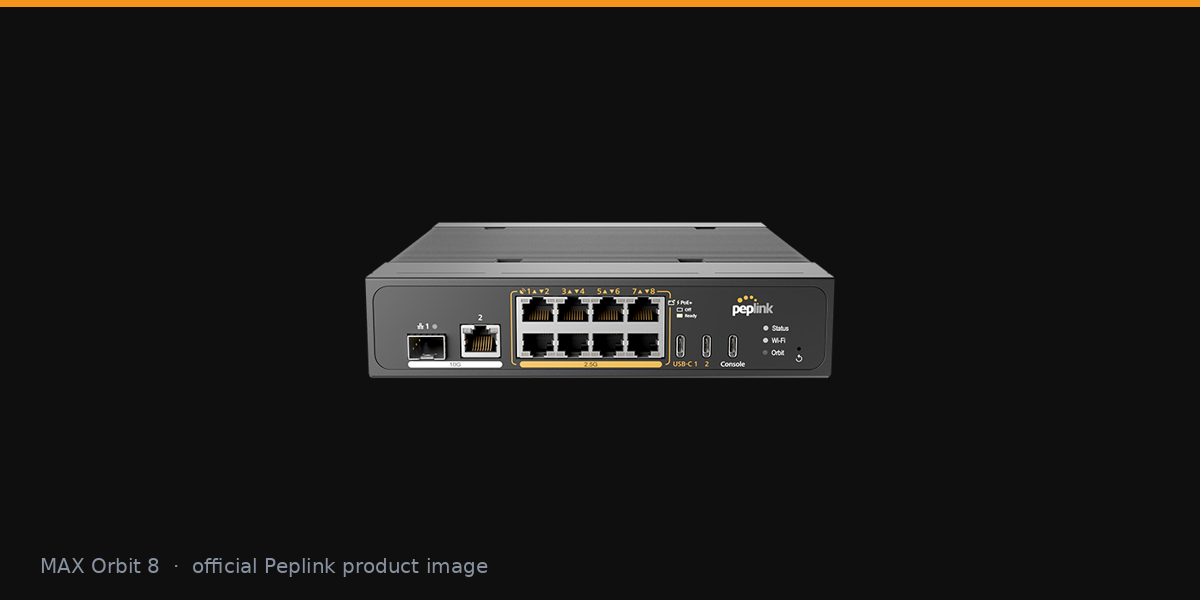
Peplink's MAX Orbit Series is the first hardware I have seen built to end that bet. It treats satellite the way I have always treated cellular and fibre: not as a miracle to be trusted, but as one link among several to bond, measure and manage. Here is what that buys you, and where the marketing stops and the engineering starts.
One dish is not a network
Starlink is genuinely brilliant, and so is the pace at which OneWeb and the rest are filling the sky with capacity. None of it changes physics. A low-earth-orbit terminal still drops on satellite handover, stalls the moment something blocks its view, and struggles in heavy weather. Put it on a moving vehicle or vessel and you can get all three before lunch. If your operation cannot survive the feed cutting out, a single terminal is not resilience. It is a gamble with a countdown timer.
The fix is the one we have trusted on cellular for years: run several links at once so no single one carries the whole load, and move between them without the session ever noticing. What is new is that the links are now satellite terminals, often from different providers and different orbits, and the box in the middle finally understands all of them.
What MAX Orbit does
Strip away the spec sheet and three things matter.
It bonds your terminals into one pipe
SpeedFusion is the engine. It bonds several satellite terminals into a single connection, so usable throughput climbs past what any one provider gives you, and it holds the session together through handovers and obstructions with hot failover and smoothing. It is the same technology I deploy for broadcast bonding, only pointed at the sky. A word of honesty, since this field is full of people who will not give you one: bonding does not abolish latency, and nothing here promises a link that never drops. What it does is make sure one terminal's bad minute is not your outage.
It runs every provider from one screen
Starlink, OneWeb and Iridium each turn up with their own portal and their own opinions. MAX Orbit pulls them into InControl, so a mixed fleet of terminals is watched and managed from a single dashboard. If you are running more than a handful of vehicles or sites, that is the line between a network you operate and a drawer of unrelated logins.
It scores the network, not just the speed test
This is the part most people will not have seen, so here is the plain version. SpeedFusion Score is a measure in InControl that rates the real-time health and performance of your bonded network as a single figure, with quality bands running from critical to excellent. It deliberately goes beyond raw megabits, the number everyone fixates on, to tell you how good the connection is and where to improve it. In practice it is how you catch a terminal going soft before your users do, and how you justify adding a link with evidence rather than a hunch.
Why a satellite router, and why now
Peplink could have left this to its existing routers. It did not, because satellite lives outside the server room and the hardware has to cope. These boxes take a wide temperature range, shrug off vibration, carry integrated GPS for situational awareness, and read ignition signals so they behave themselves in a vehicle. The Orbit 8 adds eight PoE ports with a 240W budget, the tidy way to power the access points, cameras and edge gear around a deployment from one box. The satellite terminals themselves still take their own power, as they always have, so plan that in rather than expecting the router to feed the dish.
The timing is not luck. Satellite has crossed from novelty to infrastructure. The vessel, the mine, the broadcast truck, the site whose fibre a digger has just found, all now expect to stay online. And pairing satellite with 5G, so the two cover each other and you stop paying for satellite data you do not need, has gone from clever to standard.
Put the radio where the signal is
Here is the part I think most people will skim past, and it is the bit I like most. MAX Orbit has no modem baked into the box. It is built to aggregate terminals and radios over Ethernet instead. That reads like a footnote. It is actually a design opportunity.
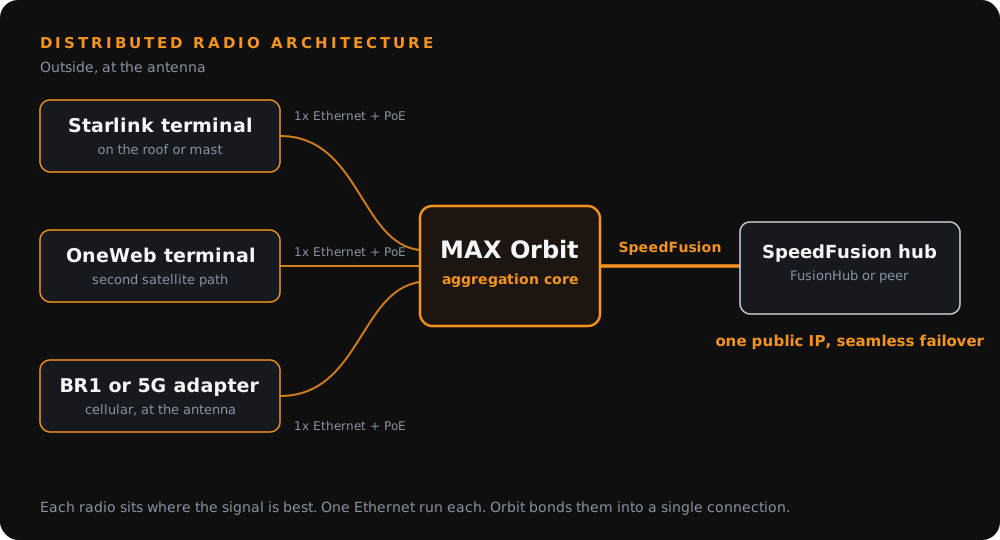
A radio buried inside a vehicle, a cabin or a comms room sits in the worst place for signal, wrapped in metal and distance. The old fix was to run coax out to a rooftop antenna, but coaxial loss climbs with frequency, so by the time you reach 5G you are giving away a real slice of your signal in the cable. MAX Orbit lets you turn that around. Put the radio outside at the antenna, a Starlink dish, a OneWeb terminal, a BR1 or a 5G adapter on the mast, run a single Ethernet cable back, power it over that same line with PoE, and let Orbit bond them.
The radio ends up exactly where it performs best, the cable carries clean digital signal rather than lossy RF, and you scale by adding more radios, each on its own run. That is what the two, four and eight Orbit ports are really for. It is modular too, so you can add or swap a terminal without touching the core. SpeedFusion ties the lot into one seamless connection on a single public IP, so the session holds when any one link has a bad moment.
The three models, in one breath
MAX Orbit 2 is the compact, PoE-powered unit for a single vehicle, vessel or go-kit that might earn a second link. MAX Orbit 4 is the mid-range workhorse, with more WAN ports, for multi-terminal vehicles and field rigs. MAX Orbit 8 is the hub: four gigabits of routing, those eight PoE ports for your site gear, 10G uplinks and Wi-Fi 7, ready to rack at a fixed site or aboard a large vessel. All three run Docker at the edge and ship with a year of PrimeCare, and the series is TAA compliant, which matters the moment you sell into government.
Where it earns its place
The jobs I keep coming back to are the ones where an outage costs more than bandwidth: the broadcast that cannot drop, the command vehicle that has to work the second it parks, the vessel days from the nearest mast, the remote site leaning on a fibre link nobody will guarantee. Multi-orbit bonding is not the cheapest way to connect any of them. It is the honest one, and MAX Orbit is the first I have seen built from the ground up to do it properly.
If you are weighing a multi-orbit deployment, that is my work. The answer is almost never the biggest box on the page. It is the right mix of terminals, a bonding policy that fits the job, and a setup you can run on a bad day. Tell me what you are building.