Most event organisers assume that simply hiring a high-spec router is enough to guarantee reliable internet connectivity. It is not. In a high-density environment, a single SIM card or a lone carrier represents a single point of failure that will likely let you down when the crowd arrives. You have likely experienced the frustration of network congestion at large gatherings or the total connection failure that occurs in remote outdoor locations.
I have spent over 15 years engineering solutions for these exact scenarios. In this article, I explain how cellular bonding for events moves beyond basic hardware hire into the realm of resilient network architecture. We will explore how Peplink technology and SpeedFusion configuration aggregate multiple carriers into a single logical connection; this approach significantly reduces the risk of dropouts during mission-critical moments. I will also outline how we maintain visibility over network health to ensure your connectivity holds when it matters most.
Key Takeaways
- Recognise why single-provider links often collapse under the pressure of high user density and cellular congestion at major gatherings.
- Understand the engineering principles behind cellular bonding for events to aggregate disparate links into one resilient connection.
- Learn the technical differences between standard failover and Peplink’s Hot Failover to ensure near-seamless throughput for live streaming.
- Discover how a thorough design phase, focused on application requirements and user density, prevents network failure before the event begins.
- Identify the essential metrics needed to scope a mission-critical deployment, from peak concurrent users to site-specific environmental challenges.
Why standard temporary internet often fails under pressure
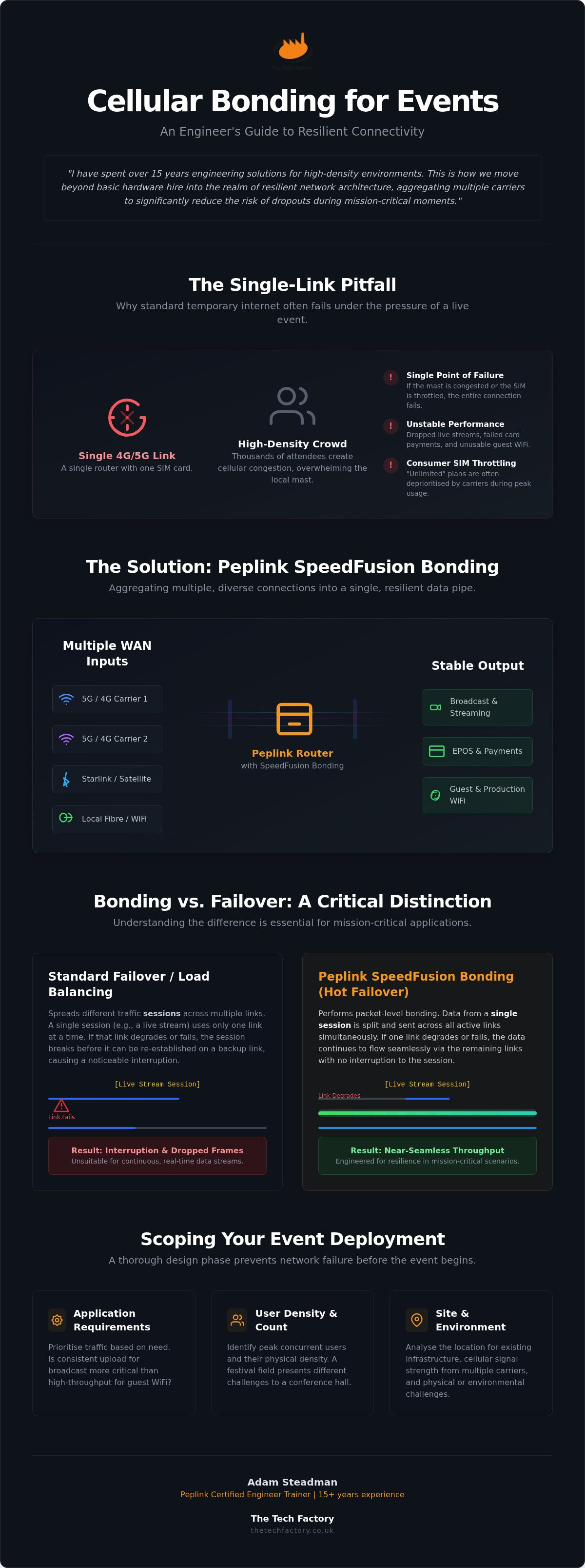
I have seen many event productions rely on a single ISP or a basic 4G router, only for the connection to collapse the moment the gates open. During the build phase, the network usually performs perfectly. The site is quiet; the local masts are under-utilised. However, as soon as thousands of attendees arrive, cellular congestion becomes the primary enemy. These smartphones compete for the same local mast capacity, effectively drowning out the mission-critical traffic required for your production. This is why cellular bonding for events is a necessity rather than a luxury for any high-stakes environment.
A single-link approach creates a single point of failure that is simply unacceptable for professional broadcast or payment processing. If that one connection becomes saturated or the mast fails, your entire operation stops. Professional event connectivity requires an architecture based on Link Aggregation, which allows us to combine multiple network paths in parallel. By using this methodology, we create a system that can withstand the loss of any single connection whilst maintaining traffic flow. This is not just about having a backup; it is about engineering a network that remains stable under the specific pressures of a live environment.
The myth of the unlimited data dongle
Many organisers believe that an "unlimited" consumer-grade SIM is a viable solution for event data. In my experience, this is a mistake. Consumer SIMs often face aggressive throttling or deprioritisation during peak usage times. The network provider will prioritise voice traffic and standard users over a single high-bandwidth dongle. I always recommend using enterprise-grade cellular data that is specifically engineered for high-throughput scenarios. In event production, data volume is rarely the issue; the quality, stability, and priority of the link are what define success.
Understanding the stakes for different event types
The requirements for connectivity vary significantly depending on the application, and a one-size-fits-all approach usually leads to failure. For broadcast and streaming, we prioritise consistent upload speeds with low jitter to prevent frame drops. Conversely, EPOS systems require high availability but relatively low bandwidth; a transaction failure at a busy bar can cause immediate queues and lost revenue. Meanwhile, attendee WiFi demands massive throughput and clever traffic shaping to prevent a handful of users from hogging the available capacity. We design the network to treat these traffic types with the appropriate level of priority to ensure cellular bonding for events delivers the required results.
Engineering resilience with Peplink SpeedFusion
At The Tech Factory, we base our event deployments on Peplink hardware because of its unique SpeedFusion technology. This is not about simple hardware hire. It is about the underlying protocol that governs how data moves across multiple paths. SpeedFusion allows us to bond multiple disparate connections, such as Starlink, 5G, and local fibre, into one logical pipe. This is not just failover; it is an active aggregation of bandwidth that reduces the risk of downtime by distributing traffic across all available links simultaneously. In my experience, this is the only way to provide the stability required for a professional outside broadcast or a high-capacity corporate gathering.
When I design these systems, I am not just looking for a backup link. I am looking for a way to ensure that if a single cellular mast becomes congested or a satellite link experiences a momentary fade, the user experience remains unaffected. This level of resilience is achieved through packet-level processing. By breaking data down and sending it across every available path, we create a robust tunnel that survives the loss of individual components. If you require a specialist to assist with SpeedFusion configuration for a high-stakes environment, our team focuses on the technical design required to make cellular bonding for events truly effective.
Bandwidth bonding vs. traditional load balancing
Load balancing is often confused with bonding, but the technical difference is significant. Load balancing spreads different traffic sessions across multiple links. However, a single session, such as a high-definition live stream, can still break if the specific link it is using fails. Packet-level bonding ensures that a single stream remains stable even if a SIM card drops out entirely. I focus on configuring these tunnels to prioritise mission-critical traffic over general guest browsing. This prevents a few attendees downloading large files from impacting the stability of the production network.
The role of Peplink InControl2 in event management
Centralised management is a requirement for any mission-critical deployment. Peplink’s InControl2 platform allows our team to monitor the health of every link in real-time from a remote location. We don't just monitor if the router is "up"; we see the latency, jitter, and packet loss on every individual WAN. We can adjust traffic rules on the fly to respond to changing network conditions on-site without needing physical access to the hardware. Visibility is key. If you cannot see the latency on your secondary WAN, you cannot manage it effectively. This proactive approach to cellular bonding for events ensures we identify and mitigate issues before they impact the production.
Evaluating temporary connectivity: Bonding vs. Failover
Many providers offer failover as a standard feature of their temporary kits. Whilst this sounds reassuring on a spec sheet, the reality of a standard failover event is often disruptive. For a live stream or a high-volume payment system, even a five-second outage constitutes a failure. I prefer to use a Hot Failover or Smooth Over configuration. In these setups, the backup link is already active and synchronised with the primary connection. This allows for a near-seamless transition that protects the integrity of the data stream and prevents session timeouts.
The choice of network architecture should always be driven by the potential cost of failure for that specific event. If a production relies on a single cellular carrier, it remains vulnerable to local mast congestion or hardware faults at the provider level. We often combine multiple carriers to ensure we are not reliant on any single network infrastructure. This diversity is a core component of cellular bonding for events. It provides the redundancy required to maintain throughput even when one path becomes unstable or drops out entirely.
When failover is sufficient
Failover might be acceptable for general production office use or non-critical guest WiFi. In these scenarios, a short pause in connectivity is often tolerable for the end user whilst the router re-establishes a connection on the secondary link. It represents a more cost-effective design for events where budget is the primary constraint. However, even in a simple failover setup, I still recommend using at least two different carriers. This ensures that a total mast failure does not result in a total site blackout. We focus on selecting the best carriers based on local signal surveys before the event begins.
Why bonding is the standard for broadcast
For outside broadcasts, we utilise SpeedFusion to ensure that the video stream never loses its connection to the studio. This approach significantly mitigates the impact of packet loss on any single cellular link by replicating or distributing packets across the bonded tunnel. I consider this level of technical design an essential part of our Peplink deployment services for the media sector. When the stakes involve global transmission, cellular bonding for events is the only responsible way to manage the risk of link failure and ensure a stable programme feed.
Planning your event network architecture
A successful deployment starts with a thorough network design phase, long before any hardware is dispatched. I have found that technical failure on-site is often a direct result of inadequate planning in the office. We begin every project by analysing the expected user density and the specific applications that will be running on the network. A 4K broadcast stream has vastly different requirements to a production office or general guest WiFi; treating them as the same is a recipe for congestion.
I always look for diverse paths to build resilience into the core of the network. This might involve combining a Low Earth Orbit (LEO) satellite link with multiple 5G connections from different carriers. This diversity ensures that if one medium fails or becomes congested, the others can maintain the SpeedFusion tunnel. This approach is fundamental to effective cellular bonding for events, as it mitigates the risk of a single provider outage impacting the entire site.
However, focusing only on the WAN is a mistake. Proper configuration of the internal LAN is just as important as the external backhaul. Poor WiFi channel planning or incorrect VLAN tagging can ruin an otherwise perfect link. We ensure the local distribution is as robust as the backhaul, using meticulous frequency coordination to prevent interference in crowded event spaces. If you are currently designing a high-stakes deployment, you can engage our team for professional network design and consultancy services to ensure every element of your architecture is fit for purpose.
Integrating Starlink with Peplink
Starlink has changed the landscape for remote events, but it is not a silver bullet on its own. Whilst it provides excellent bandwidth in isolated areas, it can suffer from occasional latency spikes or momentary obstructions. I recommend using Starlink as one of several WAN inputs into a Peplink router. By bonding it with cellular links, we can smooth out these fluctuations and ensure a more stable throughput. This hybrid approach is a core part of our SD-WAN for events UK strategy, providing a level of stability that a single satellite dish cannot achieve in isolation.
Custom portals for on-site visibility
Visibility is a recurring theme in my work. For large events, we often develop a custom network management portal for the client. This allows the event organiser to see their data usage and network health in a simplified, accessible format. They don't need to understand the technical backend to know the system is performing as expected. It provides peace of mind during the live phase and a detailed audit trail for post-event reporting. This transparency is vital for cellular bonding for events, as it allows stakeholders to verify that the redundant paths are performing their roles correctly.
Scoping your mission-critical event deployment
When you are ready to move beyond basic WiFi hire, the first step is a scoping conversation to define your technical requirements. I need to understand the specifics of your peak concurrent users, your precise location, and your must-have applications. A site in central London presents vastly different RF challenges compared to a remote greenfield festival; the congestion profiles and available carrier bands vary significantly. Our team focuses on the engineering and configuration of the Peplink environment to ensure it is ready for the day. We provide the hardware and the managed services to keep your event online, regardless of the local infrastructure challenges. This is where cellular bonding for events transitions from a theoretical design into a deployed, resilient reality.
Success in these environments depends on meticulous preparation. I have found that a well-scoped project identifies potential bottlenecks before a single cable is laid on-site. We look at the expected data throughput, the priority of different traffic types, and the physical environment that might impact signal propagation. By taking this engineering-led approach, we build a network that is not just functional, but genuinely resilient against the unpredictable nature of live events. This avoids the reactive "firefighting" that often occurs when a system has not been properly designed for the expected load.
The benefit of professional Peplink deployment
By working with a specialist, you avoid the common pitfalls of DIY configuration that often lead to network instability. I have seen many deployments fail because the SpeedFusion settings were left at default values; they were not tuned for the specific latency and jitter requirements of the on-site applications. We ensure that SpeedFusion is optimised for your specific traffic types, whether that is VoIP, 4K video streams, or transactional data. Our role is to be the technical authority that ensures your connectivity is the one thing you do not have to worry about. We manage the tunnel health, monitor carrier performance, and adjust parameters in real-time to maintain stability.
Next steps for your event
I invite you to reach out for a brief scoping conversation about your upcoming project. We can discuss the network design and how a managed Peplink solution can reduce the risk of downtime for your production. My goal is to provide a pragmatic, engineered solution that meets your specific needs. We don't offer generic, off-the-shelf packages. We provide bespoke designs based on the unique parameters of your deployment. This methodical approach to cellular bonding for events ensures that your mission-critical traffic remains stable from the build phase through to the final load-out.
Securing your next deployment
Engineering a resilient network for a high-stakes event is a matter of mitigating risk through technical design. We have explored how moving beyond simple failover to an aggregated, bonded architecture reduces the risk of total connection failure during critical moments. By combining diverse WAN paths and maintaining real-time visibility through custom portals, you ensure that your production remains online even when local infrastructure is under extreme pressure.
Effective cellular bonding for events is not a commodity service; it is a specialised consultancy process. My team and I focus on the meticulous configuration required to make Peplink technology perform in the most challenging environments. With over 15 years of experience and my status as a Peplink Certified Engineer Trainer, I prioritise technical stability and pragmatic solutions over marketing promises. If you are planning a mission-critical event and require a resilient network design, I invite you to get in touch for a scoping conversation. We can work together to ensure your connectivity is a foundation you can rely on.
Frequently Asked Questions
What is the difference between WiFi hire and an engineered internet solution?
WiFi hire typically involves a simple router rental with a single connection; an engineered solution is a designed network architecture. I focus on the backhaul resilience, using cellular bonding for events to ensure that multiple links are aggregated to prevent a single point of failure. This approach addresses the underlying stability of the connection rather than just providing a local wireless signal.
Can I use temporary internet for a live 4K broadcast?
You can, but it requires a bonded upload path to handle the high bitrate and consistency required for 4K. We utilise cellular bonding for events to combine the throughput of multiple 5G and satellite links, which significantly reduces the risk of frame drops or packet loss during a high-definition stream. The goal is to maintain a stable programme feed even if one network path fluctuates.
How many cellular connections should I use for a large event?
I typically advise using at least three different carriers to ensure network diversity. This prevents a single network outage or localised mast congestion from taking your entire production offline. In high-density environments, we often use four or more connections to distribute the load across multiple masts and providers.
Is Starlink reliable enough for a professional event on its own?
I don't recommend relying on Starlink in isolation for professional events. Whilst it offers high throughput, it is susceptible to momentary obstructions and latency spikes. In our experience, it performs best when integrated into a Peplink environment as one of several WAN inputs, allowing us to bond it with cellular links to provide a more stable connection.
Do you provide on-site technical support during the event?
We provide managed services that include technical oversight during the deployment and live phases. Our focus is on ensuring the network is engineered for resilience before the event begins. We monitor the environment remotely to manage the SpeedFusion tunnels and respond to any changes in network conditions in real-time.
What happens if one of the cellular networks goes down during my event?
The SpeedFusion tunnel remains active using the remaining healthy links. Because the data is aggregated at the packet level, the loss of one carrier is handled in a near-seamless manner. This allows your applications, such as EPOS systems or live streams, to continue without a session reset or a noticeable drop in connectivity.
How long does it take to deploy a temporary Peplink network?
Physical deployment can often be completed in a few hours, but the network design phase should begin weeks in advance. Meticulous planning is required to ensure the configuration is tailored to the specific user density and site conditions. We prioritise this design phase to ensure the hardware is ready to perform the moment it is powered on.
Can you provide a custom dashboard to monitor my event internet usage?
Yes, we specialise in creating custom software portals that provide a simplified view of your network health. These dashboards pull data from the Peplink environment to show bandwidth consumption and link stability in real-time. This gives organisers visibility over their connectivity without needing to navigate a complex technical interface.